Showing posts with label Agfa. Show all posts

Wednesday, July 8, 2015

Nikkor 35mm f1.4 AIS for Environmental Portraiture - Folklife Festival

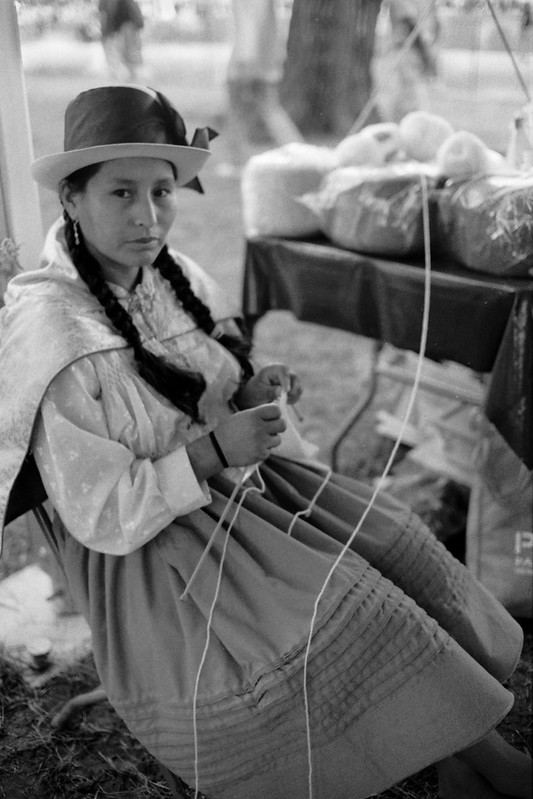
In the middle of my film scanning efforts, this image just jumped out at me.
 
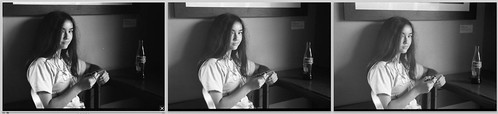
Traditional Peru in Washington, DC, by Reed A. George
Nikon FM2, Nikkor 35mm f1.4 AIS Lens, Agfa APX400 Film
 
I feel that this image includes just enough of the surroundings to give the subject context, yet still emphasizes her beautiful face and expression. So this is why many photographers prefer the 35mm focal length for environmental portraiture! I also think that the Agfa film, with its relatively low native contrast and considerable grain, gives the image a slightly vintage feel.
 
I've got more scanning to do, but am sure that I will assemble a few of these images from the Smithsonian Folklife Festival into a small collection.
 
DMC-365.blogspot.com
 

Monday, June 15, 2015

Discontinued Agfa APX400 Film - Testing and Tuning Up

My friend Dennis Gallus gave me a 100' roll of Agfa APX400 that he had in his freezer. I shot my first roll of it at the indicated speed of 400, and processed it alongside a roll of Ilford HP5, which I developed for 11.5 minutes in Kodak D-76 developer at 1:1 dilution. Those negatives came out pretty thin overall and very low contrast (underexposed and/or underdeveloped). After reading some old posts online, I learned that APX400 was known to need additional exposure, with some people treating it as iso 320 film, others at iso 200. I also found development guidelines that indicated it needed more development.
 
So, a test roll ensued. I shot a short roll of the film, capturing the same scene exposed for iso 100, 200, and 400. I also changed my development protocol to 10 minutes in full strength D-76. Here are a couple of the results.
 
Scenes exposed at iso 400, 200, and 100, APX400 Film
 
From this, I conclude two things - 1) additional development in full-strength D-76 definitely helped, and 2) somewhere between iso 200 and 320 is probably best for this film.
 
On the same day, I guessed and exposed a full 36 exposure roll at iso 200. It looks pretty good overall. I think I've figured out this film. Not that this information is much use to anyone else; as far as I know you can't get this film any more, though I do see single rolls for sale in some places. But, 100' of it will keep me busy for a while!
 
Thanks again, Dennis!
 
DMC-365.blogspot.com
 

Friday, June 12, 2015

So What Are You Reading? Agfa APX 400 Film Test

 
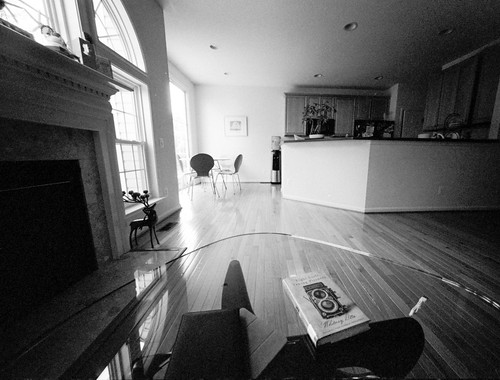
The Wide View, by Reed A. George
Zeiss SW, Voigtlander 12mm f5.6 Lens
Agfa APX 400 Film
 
I'm testing and getting my shooting parameters down for a new (discontinued) film, Agfa APX 400. My friend Dennis Gallus gave me (!) a 100' roll, which I've started to bulk load. My first roll came out underexposed and possibly underdeveloped (7 mins in D-76, 1:1). After seeing that, I read up about the film online, and found that many people used to shoot it at 200 instead of the indicated 400 speed. I will try that, and believe it will really help.
 
This shot was made with my widest lens, the Voigtlander 12mm f5.6. You can see my current book of choice in the foreground, Eight Girls Taking Pictures, by Whitney Ott. It is a fictional work, telling the story of eight female photographer/artists. I'm enjoying it very much.
 
Thanks again for the film, Dennis! I'll have it all worked out in another roll or two.
 
DMC-365.blogspot.com
 

Tuesday, December 16, 2014

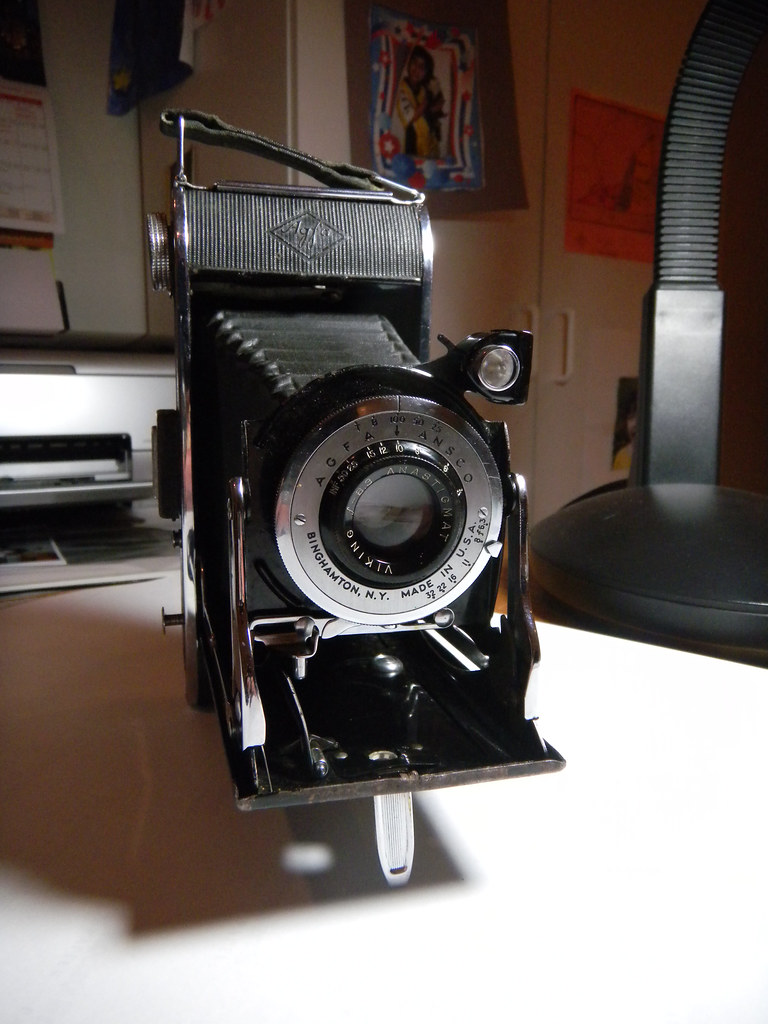
Grandpa's World War II Agfa Viking

I thought I had written about this a few years back, but it seems I forgot to post it.
Back in December of 2010, my Grandfather gave me his Agfa Viking camera. He picked it up during World War II, during which he was stationed in Japan and the Phillipines. He seems to remember trading a 35mm Japanese camera for it. Who knows what that may have been?
Anyway, once I got it, I saw that the shutter seemed to be working fine, and the lens turned to allow focusing (it's very common for the cell to get locked in place over so many years). Then I found the aspect that threatened to prevent me from using this old jewel - it is designed for 616 film, which is no longer available.
Grandpa's Agfa Viking
 
Undaunted, I hand-fabricated a thin plastic mask that allows 120 film (not as wide as 616) to ride in the correct film plane in the camera. I then modified some 120 spools to fit into the Viking. It's not perfect, and sometimes the spools slip during film transport. I measured out which exposure numbers on the 120 film backing would indicate sufficient travel. I can now use the red window on the back to make sure I've wound the film on far enough to avoid overlapping images.
 
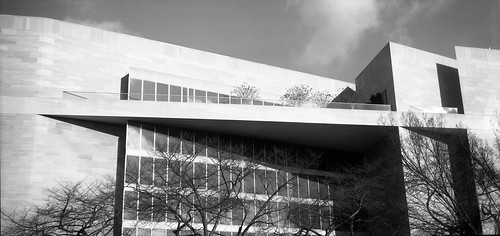
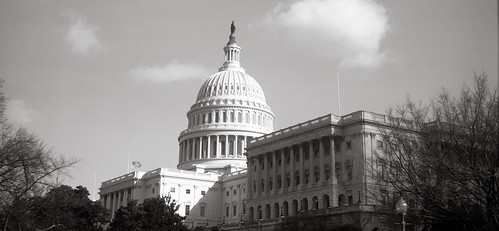
This configuration results in a panoramic aspect ratio. Here are two shots I made in Washington, DC with the Viking:
Success!
 
As I said, it's a little fiddly to use, and frankly I have enough medium format folders that were designed for 120 film that I haven't gone back and used the Viking since that maiden voyage. But, it was great fun challenging myself to be able to shoot it at all. Pretty impressive images, if you ask me.
 
That said, I hope that someday the Film Photography Project (FPP), or someone else, will reintroduce 616 film for us niche camera owners. Probably hoping against hope. I'm not sure how many cameras were sold that used this particular format film. But then again, who would have guessed that FPP would be marketing 620 film? They are!
 
(Click Here) to check out FPP.
 
DMC-365.blogspot.com
 

Wednesday, September 3, 2014

Hump Day Blues - Fujifilm Brings Sad News

I just read the sad news on Phoblographer that the Fuji GF670, one of the last remaining medium format film cameras that you could buy new, has been discontinued.
Fujifilm GF670
Image Source: http://www.thephoblographer.com/2014/08/25/fujifilm-gf670-folding-rangefinder-now-discontinued/#.U_3JHBy9KSP
 
The GF670 is the only new medium format folder that I know about. I was sorely drawn to purchasing one about a year ago, but made myself content with my old Agfa Record III instead. Very different animals, the GF670 sports a coupled rangefinder, electronic shutter, and modern optics, as compared to the Agfa's uncoupled rangefinder, manual shutter (perhaps a plus), and Solinar lens.
 
(Click Here) to read the post on Phoblographer.
 
(Click Here) to read about my Agfa Record III in a post from my "Skeletons From The Closet" series. If you search "Agfa Record" at the search window at the top of this blog, you'll find several of my posts, including those showing results from this awesome old camera.
 
As for the GF670, well, it's just the march of time and technology. We must accept it gracefully and move on. I'm happy to know that I have several wonderful medium format folders in my collection. Enough to interest me for the years I have left to shoot them!
 
DMC-365.blogspot.com

Wednesday, August 14, 2013

Results From August's Agfa Record III (Skeletons From The Closet) and a New Critique Group, PhotoWorks!

I got invited to a great photo group, known as PhotoWorks. They meet monthly at the Glen Echo Park, just outside Washington, DC.
 
(Click Here) to learn more about this very welcoming group. In addition to critiques (one of which I attended), they offer gallery space, an incredible darkroom facility, and more.
 
I decided to bring along a set of five prints, three from a recent roll of film shot in my SFTC camera for August, the Agfa Record III 6x9 folding medium format camera. The two square format images are from my Minolta Autocord, May's SFTC camera. (Click Here) to read about the Autocord.
 
These were shot at a recent world war II reenactment event.
 
All of my images were well-received, and I had to push a little to get some critical feedback. I'll mention it under each shot.
 
While everyone liked this shot, the light is a little flat. The out of focus people in the background are somewhat distracting.
 
These guys may be too happy to be real soldiers.
 
There was a suggestion to crop this picture, leaving only the guys on the right (in bright light in). This was instructive to me, because the facial expression on the guy furthest left is the important part to me. Unfortunately, he's not in great light. What I see as most important really isn't emphasized in the shot. It was also mentioned that this image doesn't fit with the others.
 
I had to admit that I cropped out an air conditioner unit on the right of this image.
 
This is Mike. I emailed him this shot, and he really enjoyed it, saying he's always disliked pictures of himself. This one changed his mind. This shot was very well-received. The framed picture in the back is Mike's wife back home in the states (reenactor in character).
 
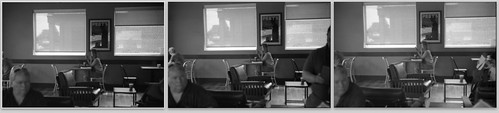
Here are a couple of shots from the critique session, just to give you a feel for the setting. These were shot on my Leica M9 with Voigtlander 28mm f1.9 lens.
 
 
This is a very experienced group, and I stand to learn a lot from them. I will certainly be back.
 
DMC-365.blogspot.com


Thursday, May 16, 2013

Skeletons From The Closet - April Results - Agfa Solinette II

April's SFTC camera was the Agfa Solinette II.
 
(Click Here) to read about my Solinette.
 
So, how did it go? Honestly, I'm getting tired of guess focusing. My last two SFTC cameras - the Zeiss Ikonta folder and April's Solinette are both guess focus cameras. It can be fun and refreshing to work without a rangefinder or through the lens focusing. However, I did come up with several images with both cameras that were just not quite sharp enough. That's frustrating, especially when I can see how good it could've been.
 
Here are some more images that I shot with the Solinette.
 
Spring is Here!, by Reed A. George
Agfa Solinette II 35mm Folding Camera
 
You may recognize the house below from one of my pinhole posts.
 
(Click Here) to see how it looks in black and white through my pinhole camera.
 
Thornton House, Manassas National Battlefield, by Reed A. George
Agfa Solinette II 35mm Folding Camera
 
Here's a quick grab shot of an early spring barbecue in preparation. I really like how the color in this shot came out. It's a trivial subject, but I think it shows how the Solinar can perform when you get things right.
 
Burgers and Dogs, by Reed A. George
Agfa Solinette II 35mm Folding Camera
 
I'll wrap this up with some shots of an activity that caught my eye - window washers on the gigantic curved glass structure where I work.
 
Spring Cleaning #1, by Reed A. George
Agfa Solinette II 35mm Folding Camera
 
These shots were easy, since there was plenty of light and I could shoot at about f11. Of course, the guys working on the glass wondered why this crazy guy with an old camera was taking picture of them.
 
Spring Cleaning #2, by Reed A. George
Agfa Solinette II 35mm Folding Camera
 
Spring Cleaning #3, by Reed A. George
Agfa Solinette II 35mm Folding Camera
 
I like ths shot above especially. I like how you can see the guy on the left clearly, while the guy on the right has made an interesting pattern of cleaner on the window in front of him.
 
Spring Cleaning #4, by Reed A. George
Agfa Solinette II 35mm Folding Camera
 
The fact is, this little folder is capable of making some nice images. I really like how the Solinar lens represents color. With a maximum aperture of f3.5, applications in low light are very limited. In today's word, f3.5 seems so slow. However, the truth is that a wider aperture would make guess focusing even harder, due to the reduced depth of field that would result.
 
I actually had trouble finding the right circumstances to shoot this camera last month. It's not that there aren't plenty of places this camera does fine in; there are just many more where a little more aperture, or some type of focusing aid would have made it more useful. So, I found that I couldn't really rely on this camera to be anything like general purpose. I made it a point to carry it all month, but found limited opportunities to use it.
 
In May, I'm shooting my Minolta Autocord. This is also an f3.5 camera, but has the benefits of the big 120 medium format negative, and gorgeous ground glass focusing capability. We'll see if I can get more use out of that.
 
DMC-365.blogspot.com


Monday, April 29, 2013

Skeletons From The Closet - Results From April's Camera - Agfa Solinette II

I've only shot one roll of film through the Solinette so far this month. I've gotten a little behind in my writing for this feature as well. But, I did get a few images worth sharing, and I'm hopeful that I'll get some more film through the Solinette before the end of April.
 
My wife and I went to Dayton, Ohio recently. Here are a couple of shots from that weekend.
 
Springtime Portrait, by Reed A. George
Agfa Solinette II with Solinar 50mm f3.5 Lens
 
While in Dayton, we visited a museum in the Carillon Park. I liked this mechanical detail of a generator at the museum.
 
Mechanical Detail, by Reed A. George
Agfa Solinette II with Solinar 50mm f3.5 Lens
 
I have a few more images to share, these taken around home. First, the old manor house at the modern biomedical facility where I work still has spring flowers come up each and every year. These must have first been planted many years ago when the manor house was occupied. I think it's interesting to see these remnants of the lives that people spent living in this beautiful old house.
 
Daffodils at the Manor House, by Reed A. George
Agfa Solinette II with Solinar 50mm f3.5 Lens
 
I grabbed this shot on the way to work one morning. I just had to pull over and catch this sunset.
 
Sunrise, by Reed A. George
Agfa Solinette II with Solinar 50mm f3.5 Lens
 
 
Finally, this scene of a tulip magnolia tree at work caught my eye. I always enjoy when this tree bursts into bloom, and usually photograph it a few times per year. This year, I liked how the shadows of the branches above connected with the fallen petals on the ground. It's a little different, at least. I'll include two examples.
 
Tulip Magnolia Petals, by Reed A. George
Agfa Solinette II with Solinar 50mm f3.5 Lens

I've enjoyed shooting the Solinette so far, even though guess focus is challenging for me. The little Solinar lens is pretty darned sharp in my opinion. The colors are a little muted, but I'm not sure if that's due to the lens or the cheap color print film I used. Either way, I think they look decent.

I've got a new 36 exposure roll of Fuji 100 print film loaded up and ready to go. I think I'll carry the Solinette around tomorrow and see what I can do with it.

DMC-365.blogspot.com


Sunday, April 28, 2013

Skeletons From The Closet - April's Camera - The Agfa Solinette II

Agfa Solinette II, April's Skeletons From The Closet Camera
 
April's camera is the Agfa Solinette II, a 35mm folding camera from the 1950s. I actually have two of these - the one pictured above with an Apotar 50mm f3.5 lens, and another with the higher end Solinar 50mm f3.5. I decided to shoot with the Solinar this month.
 
This is a guess focus camera, with no type of rangefinder for estimating distance. There's no battery or meter, either. The Solinette is a very basic, sturdy little camera. Both of mine look like brand new. I think I got both of them on eBay, for around $25 each.
 
Another month with a guess focus camera is challenging for me. Let's see what I can do.
 
DMC-365.blogspot.com