Showing posts with label Nikkor 200-400mm f4 AF-S VR G. Show all posts

Saturday, September 19, 2015

So, How Is the Nikon D810?

I'm still getting my feet wet with this camera, but check this out:
 
Great Blue Heron, Ardea herodius, by Reed A. George
Nikon D810, Nikkor 200-400mm f4 AF-S VR G Lens
iso 1600, f5, 1/2000 sec.
 
The detail in the print I made of this shot is just stupendous. iso 1600? Not a problem at all.
 
At 6400, I do see image quality start to drop off, but still quite impressive. At 1600, it's lovely.
 
DMC-365.blogspot.com
Friday, September 18, 2015

Kind of Blue - Heron, That Is

 
Kind of Blue, by Reed A. George
Nikon D810, Nikkor 200-400mm f4 AF-S VR G Lens
iso 160, f5, 1/2000 sec.
 
 
DMC-365.blogspot.com
 

Sunday, September 13, 2015

Today's Eagle Shot - Nikon D810, Nikkor 200-400mm f4 AF-S VR Lens

I got out kayaking on the Potomac River again this morning. I saw quite a lot of wildlife, including a muskrat that swam to within a few feet of my kayak, and a giant snapping turtle that nearly touched it. Both were too close for me to focus with the big lens. I also watched a herd of deer grab their morning drink at the river's edge.
 
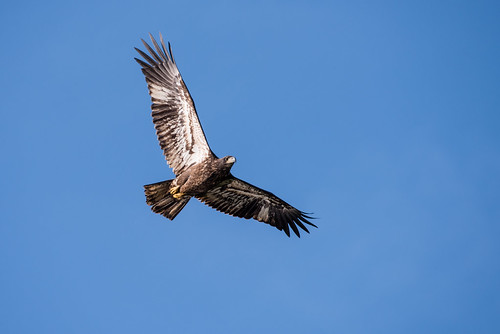
Here's the best shot I got today, of an immature bald eagle.
Immature Bald Eagle, by Reed A. George
Nikon D810, Nikkor 200-400mm f4 AF-S VR Lens
iso 220, f5.6, 1/1250 sec.
 
You can click on this image to see it larger on flickr.
 
Man, am I lucky to have access to such a beautiful place to paddle on weekend mornings at sunrise.
 
DMC-365.blogspot.com
 

Wednesday, September 2, 2015

Great Egret - Nikon D810 and Nikkor 200-400mm f4 AF-S G VR Lens

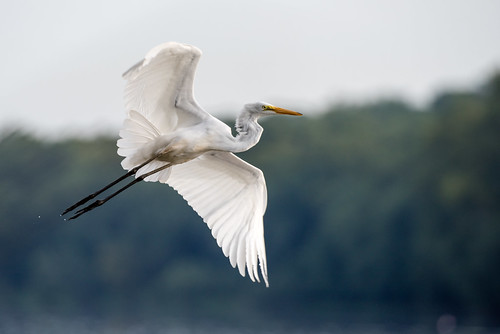
And here's my best bird-in-flight shot from Sunday's paddle trip.
Great Egret (Ardea alba), by Reed A. George
Nikon D810, Nikkor 200-400mm f4 AF-S G VR Lens
iso 200, f5, 1/1250 sec.
 
I watched this beauty, and his/her nearly-identical partner, approach me from far way, flying downriver toward my kayak. I was lucky enough to get the focus just right on this shot, and capture the wings spread wide. This camera / lens combination is just astounding. It's what I've been working toward for years in gear for nature photography.
 
I find myself tempted to try the new Nikkor 200-500mm f5.6 (Click Here), a much lower cost and lower weight solution, but it's not going to provide image quality like this. And, that extra stop of light gathering (f4) in my lens really matters.
 
DMC-365.blogspot.com


Tuesday, September 1, 2015

Back Home, on the River

My long vacation over, I'm back out on the river in my kayak, with my Nikon D810 and 200-400mm f4 AF-S VR lens. Here's a shot from last Sunday on the Potomac.
Great Blue Heron, Ardea herodias, by Reed A. George
Nikon D810, Nikkor 200-400mm f4 AF-S G VR Lens
iso 1800, f5.6, 1/1250 sec.
 
On this particular outing, I focused on wildlife photography, leaving my fishing rod untouched. Rather than "running and gunning" down the river as I fished, I pulled the kayak quietly to shore in a few places, and was rewarded with more time to observe each creature that I came across, including several bird species, as well as a red fox.
 
DMC-365.blogspot.com


Thursday, August 6, 2015

lions, tigers, and... BEARS! Oh, My.

Okay, no lions or tigers, but on the drive in to my local kayaking spot here in Northern Virginia this weekend, I did see foxes (4), deer (dozens), and a black bear!
 
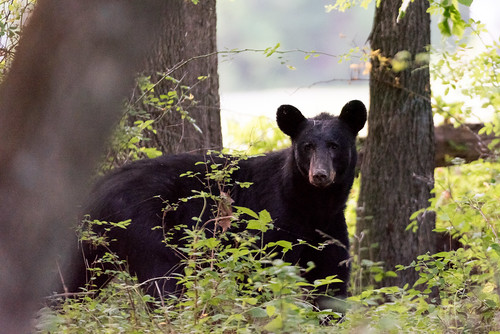
Black Bear (Ursus americanus) in Suburbia, by Reed A. George
Nikon D810, Nikkor 200-400mm f4 AF-S VR Lens
iso 3200, f4, 1/125 sec.
 
Keep in mind, this is in Northern Virginia, where the townhouses and strip malls are rapidly gaining on the trees in number. It was a pleasant surprise to see this beautiful animal here. Also a little troubling. I'm concerned for his (her?) future.
 
It was just after 6:00 AM, and the light was low there in the early morning shade. I didn't have time to make adjustments, other than to crank the iso up as far as I felt comfortable with. Luckily, that got me to a shutter speed where one or two exposures came out sharp, even though I was handholding the big 200-400mm lens, zoomed to 400mm.
 
The approximate focus distance is 29.9'. That bear could cover that distance in less than one second. Thankfully, he didn't.
 
DMC-365.blogspot.com
 

Tuesday, July 28, 2015

So, Which of My Lenses Are Best on the Nikon D810?

 
Nikon
 
The advent of the D810, and its predecessors the D800 and D800E, caused many photographers to find the limits of their lenses. It used to be rare that the sensor was good enough to have the lens be the limiting factor in image quality, or acuity. Now, it's not rare at all.
 
So, which lenses from my (rather extensive) kit of Nikkors will work well on the D810 that's on its way to me in the mail?
 
I found a nice list on the DxO page, which lists the top choices for prime and zoom lenses for the D810. Testing over 100 lenses on the D810, they've compiled a list of the ones they found most suited to the new super-sensor. (Click Here) to read the full list.
 
As expected, my new 28mm f1.8 AF-S G lens, my most modern lens, makes the list. Importantly, so does the AF-S 200-400mm VR, though they tested the version 2 of this lens; mine is version 1. As the 200-400 is likely to be my most-used lens on this new camera, that's important to me. Another modern lens in my kit, the 70-300mm f4.5-5.6 VR zoom made it on the list. That's good.
 
Then there were a couple of surprise entries from my older lens selection: the 85mm f1.8 AF-D and the 50mm f1.4 AF-D (which I use all the time). Great to see those there, as well.
 
So, I feel that in addition to the 200-400, which will be my nature workhorse, I've got a full set of wide (28mm), normal (50mm), short telephoto (85mm), and long compact zoom (70-300) to choose from with this camera. I'll certainly use other Nikkors on the D810, but with these, I know that I can expect the very best results.
 
DMC-365.blogspot.com
 

Monday, July 27, 2015

Well, I'm Going For It - Nikon D810

Nikon
 
I have long said that my Nikon D700 is the single best-performing camera I've ever owned. Not the highest fun-factor (as I love my rangefinders and old film cameras), but best at getting the shot, and in the most high quality way. So, I have not upgraded it, even after several years. I did add the Nikon Df, which is just a different beast, and brings the fun factor up considerably with its retro design, ability to take non-AI lenses, and smaller size.
 
What I did upgrade was my telephoto lens choice. Selling the spectacular 500mm f4 AiP manual focus lens, I invested in the first version AF-S 200-400mm f4 VR lens. Having fast autofocus significantly improves my chances of capturing great nature photographs. On the D700, the 200-400 really sings.
 
So why upgrade to the D810? Well, really for one reason, and one reason only - resolution. I will be able to shoot the D810 in DX crop mode and still produce 15.4 megapixel images. That is higher than the D700 at full frame, and turns my 200-400 telephoto into the equivalent of 300-600mm, without the 1.4X tele-extender! That's powerful. Or, I can shoot in full-frame (36 megapixel) mode, and crop in post-processing. That's really going to increase the number of bird-in-flight images that will be useful and printable at large sizes.
 
Resolution is the only reason that I know now. I have a feeling I'll find other reasons to love the D810.
 
I bought mine refurbished by Nikon. The cost savings was significant - I paid $2,550 at Adorama, including a third party "drops and spills" 3 year extended warranty. The camera lists for almost $3,300.
 
I don't expect the D810 to become my most-used camera; I love the Df and know the D810 won't replace it. I do expect the D810 to be my go-to nature and wildlife camera.
 
DMC-365.blogspot.com
 

Sunday, July 26, 2015

Here's Something I've Been Thinking About - the Nikon D810 in Crop Modes

 
I am now the proud (half) owner of a Nikkor 200-400mm f4 AF-S VR G lens. Half, because I co-own it with a good friend of mine.
 
I always laugh when someone asks me what gear to buy to do a little nature photography, especially bird photography. Now that I have the 200-400, typically attached to my D700, I find myself thinking about what I could do with a D800 or D810 - so many more pixels that would allow me to use the crop modes (1.2 or 1.5) that are built into the camera, and still end up with images with sufficient resolution to print big.
 
At 1.2 crop, the D810 produces 25 megapixel images, and at 1.5 crop (same as DX sensors), the images are 16 megapixels. That's a serious advantage over the D700, with its 12 megapixels at full frame.
 
I love my D700, but a D810 may just be the perfect match for the 200-400 lens for nature photography.
 
(Click Here) to read a post by Kirk Tuck on the Visual Science Lab about this very subject.
 
DMC-365.blogspot.com


Monday, July 20, 2015

Great Blue Heron (GBH)

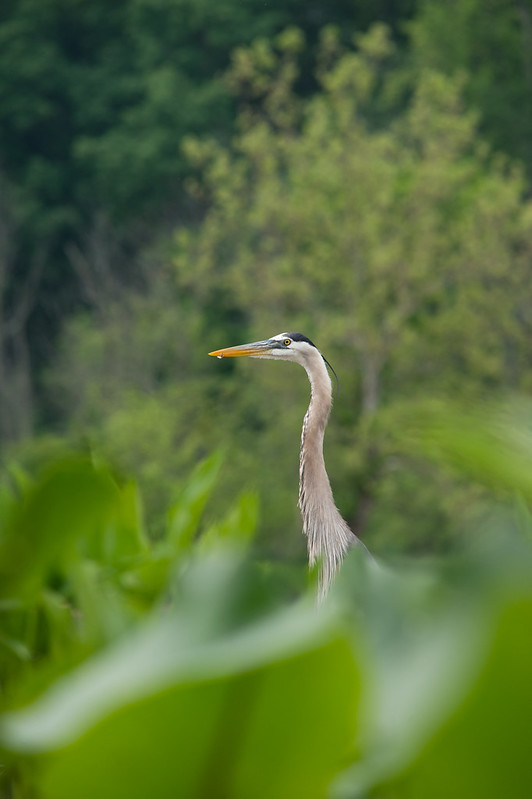
My birding friends refer to the great blue heron as a GBH. Very common in this region, they are really interesting birds. It's great fun to watch them feed. In the first shot below, you can see a fish scale hanging from this guy's beak; he had just dropped a big fish.
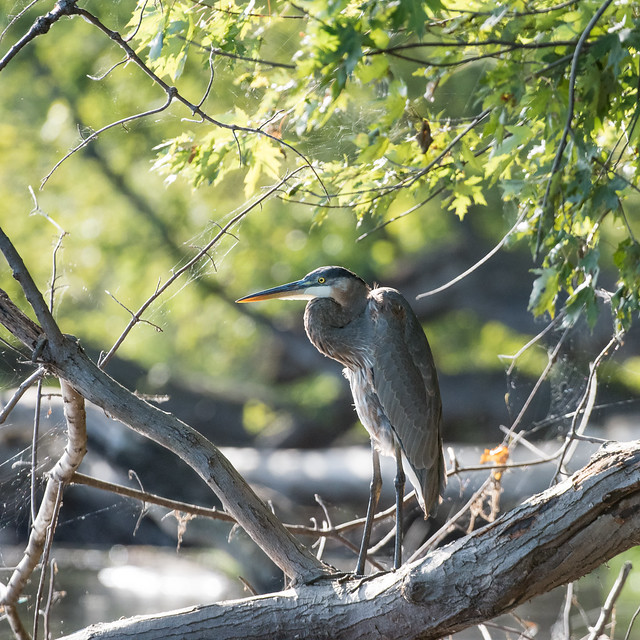
GBH Sitting, by Reed A. George
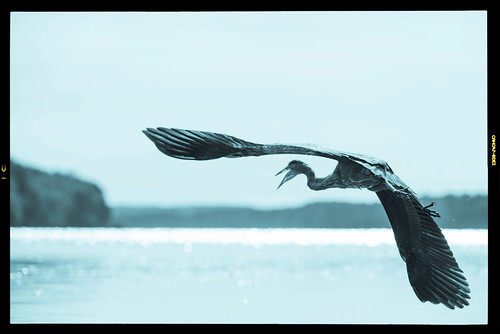
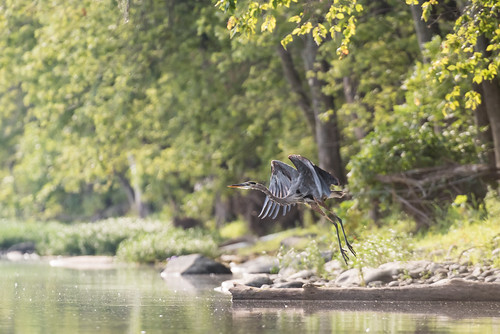
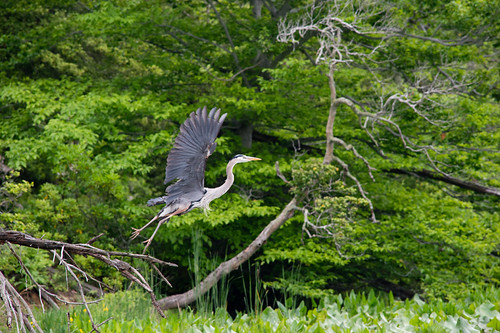
GBH Flying, by Reed A. George
 
I shot both of these images on a recent kayaking trip to Mason Neck State Park in Virginia, with my Nikon D700 and Nikkor 200-400mm f4 AF-S VR G lens.
 
DMC-365.blogspot.com

Thursday, June 25, 2015

More of a Story in Wildlife - Nikon D700 and 200-400mm f4 AF-S VR Lens

I wrote recently about a personal challenge to myself, to move my wildlife photography from mere "find the animal and shoot it" to telling at least part of a story. In photography, the story doesn't have to be complete. In fact, sometimes, if the story presents more questions than answers, that can be a good thing. That's kind of the case here.
 
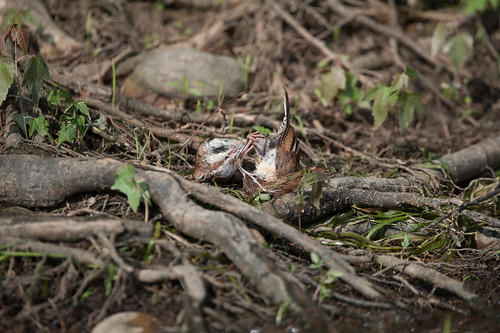
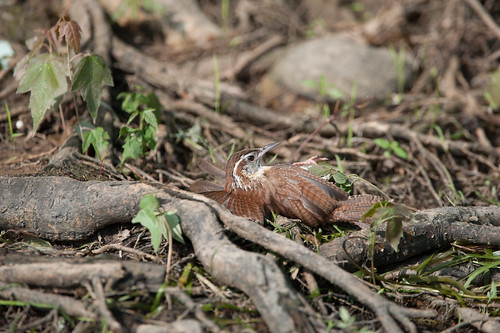
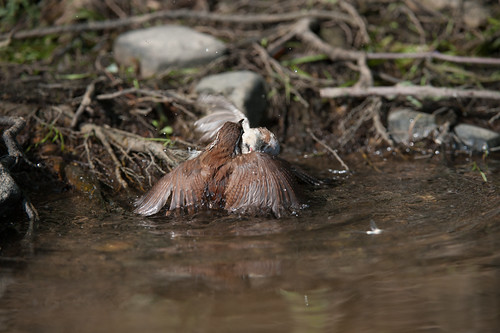
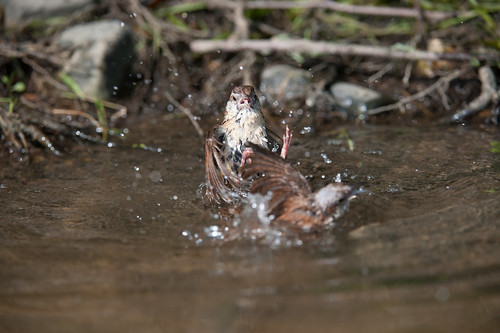
At the end of a kayaking trip, as I shoved my boat up to the shore, I saw a clump of feathers bouncing around on the bank. Not sure what I was looking at, maybe an injured bird?, I decided to look closer, and shoot. Here's what I saw.
 
 
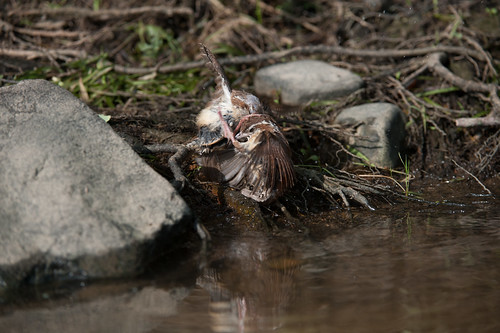
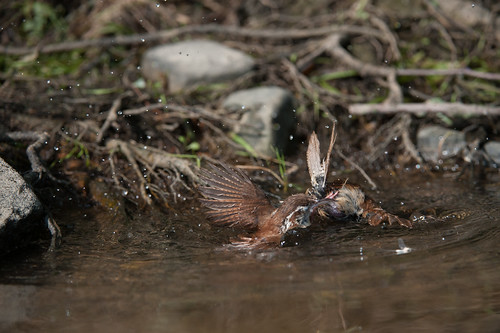
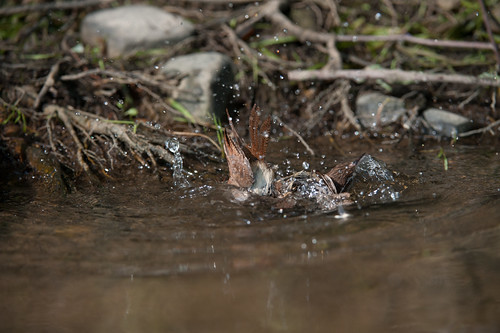
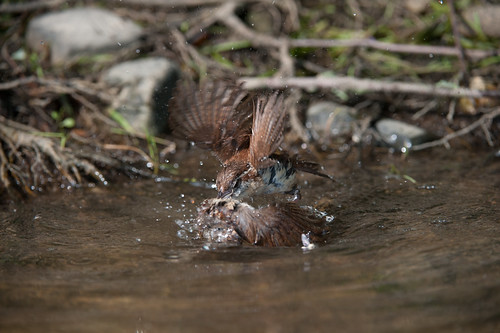
Now, the camera saw it much more clearly than I did at the time. What you're looking at is two birds (Carolina wrens?), fighting it out. And I don't mean play fighting. These two were not only using their sharp beaks against each other, they were actually clawing at each other's eyes! As they continued, and even ended up in the water, here's how it looked.
 
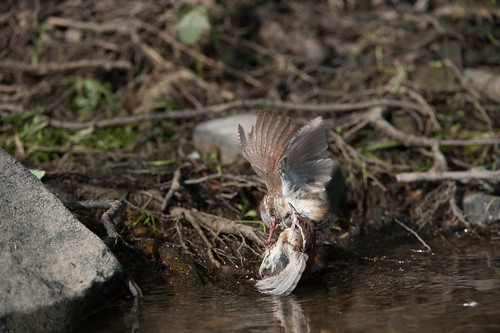
Crazy, right? And here's the final, and crowning shot. Bird rage!
 
Bird Rage, by Reed A. George
Nikon D700, Nikkor 200-400mm f4 AF-S VR Lens
 
As they finally split up and ended the fight, with one bird chasing the other off into the bushes, I just couldn't keep up with the big lens. I missed a couple of other interesting shots, but do feel that these show the event pretty well.
 
Does anyone know if I have the species correct, or what these vicious little birds were doing to each other?
 
I'm happy to have caught some very interesting behavior in this sequence.
 
DMC-365.blogspot.com

Saturday, June 20, 2015

Nature Photography - It's More Than Just Finding the Animals

 
I've been working on my nature photography this spring, and have been enjoying my new Nikkor 200-400mm f4 VR lens in the process. While I'm now quite comfortable with the lens, and very impressed with the image quality it produces, I haven't really nailed any nature shots that make me super proud yet.

Here's an example of what the lens can do:
Bald Eagle (Haliaeetus leucocephalus), by Reed A. George
Nikon D700, Nikkor 200-400mm f4 AFS VR Lens

This is a perfectly acceptable photo of a bald eagle, in a technical sense, but it sure doesn't tell much of a story. Really, I just found the animal, and got a decent shot of him. Then it was over.
 
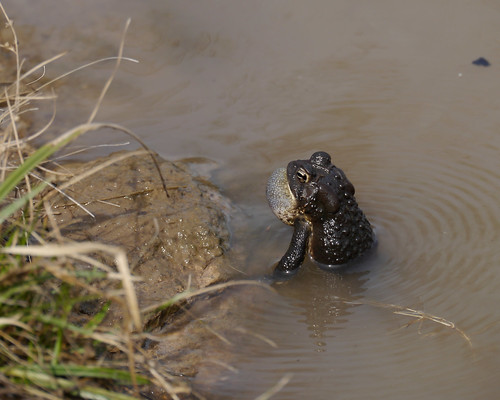
Here's a shot below that I made some time back, of a much less exotic animal, with less exotic optics, but with more of a story. I love how the toad's singing, exhibited by the extended throat, and more importantly, by the standing waves in the water surrounding it, tell you more than "This is a toad." I aspire to finding more stories like this.
 
Eastern American Toad (Anaxyrus americanus), by Reed A. George
Panasonic Lumix DMC-G3, 14-140mm Zoom Lens

The reason I'm thinking about this is that I read an interesting story about Frans Lanting, famed National Geographic nature photographer, on the Smithsonian website. (Click Here) to read that post. Lanting is a very interesting person, and the TED talk video embedded in the story tells a lot about how he feels about his work.
 
I've seen a lot of his night photography, where he sets up remote camera traps for elusive species. I see these as mainly challenges to find the animal and document it. However, he has other images, some of which he describes in the blog piece, that really tell much bigger stories. Read about the hunters reflected in the zebra's eye, and the African bullfrog, with approaching clouds above. Interesting stuff.

DMC-365.blogspot.com
 

Tuesday, May 26, 2015

Nikon 200-400mm f4 AF-S G VR Lens for Birds - The Warbler

My friend and I have just invested together in a very expensive lens - the Nikkor 200-400mm f4 AF-S G VR (version 1). Last weekend, I took it out in my kayak along with my super-sturdy Gitzo tripod and gimbal head.
 
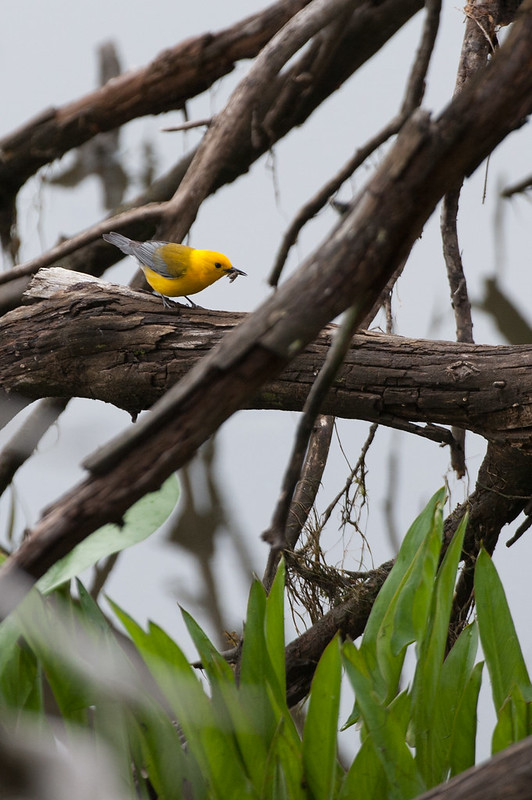
While I was waiting for large birds to fly by where I'd set up the tripod, this colorful little guy showed up.
Prothonotary Warbler, by Reed A. George
Nikon D700, Nikkor 200-400mm f4 AF-S G VR Lens
iso 720, f5, 1/1000 sec.
 
I had the D700 set to auto-ISO, so that I could set a fast (1/1000) shutter speed and the f-stop I wanted, letting the camera adjust ISO. As you can see, the warbler has an insect in his beak, a nice additional feature for the image.
 
Here's another shot of the same warbler.
 
Prothonotary Warbler, by Reed A. George
Nikon D700, Nikkor 200-400mm f4 AF-S G VR Lens
iso 1600, f5, 1/1000 sec.
 
We also purchased the Nikon TCIIE 1.4X teleconverter with our lens. I could have used it here. Both of these shots are cropped from larger compositions (hey, he's a pretty small bird!). I did get a chance to try the lens and converter together. I'll post some of those shots in the coming days.
 
This is one amazing lens.
 
DMC-365.blogspot.com
 

Thursday, May 21, 2015

Practicing my Telephoto Technique - Nikon 70-300mm AF-S VR and the Ducklings

I am anxiously awaiting delivery of a used Nikkor 200-400mm f4 zoom lens that a friend and I have decided to co-own. It's an expensive lens, so this made it possible for both of us to have access to it.
 
Most of my lenses, especially telephotos, are older technology. Starting with the Ai-P 500mm f4, which is my longest lens, it's manual focus. It's a true beauty, and makes wonderful photos, but clearly doesn't have the latest AF-S focusing. Then there's my 300mm f4 AF-I, which does have autofocus, but not the blazing fast AF-S.
 
In fact, the only long lens I have with AF-S is the 70-400mm f4.5-5.6 G VR zoom lens. So, I decided to take that lens out for a quick shoot before work yesterday, to practice my focusing technique. Based on the video by Steve Perry that I posted yesterday, I set up my D700 for back button focusing and gave it a try.
 
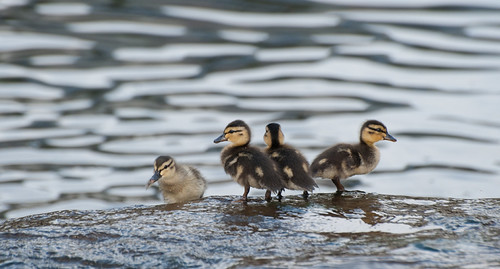
Not an action shot, but here's the best shot I made in that fifteen or twenty minutes of shooting yesterday.
 
Spring Ducklings, by Reed A. George
Nikon D700, Nikkor 70-300mm f4.5-5.6 G AF-S Lens
iso 800, f8, 1/500 sec
 
I wanted to test out the back button method, in which you leave your camera set to continuous AF, and use the button on the rear of the camera to decide when to freeze the focus, if at all. When photographing action (e.g. birds in flight), you just keep the button pressed, and the camera will focus through the entire shooting sequence. For static objects (e.g. these ducklings), you get the focus point you want, then release the rear button, locking the focus at that point. This worked very well for me here.
 
This 70-300mm lens is very good. It's not as sharp as I expect the 200-400mm to be, which should be obvious when you compare the specs and prices. But, I think it did a pretty good job for me in this case. And, it's very light and fast.
 
I can't wait to see what the 200-400 can do!
 
DMC-365.blogspot.com