Monday, October 7, 2013

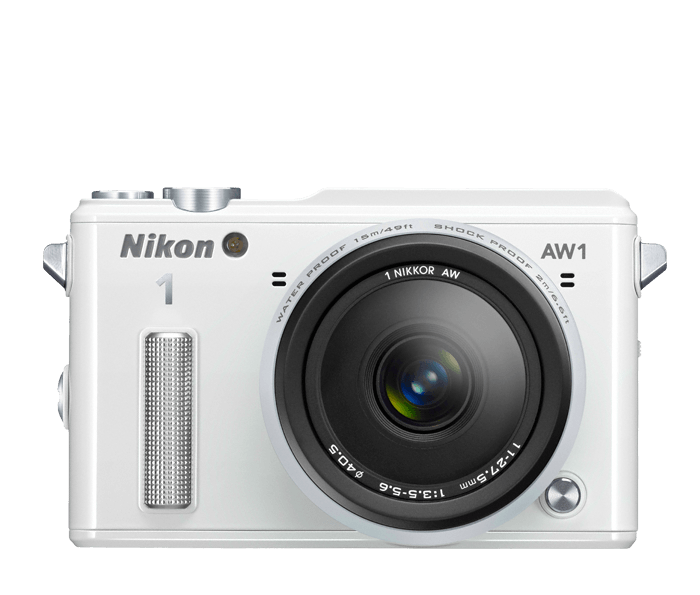
Nikon's New Underwater Interchangeable Lens Camera - the 1 AW1!

 
Image Source: nikonusa.com
 
Now here's something very interesting to me, from Nikon. A waterproof camera (good to 49') with interchangeable lenses and raw file capability, all in a small package.
 
I am a big fan of Nikon. I shoot Nikon SLRs (both film and digital), and love the Nikon lenses. However, I equate Nikon with the SLR configuration. My Nikon D700 is an extreme image quality machine, but it's an SLR - heavy, large, perhaps overloaded with features. When I want simple, I shoot Leica.
 
Until now, I have not paid much attention to Nikon's 1 series cameras. Nikon was a little late to the mirrorless camera game, and with a sensor size smaller than Micro 4/3, it just didn't motivate me to look into it. Of course, the format has been good for Nikon, and has gained a good level of adoption.
 
Now they've announced something really interesting - an underwater version. With two lenses currently certified to be waterproof along with the 1 AW1 body, this really could go somewhere. The current lenses are a 11-27mm f3.5-5.6 kit zoom, and a 10mm f2.8 prime. The zoom is probably not that great for underwater usage, but that 10mm (~27mm equivalent 35mm format field of view) could be spectacular. Fast f2.8 aperture and close focusing to ~9", this could be an excellent lens for the reefs.
 
(Click Here) to read about the new 1 AW1 and kits at nikonusa.com.
 
(Click Here) to read a first impressions post on dpreview.com.
 
I really like the idea of a flexible underwater camera system. I would prefer it to not take me into yet another camera system and format, however. If this were a Panasonic Micro 4/3 camera, I'd be getting out my credit card, even though it would not take advantage of my current lenses for underwater applications.
 
In any case, the Nikon 1 AW1 could start an interesting trend. If I were going to do a lot of diving, I'd seriously consider giving it a try. For now, I'll stick with my Lumix DMC-TS5 underwater compact camera.
 
DMC-365.blogspot.com


Sunday, October 6, 2013

Nikomat FTn at Irish Dance Exhibition - Skeletons From The Closet, September's Camera

My Nikomat FTn and I recently went to Glen Echo Park in Maryland. They were holding an Irish dance event in what used to be the bumper car ride in the old Glen Echo Amusement Park.
 
Very challenging lighting, indeed, the pavilion was ringed with mid-day sun, while the interior remained quite dark. Having not brought a flash with me, or ever attempted to use one with the FTn, I decided to go with the prevailing conditions. This first shot took advantage of the light around the edges, and allowed me to capture some details of the dancers stretching and warming up.
Warming Up, by Reed A. George
Nikomat FTn, Kodak Tmax 400 Film

To really share what the lighting was like, I decided to shoot a few silhouettes. I really like the lines of the wood planks in the floor, and how they created a pool of reflected light in the relative darkness. The rafters in the roof also add to the structure of the shots. In this first silhouette, I also like how the dancer at right is actually not touching the floor; you can just detect that by the shadows under her foot.
Silhouette #1, by Reed A. George
Nikomat FTn, Kodak Tmax 400 Film

What I like about this final shot is how the dancer's arms frame the spectator in the distance beyond them. I also think the electric fans add an element of interest.
Silhouette #2, by Reed A. George
Nikomat FTn, Kodak Tmax 400 Film
 
Hardly documentation of the event or the people involved, these shots are my personal interpretation of what I saw. I enjoyed shooting the Nikomat here, and feel that it helped me to extract some details from a challenging lighting situation.
 
DMC-365.blogspot.com


Saturday, October 5, 2013

Result - September's Skeletons From The Closet Camera, the Nikomat FTn

 
Paths, by Reed A. George
Nikomat FTn, Nikkor 80-200mm f4 AIS Manual Focus Lens
Kodak Tmax 400 Film
 
This month, I've been shooting my gorgeous example of a black Nikomat FTn.
 
(Click Here) to read about the camera.
 
I took the Nikomat, and a recently-acquired 80-200mm f4 AIS lens, out for a walk at my local suburban "nature walk," a boardwalk over some small but nice wetlands in my neighborhood. The water level is very low right now. Home to lots of turtles, including some very large alligator snappers, the pond is the lowest I've ever seen it. In fact, you can see the back and head of a large turtle in the shot above, about in the exact center of the image, where the paths converge.
 
The 80-400 f4 AIS is an interesting lens. I bought it with an F2 body that was my main interest. When I heard about the lens over the phone, I wasn't interested. When I saw and handled it, I decided to give it a try.
 
Interestingly, Nikon has recently come out with a 70-200mm f4 AF-S ED VR lens, for a full $1,000 less than the venerable f2.8 version.
 
(Click Here) to read about the new AF-S 70-200m f4.
 
Of course, my old AIS lens is in a completely different league, but so far I'm pretty impressed. And, it cost me well over 10X less than the AF version would.
 
DMC-365.blogspot.com


Friday, October 4, 2013

Whole Lotta Leica Lens for October - 50mm Summicron f2, Version III

 
My Summicron 50mm f2, Version 3
 
Sometimes I talk about what would be the last camera or lens I'd ever give up. This is only a useful train of thought to a short extent, because I never plan to do that. However, if I did pick a single lens for my Leica, it would be this one, the 50mm Summicron f2.
 
Mine was built in 1970, and is referred to as a Type 3 lens. It was the first Summicron 50 version (after the collapsible, then rigid, then dual range, each with 7 elements) to be made with six elements. This configuration change reportedly gives up some resolution in favor of higher contrast. Subsequent Summicron 50s used the 6 element configuration as well. Mine has 10 aperture blades, where later versions have 8. Ten should give better "bokeh," or out of focus areas in the image.
 
(Click Here) to see my collapsible Summicron. See my Whole Lotta Leica page (tab above) to see further posts with results.
 
While I thoroughly enjoy the collapsible, it does have a lower contrast, vintage look to the images it produces.
 
The Type 3 is an incredible lens. When it doubt, take the Summicron out.
 
We'll see what it can do on the M9 this month.
 
DMC-365.blogspot.com
 

Thursday, October 3, 2013

Wijnand Schouten Shares Fuji X100S Results on Steve Huff Photo

By Wijnand Shouten
Image Source: http://www.stevehuffphoto.com/2013/09/20/daily-inspiration-446-by-wijnand-schouten/
 
Steve Huff Photo has posted a few photos by Wijnand Shouten, who's just started working with a new Fujifilm X100S.
 
(Click Here) to read more about the camera.
 
(Click Here) to read the post on Steve Huff Photo.
 
It seems that Wijnand has experience with the Fujifilm X100, but is enjoying the upgrade to the S model. The S features an X-Trans CMOS sensor. Wijnand gets gorgeous deep blacks in his images.
 
I'm still tempted by the X100S at times, but have my hands full with my current camera selection. And, as I've said before, it doesn't have the perfect focal length for me, which is important with a fixed lens camera like the X100S. The same holds true for the lovely Leica X2. I'd rather have a 50mm equivalent lens.
 
Wijnand certainly shares with us that in the right hands, the X100S can sing.
 
DMC-365.blogspot.com
 

Wednesday, October 2, 2013

Street Photography as Time Travel (Kenneth Reitz on Leica Camera Blog)

 
At the Seafood Market, NYC, 2010, by Reed A. George
Leica M8, Rokkor 40mm f2 Lens
iso 320, f4.8, 1/125 sec
 
A local (to me) photographer, Kenneth Reitz, was recently interviewed for the Leica Camera Blog. A software developer, Kenneth lives and works in Winchester, Virginia. He even mentioned the famous(?) Apple Blossom Festival held there every year. In addition to proximity, several things Reitz said gave me the feeling that we have a lot in common.
 
Like me, Reitz came back to photography after college. He has this to say about the role of photography in his life:
 
"...it makes me happy and keeps me sane."
Exactly, Kenneth. I couldn't have said it any better.
 
Reitz sees street photography as a form of time travel. The shot above takes me back to the moment, three years ago, when I shot the picture. I'm sure it will do the same 20 years from now, if I'm lucky enough to be around still.
 
Also like me, Kenneth has an interest in pieces of Leica history. He has recently purchased a 1954 M3 (which must be a double-stroke, like mine, based on the dates). When asked about shooting film, Reitz comments that everything he's ever created exists only in an electronic realm. Film breaks that pattern.
 
Here's where Reitz and I differ - he shoots only a single focal length - 35mm. Shooting a 35mm f2 Summicron aspheric on his Monochrom, and a 1979 model 35mm f2 Summicron on his M3, he comments:
 
"I plan to shoot with only my 35mm Summicron for the rest of my life."
 
Personally, I will shoot with mine, amongst many others, for the rest of my life. Committing to a single lens for a month (e.g. for my Whole Lotta Leica series) is challenge enough.
 
Kenneth even mentions meditation in passing. This is something I've become more interested in of late. Seems like I should contact Kenneth to see if we can have coffee together sometime.
 
(Click Here) to read the interview on the Leica Camera Blog.
 
(Click Here) to visit Reitz's website.
 
DMC-365.blogspot.com


Tuesday, October 1, 2013

Whole Lotta Leica Results - Minolta 45mm f2.8 Rokkor LTM

I have been very busy this month, but did get out a couple of times so far with this month's WLL lens, the Rokkor 45mm f2.8 in LTM.
 
(Click Here) to read about the lens.
 
First off, I took the lens to a meetup with some fellow Leica fans. I'm learning a lot from these guys, who have an amazing knowledge of not only the equipment but of how to use it to great advantage. Anyway, while meeting in the coffee shop, I saw this lovely lady sitting in wonderful backlight and asked if I could take her picture, to which she agreed.
Backlit 1, by Reed A. George
Leica M9, Minolta Rokkor 45mm f2.8 LTM lens
iso320 f5.6, 1/250 sec.
Backlit 2, by Reed A. George
Leica M9, Minolta Rokkor 45mm f2.8 LTM lens
iso320 f5.6, 1/250 sec.
 
I may have benefitted from opening the lens wider in the shots above, as some of the lines in the background (especially those at the top of the lady's head) are distracting.
 
The Rokkor is quite sharp, especially closed down a little as above. One thing I mentioned in the description post is that the aperture setting on my copy is a little fidgety. First, the reference point moves with the focus ring, which will be true of all copies of this particular design. Secondly, and more important, there are no click stops. So, it's very easy to bump it, especially while focusing, and change the aperture setting. I don't know if this is specific to my copy, or if this lens was designed without click stops.
 
On the same day as the meetup, I took the Rokkor to National Harbor in DC, where I was meeting some friends for dinner. It's a lively place, with plenty of people to photograph on a weekend evening.
 
The Awakening Sculpture, by Reed A. George
Leica M9, Minolta Rokkor 45mm f2.8 LTM lens
iso320 f9.5, 1/1000 sec.
"The Awakening" is a focal point of National Harbor. I didn't feel that I found a great composition of the sculpture, but did enjoy the interplay of the people and the piece.
 
Mosaic, by Reed A. George
Leica M9, Minolta Rokkor 45mm f2.8 LTM lens
iso320 f8, 1/1000 sec.
Basking in the Weekend Sun, by Reed A. George
Leica M9, Minolta Rokkor 45mm f2.8 LTM lens
iso320 f9.5, 1/1000 sec.
Another observation about the Rokkor has to do with which framelines you want to bring up on the M9. Since the focal length is closest to the 50mm Leica standard, I chose an LTM-M adapter ring that brings up the 50mm framelines. I find that the angle is much wider, and therefore produces images that go well outside the 50mm framelines. In fact, I think it's close to matching the 35mm framelines. However, I'd rather include some extra elements that may be cropped out later than miss something that was inside the framelines. For this reason, I live with the extra space in the image outside of the 50mm lines, rather than guessing how far inside the 35mm lines it will actually capture.
 
I've found a similar situation with the 40mm Rokkor f2, which came with the Leica/Minolta CL. One of my favorite lenses, the 40mm used to live on my Leica M8 when I had it. I used the 35mm framelines for that lens, which matched the Rokkor 40's actually field of view quite well.
 
Overall I'd say the Rokkor 45mm f2.8 LTM is a decent lens. Mechanically, it's not up to Leica standards, at least at its current age. Optically, it does quite well. I'll probably not use it a lot on the M9 after this month, but it's a fun little piece to have on a screwmount film camera, for example. It's quirkiness only adds to the fun in that case.
 
DMC-365.blogspot.com