Showing posts with label normal lens. Show all posts

Wednesday, July 15, 2015

Another Person Who Appreciates the Zeiss ZM Sonnar 50mm f1.5 Lens

 
by Reed A. George
 
The Zeiss Sonnar 50mm f1.5 lens engenders a lot of debate in the photo community. Acknowledged by Carl Zeiss as an updated build of a classic Sonnar design, it does not have all the technical performance of say a modern Leica Summilux. It does have character. I own both lenses, and love them both. But, the Sonnar has more character than the Summilux. If I want near perfection, I use the Summilux. If I'm willing to take a chance and maybe make something more unique, I use the Sonnar.
 
(Click Here) to read an account of using the Sonnar on the blog DearSusan. I think it's nicely done.
 
Thanks to my friend Bill for alerting me to the DearSusan blog!
 
DMC-365.blogspot.com


Tuesday, June 16, 2015

Dancer - Leica IIIG and Uncoated Summitar 5cm f2

Dancer, by Reed A. George
Leica IIIG, Summitar 5cm f2 Collapsible Lens
Agfa APX400 Film @ iso200
 
I think I have figured out this film. I actually like the grain it produces. Shooting it at iso 200 and developing for 10 minutes in undiluted D-76 does the job.
 
DMC-365.blogspot.com
 

Sunday, April 5, 2015

Stained Glass, Mausoleums in Rock Creek Cemetery

A final post of images I made during my recent visit to Rock Creek Cemetery.
 
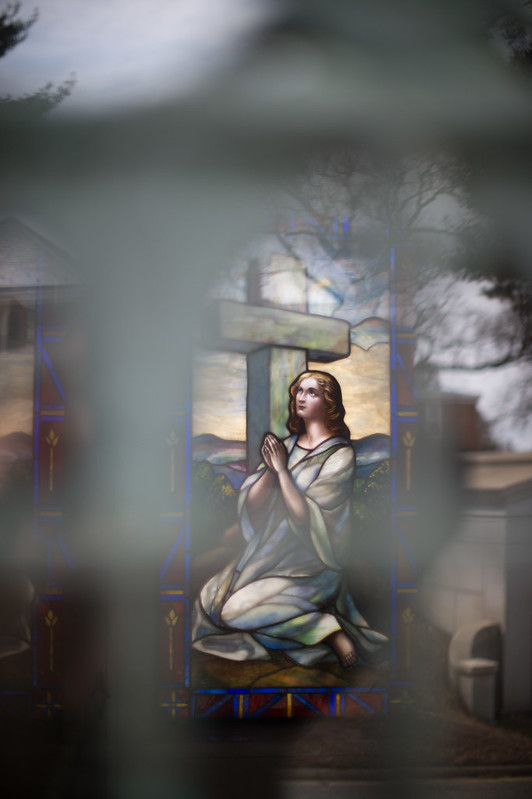
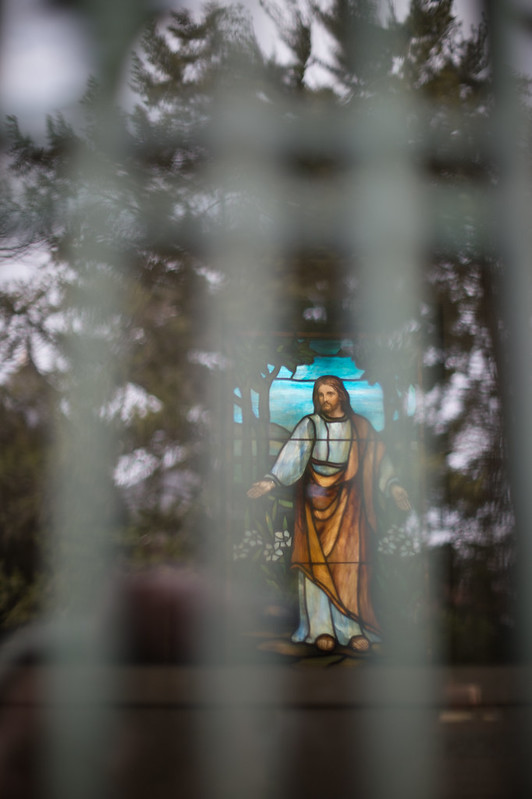
There are a lot of mausoleums at this cemetery, and some of them have lovely stained glass windows, usually in the rear of the building. I decided to shoot some of them using my new Nikkor 50mm f1.2 AIS lens. This lens allowed me to get sharp images of the stained glass, but blur the distracting front glass and iron gates of the mausoleums. I like how the shallow depth of field isolates the images from the rest of the scene.
Mausoleum Stained Glass, by Reed A. George
Nikon Df, Nikkor 50mm f1.2 AIS Lens at f1.2
 
I also like the reflections of the trees in the front glass.
 
This lens provides the opportunity to do some very unique things with my images.
 
DMC-365.blogspot.com
 

Friday, February 27, 2015

Leica M9 - Still Something Special About It

 
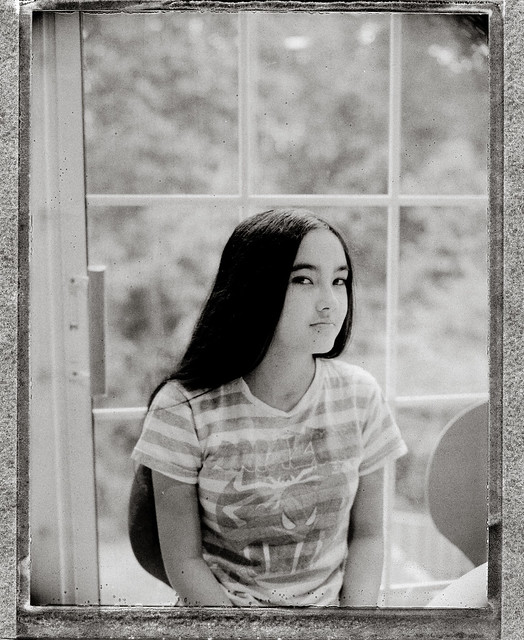
Teen Style, Morning Light, by Reed A. George
Leica M9, Zeiss Sonnar C 50mm f1.5 Lens
iso 500, f1.7, 1/15 sec.
 
Yes, there's still something unique about how the Leica M9 sensor renders an image. Nothing in your face, for sure. But, this is basically the tonality that I had in mind when I made this shot on the way out of the house this morning. There's something subtle about the way this camera draws.
 
DMC-365.blogspot.com

Saturday, November 29, 2014

Entertaining Coverage of Leica Noctilux f0.95 Lens

Video Source: http://youtu.be/tFJ96onYmu0
 
Well, I don't own a Leica Noctilux 50mm f0.95 lens. So, I can only share someone else's experience with you.
 
If you haven't seen Kai's videos on DigitalRev before, they're quite entertaining. Many times, they're as much about humor as about photography. He sometimes goes overboard, like when he destroys a DSLR by catching it in elevator doors, etc. But, in the case of this video, Kai treats the Leica Noctilux with the respect that it deserves. It's a great review of the lens.
 
I'll just have to do with my Summilux 50mm f1.4 for now. It's actually hard to imagine a lens with well over an additional stop of light gathering capability over the Summilux. It's also hard to image being able to focus it well enough, with the super-thin depth of field that that wide aperture produces.
 
If clicking the image above doesn't take you to the movie, (Click Here).
 
DMC-365.blogspot.com


Monday, November 10, 2014

Japanese Maple in Autumn - Nikon Df

I'm enjoying my new Nikon Df a lot. Here's a shot of the Japanese maple outside my office.
 
Japanese Maple in Autumn, by Reed A. George
Nikon Df, Nikkor 50mm f1.4D AF Lens
iso 100, f1.4, 1/125 sec.
 
The 50mm f1.4 AF-D lens is now well out of date in the Nikkor lineup. It has always drawn criticism for lack of sharpness wide open, which I suppose is true. That doesn't keep me from using and enjoying it.
 
That said, the new Sigma 50mm f1.4 ART lens is the hot thing out there these days. My friends who have them approve. Much larger than the AF-D lens, these new Sigmas really seem to deliver amazing image quality. The updated Nikkor product, the AF-S 50mm f1.4G is another option, but both the Nikkor and Sigma lack aperture rings, something I'm unhappy about. This means that I can't use them on my old Nikon film bodies, or even adapted to Micro 4/3 for that matter.
 
As it stands, I can carry my older AF-D lens in the bag with any of my Nikon SLR bodies, from the 1959 model F to the 2014 model Df, and it will work just fine with any of them.
 
DMC-365.blogspot.com
 

Saturday, October 25, 2014

Some Camping Area Shots from Watermelon Park Festival 2014

I've shared my Watermelon Park Festival writeup on Cosmic Vibes Live, along with my digital photographs, largely taken on or around the stage.
 
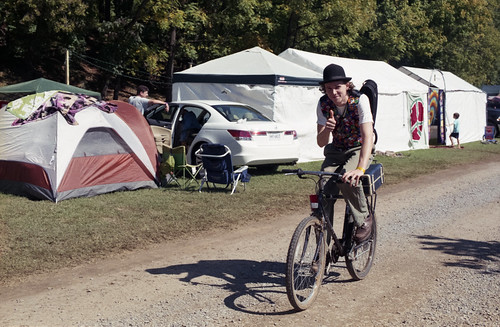
Now, I'll share a few more casual shots, taken in the Camping area with my Nikon FM2, 200 speed drugstore color negative film, and 50mm f1.4 Nikkor AF-D lens. Of course on the FM2, I had to manually focus.
 
Deep Morning Thoughts with Erik Burnham, by Reed A. George
 
Chester and Milo, by Reed A. George
 
These two guys are my music photography heroes - Chester Simpson and G. Milo Farineau. Both are mad-skilled, friendly, and generally great to hang out with.
 
Rudy B., by Reed A. George
 
Speaking of fun to hang out with, here's Rudy B. of the Plank Stompers.
 
I really love carrying around the compact FM2 and normal lens while I'm tooling around the festival, especially during the day. Yes, I'll carry the D700 for the lowlight stuff. But, the FM2 just fits my hands so well.
 
DMC-365.blogspot.com
 

Monday, September 29, 2014

Watermelon Park Fest 2014 - Mandolin Players Extraordinaire!

It's Sunday, and I just returned home at 2:30 AM from my favorite music festival of this and every year, Watermelon Park. I've been attending for several years now, and it's a big party with so many of my friends, I look forward to it all year long.
 
I'm pretty wiped out today, but thought I'd share a few images of a workshop of three of the world's best mandolin players - (left to right) Sam Bush (Sam Bush Band), Danny Knicely (Furnace Mountain Band), and Drew Emmitt (Leftover Salmon). Check them out.
 
 
These guys were great, sharing several tunes and lots of funny stories, like how Sam was accosted by several "locals" back in the early seventies while attending the festival. The nicest thing they had to say to him was that they were going to cut off his hair. Luckily, Sam escaped unharmed and came back some 40 years later.
 
I was right at the edge of the stage, shooting with my Nikon D700 and 50mm f1.4 AF-D lens. Being held in a big white tent, the background light was much brighter than that on Sam, Danny, and Drew's faces. I simply used the spot meter setting in the D700 to get the exposure right, and then it was a matter of catching a few moments and interactions. What a blast!
 
DMC-365.blogspot.com
 

Friday, August 22, 2014

Mamiya Press Universal and Fuji FP3000B

I'm continuing to enjoy shooting instant pictures with my new Mamiya Universal. Here's a shot I made with Fuji's black and white iso 3000 pack film. I used the standard 100mm f3.5 Mamiya Sekor lens for this one.
 
Cropped, From Scanned Print
 
And, for reference, here's what the whole image looks like, scanned from the paper negative:
 
From the Paper Negative
 
I really need to photograph the Universal camera so that I can share all the details of what's included. It's a big heavy beast, but has a lot of interesting features.
 
I've received my first online scans from film I shot in the Universal, and am really impressed with the image quality. As soon as my film returns home from The Darkroom (thedarkroom.com), I'll make high resolution scans of a few images and share them as well.
 
DMC-365.blogspot.com
 

Thursday, August 21, 2014

Pana-Leica Summilux 15mm f1.7 For Micro 4/3 - Great, but Neither Here Nor There?

Image Source: http://shop.panasonic.com/shop/model/H-X015K
 
Leica's product emphasis seems nearly as varied as my own these days. With the advent of the new Leica T system with APS-C sensor, Leica seems to have made it even more clear that sensors smaller than that are not serious enough to warrant their direct attention. That said, their compact camera offerings continue, and are pleasing to many. To me, it seems that Micro 4/3 is in a bit of a no man's land with Leica.
 
Actually, Micro 4/3 is occupying a similar place for me personally. With only so many hours free to use my camera gear, I find my interest pulled in many directions. Leica rangefinders are my most common companions. However, on any given day, you may also find me with a Nikon SLR, a medium format film camera, or even a 4x5 pinhole camera in my hand. Yet, my Micro 4/3 gear persists. It's still my favorite choice for many types of travel.
 
Anyway, back to Leica. Their collaboration with Panasonic continues, and the newest addition to the Pana-Leica lens kit is the 15mm f1.7 Summilux. I won't speculate on the performance of the lens, except to say that I expect it to be wonderful, just like the 25mm f1.4 Summilux is in my opinion. For more on those aspects, please
 
(Click Here) to read a nice introduction to the lens by Napier Lopez on mu-43.com.
 
From my point of view, the 15mm focal length, which provides an equivalent field of view as a 30mm lens on full frame 35mm sensors, is an odd choice. To me, it's neither here nor there. In between the classic lengths of 35mm (a wide normal) and 28mm (what was once considered a very wide angle lens), 30mm equivalent field of view would take some getting used to. Now, my view on this is not purely based on sticking to the most common lengths. For example, I find the 40mm focal length on full frame to be nearly ideal for my style of shooting.
 
I am very pleased to see the Pana-Leica lens lineup continue to grow. I'm certain that many people will make great use of this non-standard field of view lens. I'll have to keep my eyes and mind open to see if it leads to any new styles or views that I should consider.
 
DMC-365.blogspot.com


Thursday, May 22, 2014

Super Quick, Super Positive Post about Film Photography Project (FPP) Walking Workshop!

I attended the FPP Walking Workshop in Findlay, Ohio today. Twelve hours of photographic fun, discussion, and practice. We got to sit in on recording a session of the FPP podcast, had two separate amazing equipment raffles, had two walking tours, opportunity to develop our own films, an instant photography extravaganza (with everything from small Instax images to 8x10 Impossible Project film!), and much more... All for the amazing price of ZERO DOLLARS!
 
(Click Here) to check out FPP. Listen to their podcast. Importantly, buy your film from them; they match or beat the big stores' prices.
 
Here's part of what I won in the first raffle, a Nikkormat FT3 body and 50mm f2 AI lens. The FT3 is unique in the Nikkormat line, in that it supports the use of AI lenses; earlier models are for pre-AI lenses.
 
Raffle Prize!
 
This lens is somewhat interesting. Only marketed for a couple of years, it is unique in the Nikon line in that it has six aperture blades. Most (all?) other Nikkors have an odd number of blades. This six-bladed model produces a characteristic star pattern when used to shoot bright points of light. I'll demonstrate this when I get a chance.
 
For now, I'd like to say thanks to all the FPPers who made the event a lot of fun!
 
DMC-365.blogspot.com
 

Saturday, April 5, 2014

Nikkor 5cm f1.4 Rangefinder Lens on Leica M9

I mentioned that I'd purchased a very nice old Nikon S rangefinder camera, Nikkor 5cm f1.4 lens, and Amedeo adapter to mount the lens on my Leica M9. Here are some quick test shots to show what that Nikkor lens can do on the M9 body. All of these are jpegs right out of the camera, no editing.
 
First, I shot these three shots at the same exposure, but at three different f-stop settings (f1.4, f2, f2.8) to show sharpness and depth field.
 
Nikkor 5cm f1.4 at f1.4, 2, and 2.8
 
At this size, the most obvious effect of closing down the aperture is eliminating vignetting (darkening around the edges of the image). This lens vignettes quite significantly at f1.4. It clears up pretty well by f2.8.
 
How about sharpness? Here are crops of the same three shots, showing focus at the three f-stop settings:
 
 
Crops at f1.4, 2, 2.8
 
I think it's pretty sharp, even wide open. By f2.8, it's very sharp.
 
But, of course, none of that matters too much. If I was going to ultimate sharpness, a modern lens would be the best bet, not a lens from the 1950s. What really matters is whether or not I like the look the lens produces. Well, I'm not sure yet. But, here's an early hint:
 
 
Just a Quick Shot
 
This shot was also made wide open at f1.4. I'm definitely looking forward to shooting some more with this lens. I also need to explore how it renders color. I'm also interested in seeing how it does on the Nikon film body it was designed for.
 
DMC-365.blogspot.com


Friday, February 14, 2014

Is 40mm (or Equivalent) the Most Natural Field of View?

I have always liked the 40mm field of view on a 35mm camera. It's a nice middle point between 35mm (which I'm learning to love, but initially felt a little too wide) and 50mm (which has always been my standard focal length, but can be a little tight).
 
I first discovered the 40mm focal length with my Leica CL and Rokkor 40mm f2 lens that was designed for it. A world-class lens, the Rokkor (or otherwise branded 40mm Leica Summicron) is about as good a lens as I could hope for.
 
I rediscovered the focal length with the Lumix 20mm f1.7 on my Panasonic Micro 4/3 cameras (giving the same field of view as a 40mm on 35mm format). Here's an example shot with the 20mm f1.7:
 
Perfect Field of View?, by Reed A. George
Panasonic Lumix DMC-GF1, Lumix 20mm f1.7 Lens
iso 100, f8, 1/80 sec.
 
(Click Here) to read a great post on mu-43.com to see what other people think. Be sure to click on the link to read a related piece by Mike Johnston.
 
Not being a real wide angle shooter most of the time, I find the Leica CL's standard 40mm and 90mm focal lengths to be an excellent choice for a two prime lens travel kit. If I pick either 35mm or 50mm as my standard lens, I feel that I need to carry three lenses (35, 50, 90). The biggest issue I have with the 40/90 two lens kit is that my CL is the only rangefinder camera I own with 40mm framelines. Of course, the Micro 4/3 format fixes that with the electronic viewfinder (EVF).
 
DMC-365.blogspot.com


Friday, November 29, 2013

Whole Lotta Leica - October Results - That Summicron Bokeh

Not All That Matters Is Sharp, by Reed A. George
Leica M9, Leica Summicron 50mm f2 v.3 Lens
iso 400, f2.8, 1/3000 sec.
 
Lens geeks, especially Leica lens geeks, frequently discuss "bokeh." Apparently, bokeh is a Japanese word for "out of focus" areas in an image. The lens design, including the number and shape of the aperture blades, has a lot to do with how "pleasing" a given lens' bokeh will be. In general, more aperture blades, and rounded edges, yield smoother bokeh.
 
The Summicron is known for beautiful bokeh. In fact, I believe it was Mike Johnston who decided that the 35mm Summicron version 4 lens is the "king of bokeh." At any rate, you should expect a lot from any Summicron in this area.
 
In the shot above, I exposed the tree at f2.8, making for very shallow depth of field, on purpose. The combination of a wide aperture and close focus makes for lots of bokeh. To me, the structure in the back is as important as the tree leaves. It gives a strong sense of the context of the image. The red maple leaves go along with the Asian style structure. Neither element would be as strong without the other.
 
People argue about bokeh - what is pleasing, which lenses have the best. I've noticed that the bokeh from some of my cheaper lenses is as nice as higher end lenses. In fact, I've seen quite nice bokeh from very cheap lenses, with few (four) aperture blades. So, I'm not saying you need a Summicron to get beautiful bokeh. I am saying that bokeh can be important to conveying what you want with an image.
 
DMC-365.blogspot.com


Tuesday, October 1, 2013

Whole Lotta Leica Results - Minolta 45mm f2.8 Rokkor LTM

I have been very busy this month, but did get out a couple of times so far with this month's WLL lens, the Rokkor 45mm f2.8 in LTM.
 
(Click Here) to read about the lens.
 
First off, I took the lens to a meetup with some fellow Leica fans. I'm learning a lot from these guys, who have an amazing knowledge of not only the equipment but of how to use it to great advantage. Anyway, while meeting in the coffee shop, I saw this lovely lady sitting in wonderful backlight and asked if I could take her picture, to which she agreed.
Backlit 1, by Reed A. George
Leica M9, Minolta Rokkor 45mm f2.8 LTM lens
iso320 f5.6, 1/250 sec.
Backlit 2, by Reed A. George
Leica M9, Minolta Rokkor 45mm f2.8 LTM lens
iso320 f5.6, 1/250 sec.
 
I may have benefitted from opening the lens wider in the shots above, as some of the lines in the background (especially those at the top of the lady's head) are distracting.
 
The Rokkor is quite sharp, especially closed down a little as above. One thing I mentioned in the description post is that the aperture setting on my copy is a little fidgety. First, the reference point moves with the focus ring, which will be true of all copies of this particular design. Secondly, and more important, there are no click stops. So, it's very easy to bump it, especially while focusing, and change the aperture setting. I don't know if this is specific to my copy, or if this lens was designed without click stops.
 
On the same day as the meetup, I took the Rokkor to National Harbor in DC, where I was meeting some friends for dinner. It's a lively place, with plenty of people to photograph on a weekend evening.
 
The Awakening Sculpture, by Reed A. George
Leica M9, Minolta Rokkor 45mm f2.8 LTM lens
iso320 f9.5, 1/1000 sec.
"The Awakening" is a focal point of National Harbor. I didn't feel that I found a great composition of the sculpture, but did enjoy the interplay of the people and the piece.
 
Mosaic, by Reed A. George
Leica M9, Minolta Rokkor 45mm f2.8 LTM lens
iso320 f8, 1/1000 sec.
Basking in the Weekend Sun, by Reed A. George
Leica M9, Minolta Rokkor 45mm f2.8 LTM lens
iso320 f9.5, 1/1000 sec.
Another observation about the Rokkor has to do with which framelines you want to bring up on the M9. Since the focal length is closest to the 50mm Leica standard, I chose an LTM-M adapter ring that brings up the 50mm framelines. I find that the angle is much wider, and therefore produces images that go well outside the 50mm framelines. In fact, I think it's close to matching the 35mm framelines. However, I'd rather include some extra elements that may be cropped out later than miss something that was inside the framelines. For this reason, I live with the extra space in the image outside of the 50mm lines, rather than guessing how far inside the 35mm lines it will actually capture.
 
I've found a similar situation with the 40mm Rokkor f2, which came with the Leica/Minolta CL. One of my favorite lenses, the 40mm used to live on my Leica M8 when I had it. I used the 35mm framelines for that lens, which matched the Rokkor 40's actually field of view quite well.
 
Overall I'd say the Rokkor 45mm f2.8 LTM is a decent lens. Mechanically, it's not up to Leica standards, at least at its current age. Optically, it does quite well. I'll probably not use it a lot on the M9 after this month, but it's a fun little piece to have on a screwmount film camera, for example. It's quirkiness only adds to the fun in that case.
 
DMC-365.blogspot.com


Tuesday, August 6, 2013

Whole Lotta Leica Lens for August - 35mm f2 Summicron Type 3

I recently picked up this Summicron 35mm f2, unplanned, for a very good price at a local camera store. I'll be shooting this lens a lot with my M9 in the month of August. In fact, I already posted one shot from it, on August 4.
 
Leica Summicron 35mm f2, Version 3, 1975
 
Leica's Summicron lenses are world-renowned for their quality. Earlier in the year, I picked a more expensive 35mm lens from the same approximate time period, the f1.4 Summilux, for my Whole Lotta Leica (WLL) series.
 
(Click Here) to read about the Summilux. It is a very nice lens, and the fast f1.4 makes it very flexible. However, that lens is known to be a little soft wide open. Not so with the Summicron.
 
If you haven't noticed, I've consolidated all of my WLL post links onto a single page, so it's easy to find a particular lens and the results from it.
 
(Click Here) to go to my WLL links page.
 
Back to the Summicron that I'll be shooting this month, it is the third version of the 35mm f2 by this name. Mine was made in 1975. There are at least five versions at this point. The version 2 and 3 Summicron 35s have six elements, as compared to eight in the earlier model 1. This reduces the number of glass-to-air interfaces, reportedly improving (increasing) contrast, at the cost of some resolution.
 
This is a gorgeous, tiny lens, that makes the perfect mate to a nice M body like the M9. We'll see how it performs this month. I'm thinking it's going to be good.
 
DMC-365.blogspot.com


Monday, July 8, 2013

June Results - Whole Lotta Leica - Carl Zeiss C Sonnar 50mm f1.5

In the month of June, I shot my Zeiss Sonnar C 50mm f1.5 lens on the Leica M9.
 
(Click Here) to read my post about the lens.
 
In June, I took a great workshop through the Leica Akademie, called "The Truth About Photos." This was a full weekend workshop, with most of Saturday dedicated to shooting in Washington, DC. I used only the Sonnar the whole weekend. I'll be posting a full write-up of the workshop soon, which will have a lot more images from the Sonnar / M9 combination. Stay tuned for that.
 
In the meantime, here are some other images I took with the Sonnar 50mm on the M9 in June.
 
My Favorite Shot From June, by Reed A. George
Leica M9, Zeiss C Sonnar 50mm f1.5 Lens
iso 640, f2.8 1/125 sec
 
The Sonnar renders colors very nicely. The image above is very high contrast, but I'm pleased with the light tonality on the subject's face. It was a tough shot that I think really came out well.
 
 
Leica X-Vario Convert?, by Reed A. George
Leica M9, Zeiss C Sonnar 50mm f1.5 Lens
iso 400, f2.4 1/125 sec

 
Barnack!, by Reed A. George
Leica M9, Zeiss C Sonnar 50mm f1.5 Lens
iso 400, f4 1/350 sec

 
Dramatic Light, by Reed A. George
Leica M9, Zeiss C Sonnar 50mm f1.5 Lens
iso 320, f2.8 1/180 sec
 
Dinner Discussion, by Reed A. George
Leica M9, Zeiss C Sonnar 50mm f1.5 Lens
iso 320, f2 1/180 sec
 
Sharing Earphones, by Reed A. George
Leica M9, Zeiss C Sonnar 50mm f1.5 Lens
iso 320, f16 1/350 sec

 
These ladies were sharing a set of earphones, laughing, and singing at the top of their lungs while walking down the street. Love it.
 
ELAS?, by Reed A. George
Leica M9, Zeiss C Sonnar 50mm f1.5 Lens
iso 640, f1.5 1/60 sec

 
This shot was made wide open with the Sonnar. I love the rendering, and the OOF areas (bokeh).
 
 
Recruiting, by Reed A. George
Leica M9, Zeiss C Sonnar 50mm f1.5 Lens
iso 160, f5.7 1/350 sec

Another high contrast scene. There's plenty of detail in the shadows to pull them up, but this shows what it really looked like.


Sweep, by Reed A. George
Leica M9, Zeiss C Sonnar 50mm f1.5 Lens
iso 200, f13 1/125 sec
 
Forest of Feet, by Reed A. George
Leica M9, Zeiss C Sonnar 50mm f1.5 Lens
iso 200, f1.5 1/250 sec
 
Another shot showing how the Sonnar performs wide open.
 
I thoroughly enjoyed shooting with the Sonnar for the month. It is a special lens, and really helps to give a certain feeling to the images, especially wide open. Mine (which I bought used) is starting to feel a little friction in the focusing ring, which I gather is not uncommon with these lenses. I think I'll send it off to Zeiss for service.
 
The lens works very well with the Leica M9, in my opinion. I don't have a 50mm Summilux (Leica's f1.4 lens), and would really like to spend some time with one. Until I hit that lottery, the Sonnar is doing a fine job in my opinion. I also want to compare the results with my older Canon 50mm f1.4 LTM lens in a future Whole Lotta Leica month.
 
Stay tuned for more images shot with the Sonnar this month in my upcoming post about the Leica Akademie workshop.
 
DMC-365.blogspot.com


Friday, July 5, 2013

Whole Lotta Leica Lens for July - Coated Summitar 5cm f2 Collapsible

 
My Coated Summitar
 
This month, I will shoot the Summitar 5cm f2 on my Leica M9. The Summitar replaced the earlier Leica Summar 5cm f2 in 1939, and was manufactured until 1953. I have two Summitars. This one is a late model (1951) with coated lens elements. The other is an early uncoated model. I love them both, but for different reasons.
 
The Summitar was the penultimate 50mm f2 design, coming directly before the benchmark Summicron. (Click Here) to read about the first version Summicron, which was my Whole Lotta Leica (WLL) lens for April. You can see lens and results posts for all of my WLL selections so far if you (Click Here).
 
Back to the Summitar. This is a collapsible normal length lens, and was used by countless Leica photographers as their fast lens, and many times only lens on their camera. It is a solid performer, and I think rivals the Summicron in many ways. My coated version is great for color or black and white.
 
This particular lens came with a Leica IIIF I both several years ago.
 
On the M9, I will have to be careful not to collapse the lens, as it can interfere with the sensor. Obviously, I'll also have to use an M mount adapter, as this is an LTM lens. Neither of these is a real issue, and I'm sure I can make some nice images with the Summitar.
 
In future months, I'll shoot the earlier Summar (which is one of my all-time favorite Leica lenses), and a more modern Summicron. So, we have plenty more to look forward to.
 
Wish me luck in getting some time to get out and shoot in July!
 
DMC-365.blogspot.com


Saturday, June 22, 2013

The 50mm Summarit (The Old, Fast One) - You'll Being Seeing More From This Lens In a Coming Month

One of the lenses that I'll shoot for a month as part of my Whole Lotta Leica series is the original 50mm f1.5 Summarit in LTM. I'm writing about it today because I found a post with some interesting example images.
 
Shot by raytoei on rangefinderforum, the images simultaneously show some of the quirks and strengths of this classic lens.
 
 
(Click Here) to see other Summarit images from raytoei on rangefinderforum, including some that show where the lens excels (hint: not in direct light coming into the front element). The shots in the post are all shot on a Leica M6.
 
My example of the 50mm Summarit was my very first Leica lens. From the 1950s, mine has exceptionally well-preserved glass surfaces, which is rare for this particular lens. Most of them have "cleaning marks" on the front element. Just in case you're wondering, "cleaning marks" are scratches. I don't care if they got there through someone trying to be nice to their lens or not, they do degrade image quality.
 
Anyway, mine doesn't suffer much from scratches, but it does have some internal haze. I haven't sent it off for cleaning, mainly because I'm afraid of it coming back worse than when it left. For some reason, the glass on these particular lenses tends to scratch very easily. Instead, I purchased an aftermarket hood from Cameraquest, which helps keep internal reflections down. I also don't rely on mine as an everyday lens; I use it when I'm looking for a particular mood in my images. Here are a couple of my own images from the Summarit:
Nature's Code, by Reed A. George
Leica M9, Summarit 50mm f1.5 Lens
iso 200, f2, 1/180 sec
 
Artifacts of Life Past, by Reed A. George
Leica M9, Summarit 50mm f1.5 Lens
iso 200, f2.8, 1/250 sec
I haven't decided when I'll shoot the Summarit for my WLL lens. Probably sometime in the winter.
 
By the way, this lens is not to be confused with the modern Leica Summarit 50mm f2.5. That is a new lens, made with modern materials and manufacturing technologies; it suffers from none of the fragility or age-related flaws (features) of the older, faster Summarits.
 
DMC-365.blogspot.com
 
 
You can buy the modern Summarit 50mm f2.5 (lower cost than a Summicron or Summilux, but yielding excellent Leica image quality) here:


Saturday, June 15, 2013

Whole Lotta Leica - June's Lens is the Modern Carl Zeiss C Sonnar 50mm f1.5!

 
Zeiss C Sonnar 50mm f1.5 Lens
 
This month, I'm going from an old, slow (f3.5) wide angle LTM lens to a modern, fast (f1.5), 50mm.
 
The Zeiss C Sonnar is a very interesting and controversial lens. The "C" stands for classic, which means that this is a modern incarnation of the classic Zeiss Sonnar design, made with modern materials and manufacturing processes. I believe it's manufactured in Japan. To me, this is the perfect marriage - classic German design and modern Japanese manufacturing.
 
Because it's based on a classic design, there is some focus shift when shooting close up at wide apertures. This means that while your rangefinder indicates you're in focus, the lens' focal point is a little closer o further away. There is a lot of talk online about having your Sonnar "optimized" for focus at either f2.8, which is a common wide aperture to use, or f1.5, which is why many people spring for an expensive fast lens - to shoot wide open.
 
I got my C Sonnar used, so I honestly don't know which aperture it's optimized for. I've shot it at both f2.8 and f1.5, and have no complaints.
 
(Click Here) to see a shot at f2.8 on film.
 
So, wish me luck! I'm taking the M9 and the C Sonnar (only) to a weekend Leica workshop in DC. I hope to have some nice results to share with you soon.
 
DMC-365.blogspot.com