Showing posts with label mirrorless. Show all posts

Thursday, July 3, 2014

Hey, Maybe Micro 4/3 is a Sweet Spot After All?

Image Source: http://www.the.me/nikon-lost-in-hall-of-mirrors/

While I'm not happy to hear that Nikon's camera business is struggling, I found the graph above most interesting. And, while I understand that not all mirrorless cameras are Micro 4/3, the text in this post on THEME makes special mention of that format and how well it's doing.

(Click Here) to read more about how DSLRs are losing ground to mirrorless, and how Nikon and Canon, while offering what some consider to be weak options in mirrorless, are looking to new business areas for revenues.

While the post on THEME says that Nikon has no experience in Medical Imaging (the major market they've announced they'll pursue), I know firsthand that they do have expertise in imaging for medical research. Their research microscopes are excellent, and they are clearly working hard to bring new products to market that compete with the other best-in-class companies.

The theory in this article about why Nikon and Canon have offered "compromise" mirrorless cameras is that they are afraid of cannibalizing their DSLR market. That may be true. However, I've always marvelled at how Nikon will come out with a $5,000 super DSLR, then follow it up 9-12 months later with a $2,000 camera that has 95% of the features of the former. It's great for us users. But, I don't see fear of cannibalization going on there (within their own DSLR lineup), at least.

I agree that mirrorless cameras are certainly now encroaching on the specific market for DSLRs. I loved carrying two Micro 4/3 bodies and more lenses than necessary in a single bag on my most recent vacation. However, I'll be grabbing my Nikon DSLR this weekend for a music event. So, my hope, as a selfish user, is that both formats have a long future, with lots of improvements still to come. And no, I don't mean video capability that allows you to pick the perfect frame out of 10,000 captured!

DMC-365.blogspot.com

Tuesday, May 20, 2014

Analyzing a "This Type of Camera Versus That" Discussion

 
I frequently see posts on various forums, discussing and sometimes arguing the relative merits of different types of cameras. Some people become very defensive about their favorites. It's interesting. It's even more interesting when the discussion stays civil, and some good points are brought out.
 
Even then, these discussions tend to become very long-winded, so I don't read a lot of them. For example, I'm reading a nice one, started by member tom.w.bn on Rangefinder Forum.
 
(Click Here) to read the discussion.
 
Now, my analysis of this particular discussion is that it has remained largely civil, at least in the first two of five pages I've read; I probably won't read the rest. I think the main points that interest me have been made in the first two pages. Here are the most important parts from my perspective:
 
  1. When thinking about what type(s) of camera are best for you, it's important to ask where you get the majority of enjoyment from photography. Is it in the act of taking pictures, the satisfaction of seeing a wonderful shot achieved and in print? A combination? Perhaps the more rare satisfaction of seeing a perfectly-achieved image made in more challenging circumstances? This should be a controlling factor in deciding what camera style may be best for you.
  2. One response by YYV_146 makes a very interesting point in comparing using a rangefinder camera versus a mirrorless camera with electronic viewfinder (EVF). The point is that looking through an optical rangefinder gives you a very accurate view of the world you're photographing, while looking through an EVF, which is an electronic representation directly from the camera sensor, gives you an accurate view of what the final image will look like. Two very different things.
For me, the act of taking photographs brings much more enjoyment than reviewing them, and especially more than post-processing them. I do love to see a perfect image, and I do value a great image from myself more if I know that it was particularly challenging to achieve. That said, I don't want it to be so challenging that I never get a good shot.
In different situations, different things matter to me. If I'm trying to document something, or have a high chance of getting a shot someone else will care about, I hedge my bets. For example, in shooting a musical act that I don't see often (e.g. rare opportunity) in low light, I'll reach for my Nikon D700. If it's a band I do see often, and I want to have more fun shooting, I'll perhaps grab my Leica M4-2 film rangefinder and load up some high speed film. This is part of the reason that I have not consolidated or focused on only one camera system.
 
So, which part of the photographic process brings you the most enjoyment? How does that affect which camera(s) you choose? I'm interested to hear.
 
DMC-365.blogspot.com
 

Monday, October 7, 2013

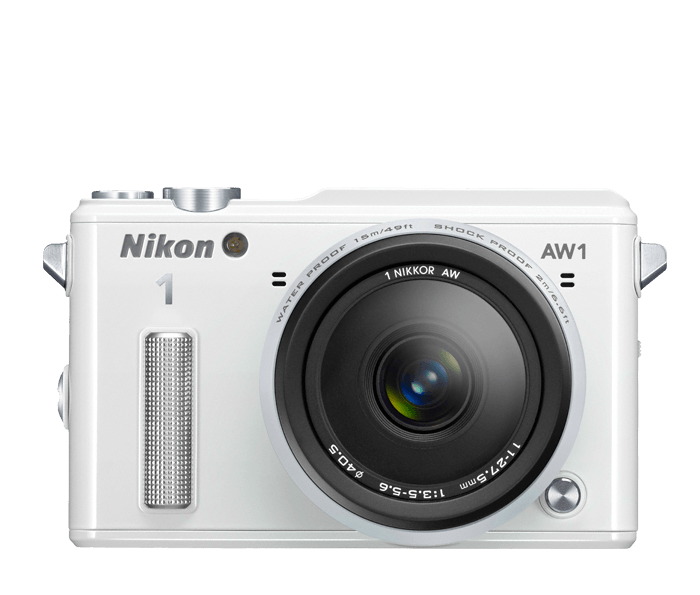
Nikon's New Underwater Interchangeable Lens Camera - the 1 AW1!

 
Image Source: nikonusa.com
 
Now here's something very interesting to me, from Nikon. A waterproof camera (good to 49') with interchangeable lenses and raw file capability, all in a small package.
 
I am a big fan of Nikon. I shoot Nikon SLRs (both film and digital), and love the Nikon lenses. However, I equate Nikon with the SLR configuration. My Nikon D700 is an extreme image quality machine, but it's an SLR - heavy, large, perhaps overloaded with features. When I want simple, I shoot Leica.
 
Until now, I have not paid much attention to Nikon's 1 series cameras. Nikon was a little late to the mirrorless camera game, and with a sensor size smaller than Micro 4/3, it just didn't motivate me to look into it. Of course, the format has been good for Nikon, and has gained a good level of adoption.
 
Now they've announced something really interesting - an underwater version. With two lenses currently certified to be waterproof along with the 1 AW1 body, this really could go somewhere. The current lenses are a 11-27mm f3.5-5.6 kit zoom, and a 10mm f2.8 prime. The zoom is probably not that great for underwater usage, but that 10mm (~27mm equivalent 35mm format field of view) could be spectacular. Fast f2.8 aperture and close focusing to ~9", this could be an excellent lens for the reefs.
 
(Click Here) to read about the new 1 AW1 and kits at nikonusa.com.
 
(Click Here) to read a first impressions post on dpreview.com.
 
I really like the idea of a flexible underwater camera system. I would prefer it to not take me into yet another camera system and format, however. If this were a Panasonic Micro 4/3 camera, I'd be getting out my credit card, even though it would not take advantage of my current lenses for underwater applications.
 
In any case, the Nikon 1 AW1 could start an interesting trend. If I were going to do a lot of diving, I'd seriously consider giving it a try. For now, I'll stick with my Lumix DMC-TS5 underwater compact camera.
 
DMC-365.blogspot.com


Tuesday, January 29, 2013

An Image That Sticks in My Mind

Sunset Approaching, by Reed A. George
Panasonic Lumix DMC-GF1, Lumix 20mm f1.7 Lens
iso 400, f4, 1/640 sec
 
For various reasons, I've had very little time to get out and shoot much in the past week or so. So, I'm going back through some old images, looking for the ones that make me think "Hey, I remember that one!" The shot above is an example.
 
I shot this one right before sunset on the boardwalk in Sacramento, California. To me, it says something about aging, the passage of time. I love the texture in the wood on the boardwalk, and the paddlewheel boat in the distance.
 
Perhaps I also remember this shot because I was in Sacramento that evening to meet with some good friends that I hadn't seen in a while at that point. I spent part of our dinner time explaining why I was so pleased with the GF1.
 
I still have my GF1, even though it's multiple generations old now. The form factor is so attractive. The image quality was quite good. I find that I don't use it much anymore, but with the price of used digital gear, I'd rather keep it as my in-car camera than sell it for a little over $100. The GF1 was a ground-breaking design, in my opinion. I'm waiting for the announcement of the GX2, which should bring me back to that form factor, yet with the very latest sensor technology.
 
Maybe I'm not done with Micro 4/3 yet.
 
DMC-365.blogspot.com


Tuesday, December 18, 2012

Interesting Photo Challenge - Simplify, Focus on Framing and Timing

Here's a challenge, presented on the facebook page of Next Cameras (http://www.facebook.com/NextCameras?ref=stream
 
"...Hmmm. So here's a simple technique to try: shoot like a Reuter's PJ next time you head out. Bring a wide angle zoom and start with it at the widest focal length. Set aperture priority with your fastest aperture. Change only one camera setting: ISO value to keep your shutter speed in a range you're comfortable that you'll get sharp images from (and if
you're really following the rules, set your Nikon body to one-stop increments for ISO ;~). Spend all your remaining energy on just three things: framing, focus, and timing. Note that "framing" may mean moving forward, backward, and sideways! You, not the zoom. (For those that think landscape photography can't be done this way, think again. It's actually very close to the way I learned from Galen Rowell and still practice, only we don't usually set maximum aperture, but rather something like f/8.

I'll make a small wager: you get better images by concentrating this way. PJs do, so why should you be any different? ;~)
Thanks to Thom Hogan for the idea."
I like this. It reminds me of the shooting I recently did with my new Holga lens on the Lumix DMC-G3.


Shot With Holga 25mm f8 Lens on Lumix DMC-G3
Sometimes it's just plain good to narrow the variables. I will try Thom's suggestion above.
 
DMC-365.blogspot.com


Tuesday, November 27, 2012

New Olympus 17mm f1.8 Lens for Micro 4/3

 
New Olympus 17mm f1.8 for Micro 4/3
Image Source: http://www.olympus.co.uk/site/en/c/cameras_accessories/pen_om_d_cameras_accessories/pen_om_d_lenses_adapters/m_zuiko_digital_17mm_1_1_8/index.html
 
Olympus has announced a new 17mm f1.8 lens for Micro 4/3 cameras. This is a welcome addition to the Micro 4/3 world, giving an equivalent field of view to the 35mm lens on a full frame 35mm camera. This is a classic focal length, and comes in second only to 50mm field of view as a "standard" lens.
 
(Click Here) to read about it on ePhotoZine.
 
The new lens features Olympus new "ZERO" low reflection lens coatings, and a quick focus mechanism. I have never tried this, but the description says that you slide the focus ring to get approximately in focus, then twist it (like a normal focus ring) to dial in with precision. To me, this sounds like replacing one motion with two, and doesn't sound fast. On the other hand, if your manual focus ring requires a lot of turns to cover the focus range, perhaps this approach is faster.
 
So what does this lens compete with? First in my mind is the Panasonic Lumix 20mm f1.7. The field of view is slightly different, but not that much. The Panasonic lens is a jewel - tiny, fast, sharp. Otherwise, there's the older Olympus 17mm f2.8 lens. I have never used one, but it sure doesn't get good reviews online. Now, take that with a grain of salt. I bet it's a quite useable lens, just not a premium model like the newly announced 17mm f1.8.
 
As with all Olympus lenses, there is no in-lens optical stabilization; Olympus builds that into their camera bodies. The Lumix lens doesn't have stabilization either, and in my opinion it's not needed at this focal length, as long as you have a fast aperture (like f1.7 or 1.8).
 
Based on the new Olympus 75mm f1.8 lens that I have recently purchased, I would predict that this premium lens from Olympus will be a real winner.
 
DMC-365.blogspot.com
 
 
DMC-365.blogspot.com
 

Monday, October 1, 2012

Well, It's No Surprise, But the New Zeiss Lenses for Mirrorless Are Not For Micro 4/3 - Yet?

 
Image Source: http://forum.getdpi.com/forum/sony/40472-awesome-zeiss-lenses-news.html
 
Carl Zeiss has introduced a new line of autofocus prime lenses for mirrorless camera systems. Unfortunately for Lumix users, formats don't include Micro 4/3, at least not at this point. I guess this is no surprise, given Zeiss' relationship with Sony. Of course the NEX mount is the main platform.
(Click Here) to read more details on the Zeiss site.
At this point, they've announced the following lenses: 12mm f2.8, 32mm f1.8, and 50mm f2.8 macro.
What is a little surprising to me is that they did include the Fujifilm XPro mount. Great news for Fuji and users!
These three lenses all have autofocus capability, with complete system compatibility. None of them offer image stabilization.
Zeiss reports that they will be around the 1,000 Euro mark in price, and should be available in spring/summer 2013.
In the article, Dr. Michael Pollman, Consumer Lenses Product and Program Manager, leaves the door open for future Micro 4/3 lenses. He states that Zeiss wanted to focus on the larger APS-C sensor market first. He also makes it clear that the focal length and size of lenses designed for APS-C would not be optimal for Micro 4/3. I can go along with that. The 12mm focal length is well-covered by an excellent Olympus product, and the macro is covered by the Pana-Leica Macro-Elmarit 45mm f2.8.
Well, Dr. Pollman, us Micro 4/3 users will keep our fingers crossed! We'd love to welcome Zeiss lenses to our cameras.
DMC-365.blogspot.com


Friday, September 21, 2012

Well, A Little Reporting Balance, Perhaps

If you read my blog regularly, you know that I am a big fan of the Micro 4/3 format. I chose the Lumix DMC-G3 as my Micro 4/3 camera, and regularly carry two bodies and primes lenses. I'm quite happy with the results.
 
Panasonic Lumix DMC-GX3
Image Source: shop.panasonic.com
 
 
Micro 4/3 is by design a compromise between sensor size and overall camera and lens weight and volume. Micro 4/3 is a great compromise in that way, in my opinion. While the sensor is ~1/4 the size of 35mm full frame (50% in each direction), the compactness of the system is just plain right. If it were smaller, it would be too hard to use with human hands, in my opinion. As it is, I certainly hit the wrong buttons on the G3 once in a while, but that's probably my fault. Again, in my opinion, if I were designing a system, I would likely do exactly what they did with Micro 4/3 - go slightly smaller in sensor size, in favor of a compact system overall. This is because we all know that sensor technology will continue to improve, so the down sides to a small sensor will decrease over time. The progress made in high iso performance since Micro 4/3 started a few years ago is amazing. And, it's getting better all the time. The only real limitations are physical - like the effect on depth of field imposed by the small sensor. That can't be fixed by sensor improvements.
 
That said, not everyone agrees with me on how good the format is. PhotoPat on mu-43.com posted that he had a terrible experience with the Lumix DMC-GX1. He's now sold it off.
 
(Click Here) to read PhotoPat's thread on mu-43.com
 
As you can imagine, and read in the comments in PhotoPat's thread, posting disappointment in Micro 4/3 on a Micro 4/3 forum invites some dissent. Nothing too bad, but interesting.
 
Sometimes I have to go back and compare images that I've gotten with full-frame cameras to what I'm getting with Micro 4/3, just to convince myself again that Micro 4/3 image quality is good. It is. I'm pleased with it for much of my photography.
 
Here's an example shot, which won me a contest and made it into the Civil War Trust's 2011 calendar (September page). This was shot with a first-generation Micro 4/3 camera, the DMC-G1.
 
Henry House at Manassas National Battlefield, by Reed A. George
Panasonic Lumix DMC-G3, Leica Elmar 3.5cm f3.5 Screwmount Lens
 
I would never prescribe Micro 4/3 only to anyone else. In fact, you'll see that I shoot plenty of other systems. But, if you use it carefully, the Micro 4/3 system is surely capable of producing some nice images.
 
DMC-365.blogspot.com


Friday, September 7, 2012

Carl Zeiss Announces Big Plans for Photokina

Image Source: http://blogs.zeiss.com/photo/en/?p=2745
 
Photokina, to be held in Cologne, Germany September 18-23, 2012, is one of the premier photographic trade shows in the world. Carl Zeiss has posted some information about exciting news that they plan to formally announce during the show.
 
(Click Here) to read the Carl Zeiss page.
 
First, they plan to exhibit a new manual focus 55mm f1.4 lens for SLRs. Zeiss already offers the awesome Planar 50mm f1.4 for SLR mounts, but this lens is reported to give optical results formerly only available from lenses designed for medium format cameras. And Zeiss sure knows how to design those. If you know medium format cameras, you know that the legendary Hasselblad image quality relies on Zeiss lenses.
 
Next, and here's a big one, Zeiss plans to unveil a series of autofocus (yes, autofocus) lenses for mirrorless cameras. With Zeiss' collaboration with Sony, I'm sure this will mean NEX mount. PLEASE, PLEASE, PLEASE make them for Micro 4/3 too! My heart says yes they will; my brain says no. It would make Sony angry. But, I'll keep my fingers crossed. How great would it be to have both Pana-Leica and Zeiss lenses for Micro 4/3? As I've reported in the past, Zeiss does make some very expensive cine lenses for the Micro 4/3 mount. Fingers crossed on both hands that they'll make the new line fit M4/3 as well.
 
Finally, they hint at an exciting new lens addition to the popular manual focus Zeiss lenses for the Leica M mount.
 
I am very excited to hear the details!
 
DMC-365.blogspot.com