Showing posts with label screwmount. Show all posts

Thursday, May 14, 2015

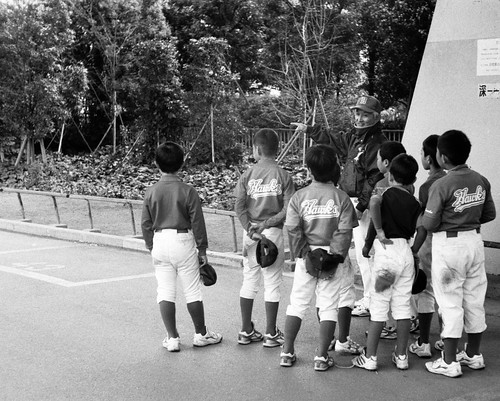
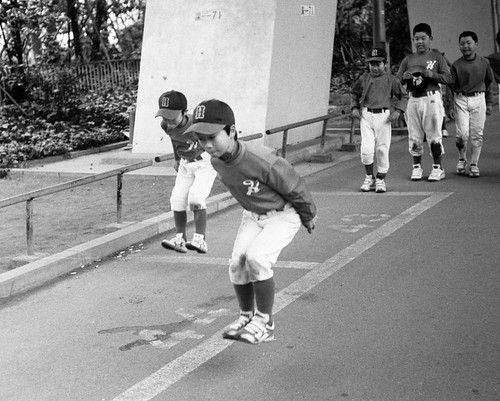
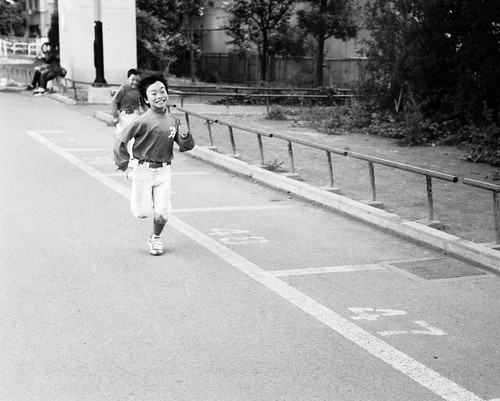
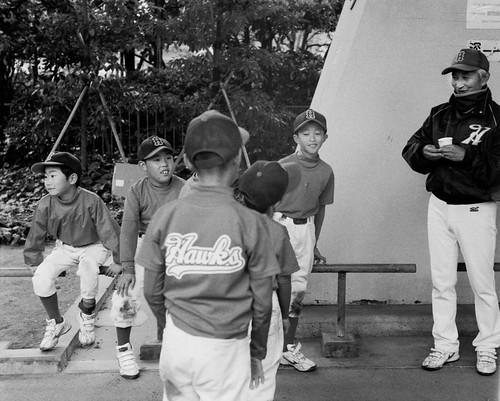
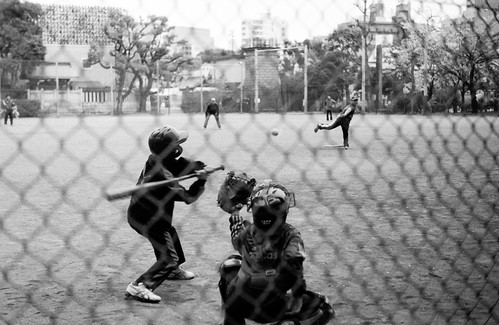
Baseball - Japanese Little League, Shot with Leica IIIG

Baseball is big sport in Japan, including Little League.
 
Little League Baseball, Japan, by Reed A. George
Leica IIIG, Elmarit 5cm f3.5 Collapsible Lens
Kodak TMax 400 Film
 
On one of my morning walks around Tokyo, I came across this team, running drills either before or after their games. I was impressed by the enthusiasm of the young players, and the attention their coach paid to them. All of the following shots were made with the Leica IIIG, this time with a Nikkor 50mm f2 LTM lens that I purchased at Map Camera in Tokyo. It's a beautiful little lens.
 
I very much appreciated capturing a little slice of the Hawks' fun together. Great fun with an old Leica rangefinder.
 
DMC-365.blogspot.com
 

Thursday, January 9, 2014

Three Approaches to Using a Barnack (Leica Screwmount) Camera - Tips by Khoa Tran on Steve Huff's Site

Yes, It Works as a People Camera!, by Reed A. George
Leica IIIC, 5cm Summitar f2 Lens
 
Well, for those of you following, I may be on a path to recovering most of my files lost in the Lightroom transfer. Until I'm done with that, I'm writing without access to most of my files. The one above is in my flickr account, so I could grab it for the purposes of this post. Fingers crossed, I hope to be back on my main image collection soon.
 
I recently bought a second wartime IIIC, which is currently on its way to see Mr. Youxin Ye, Leica service wizard, in Massachussetts. If you ever need your Barnack camera or lens serviced fast, well, and inexpensively, you should give Youxin a try. You can reach Youxin by email at: wye7@yahoo.com
 
I was reading posts about the IIIC and other Barnack cameras, when I came across a guest post on Steve Huff's site, by Khoa Tran.
 
(Click Here) to read the full post on Steve Huff's site.
 
In it, Khoa suggests three approaches to using a Barnack camera:
 
  1. As a point and shoot camera
  2. As a tool to develop your photographic skills
  3. As a portrait/people camera
By "point and shoot," I think he means to use a small aperture, hyperfocal or zone focusing, and preset exposure. When you do this, you can basically have in your mind as you walk down the street:
 
"Anything X ft or further away is in focus"
I do this all the time. All you have to do at this point is look for the right moment or composition, lift the camera to your eye, frame, and shoot. I totally agree with this being a great way to use one of these cameras.
 
As far as a tool to develop your skills, I think he's talking about the fact that these cameras have no meters. So, you can teach yourself to guesstimate exposure for different lighting situations. Again, I agree. Especially if you stick to a particular film speed (400 is my standard), you'll see that you can guess exposure settings much faster than you may have thought.
 
Finally, yes, the Leicas are great people cameras. I love to shoot photos of people, those I know (as above) and those I don't. The little Barnack Leica screwmount cameras are anything but threatening to people. Great for candid people photography.
 
DMC-365.blogspot.com


Tuesday, October 1, 2013

Whole Lotta Leica Results - Minolta 45mm f2.8 Rokkor LTM

I have been very busy this month, but did get out a couple of times so far with this month's WLL lens, the Rokkor 45mm f2.8 in LTM.
 
(Click Here) to read about the lens.
 
First off, I took the lens to a meetup with some fellow Leica fans. I'm learning a lot from these guys, who have an amazing knowledge of not only the equipment but of how to use it to great advantage. Anyway, while meeting in the coffee shop, I saw this lovely lady sitting in wonderful backlight and asked if I could take her picture, to which she agreed.
Backlit 1, by Reed A. George
Leica M9, Minolta Rokkor 45mm f2.8 LTM lens
iso320 f5.6, 1/250 sec.
Backlit 2, by Reed A. George
Leica M9, Minolta Rokkor 45mm f2.8 LTM lens
iso320 f5.6, 1/250 sec.
 
I may have benefitted from opening the lens wider in the shots above, as some of the lines in the background (especially those at the top of the lady's head) are distracting.
 
The Rokkor is quite sharp, especially closed down a little as above. One thing I mentioned in the description post is that the aperture setting on my copy is a little fidgety. First, the reference point moves with the focus ring, which will be true of all copies of this particular design. Secondly, and more important, there are no click stops. So, it's very easy to bump it, especially while focusing, and change the aperture setting. I don't know if this is specific to my copy, or if this lens was designed without click stops.
 
On the same day as the meetup, I took the Rokkor to National Harbor in DC, where I was meeting some friends for dinner. It's a lively place, with plenty of people to photograph on a weekend evening.
 
The Awakening Sculpture, by Reed A. George
Leica M9, Minolta Rokkor 45mm f2.8 LTM lens
iso320 f9.5, 1/1000 sec.
"The Awakening" is a focal point of National Harbor. I didn't feel that I found a great composition of the sculpture, but did enjoy the interplay of the people and the piece.
 
Mosaic, by Reed A. George
Leica M9, Minolta Rokkor 45mm f2.8 LTM lens
iso320 f8, 1/1000 sec.
Basking in the Weekend Sun, by Reed A. George
Leica M9, Minolta Rokkor 45mm f2.8 LTM lens
iso320 f9.5, 1/1000 sec.
Another observation about the Rokkor has to do with which framelines you want to bring up on the M9. Since the focal length is closest to the 50mm Leica standard, I chose an LTM-M adapter ring that brings up the 50mm framelines. I find that the angle is much wider, and therefore produces images that go well outside the 50mm framelines. In fact, I think it's close to matching the 35mm framelines. However, I'd rather include some extra elements that may be cropped out later than miss something that was inside the framelines. For this reason, I live with the extra space in the image outside of the 50mm lines, rather than guessing how far inside the 35mm lines it will actually capture.
 
I've found a similar situation with the 40mm Rokkor f2, which came with the Leica/Minolta CL. One of my favorite lenses, the 40mm used to live on my Leica M8 when I had it. I used the 35mm framelines for that lens, which matched the Rokkor 40's actually field of view quite well.
 
Overall I'd say the Rokkor 45mm f2.8 LTM is a decent lens. Mechanically, it's not up to Leica standards, at least at its current age. Optically, it does quite well. I'll probably not use it a lot on the M9 after this month, but it's a fun little piece to have on a screwmount film camera, for example. It's quirkiness only adds to the fun in that case.
 
DMC-365.blogspot.com


Tuesday, May 14, 2013

Whole Lotta Leica - May's Lens for the M9 is the Summaron 3.5cm f3.5 LTM

 
Leica Summaron 3.5cm f3.5 LTM, ca. 1949-1960
 
This month's pick for my Whole Lotta Leica (WLL) series, where I pair up a different "normal" focal length lens with the Leica M9 is the Summaron 3.5cm (35mm) Leica Thread Mount (LTM).
 
This is one of those sleeper lenses that gets underestimated because of its relative small maximum aperture of f3.5. However, it's capable of great things.
 
I got mine along with an old LTM camera kit I bought on eBay. This was the diamond in the rough in that bag. It is in great shape, and looked pretty much unused, except for some haze on the internal elements. A quick trip to DAG fixed that, and now it's really a great little lens.
 
And by little, I mean little. I compare it to the Nikkor 3.5cm f2.5 that was my WLL pick for February. While my Nikkor is also in beautiful shape and faster, the Summaron outperforms the Nikkor in image quality.
 
(Click Here) to go to my WLL page and see all of the lenses I've used in the series so far, along with results.
 
Here's one of my favorite shots from the Summaron, made with a Leica CL film camera.
Harpers Ferry Train Station, by Reed A. George
Leica CL, Leica Summaron 3.5cm f3.5 Lens
 
This image has won contests and even sold prints.
 
This lens has a great way of handling color, quite warm and subtle. Below is an image I shot in an afternoon project on a business trip to Concord, Mass. It was Halloween, and I shot pictures of the pumpkins around town with my CL and the Summaron 3.5cm.
 
Pumpkins of Concord, by Reed A. George
Leica CL, Leica Summaron 3.5cm f3.5 Lens
 
(Click Here) to see the whole Pumpkins of Concord series.
 
But, this month, we'll see how the Summaron performs with digital sensor technology, on the M9. I'm pretty sure it's going to do great.
 
DMC-365.blogspot.com


Tuesday, November 13, 2012

A Defunct Rangefinder Blog Gains New Life - Nick DeMarco's Rangefinder Chronicles

And here's what brought it back - a "mint" Leica IIIF Red Dial and 5.0cm f3.5 Elmar.
Nick DeMarco's New IIIF
 
Nick DeMarco's blog, the Rangefinder Chronicles, has been inactive since January of this year. Recently, it got some new life breathed into it. Apparently, Nick found an essentially-new condition Leica IIIF from 1955, complete with original lens and case. So far, he's posted three different pieces about using it, including some sample images.
 
(Click Here) to read the Rangefinder Chronicles.
 
In one of his posts, Nick writes about how he set his own expectations too high when he started the blog. Believe me, I know exactly how hard it is to keep up a blog with daily entries. In fact, I find myself questioning if I'll keep it up, or in what fashion, once I've met my goal of trying daily blogging for a year. I just entered month eleven of twelve.
 
In many ways, I find blogging refreshing and informative. However, it sure takes dedication and time. Time is what I have the least of these days. But, I do believe for a blog to be useful at all, it needs frequent, regular entries. One per day is not a lot by active blog standards.
 
Anyway, I'm glad to see the Rangefinder Chronicles coming back to life. I'll be sure to follow it.
 
DMC-365.blogspot.com