Friday, December 6, 2013

The Point Reyes, Shot with Leica M6 and Summicron 50mm f2 v.3

 
The Point Reyes, by Reed A. George
Leica M6 Titanium, Summicron 50mm f2 v.3 Lens
Kodak iso 400 Color Print Film, Converted to Monochrome in Lightroom
 
While in California a while back, I took the opportunity to meet up with two fellow LHSA (International Leica Society) members, Gary Hough and Andy Godlewski, in Marin County to explore one of my very favorite places, Point Reyes.
 
This old boat has been beached here as long as I've been coming to Point Reyes, well over ten years for sure. I found Point Reyes when I lived in the Bay Area from 1997 to 2005. I sure miss the place.
 
We spent the day hiking, catching up, and shooting pictures together. I have a few other images that may be worth presenting, but mostly it was a good time to get out with friends.
 
I think the black and white conversion of color print negatives in Lightroom works extremely well. I do still shoot a lot of Kodak Tmax 400 black and white film, but I'm not sure I can explain the logic, given these results.
 
I really enjoyed shooting the M6 film camera alongside my digital M9.
 
DMC-365.blogspot.com


Mimo Khair - Artistic Fall Photos, Shanghai

Fall Games - Shanghai, by Mimo Khair
Image Source: http://mimokhairphotography.com/2013/11/25/the-inevitable-change/
 
Mimo Khair's is one of the blogs I try to keep an eye on. She has posted a beautifully creative set of autumn pictures, from Shanghai.
 
(Click Here) to see the complete set of photos and some words on Mimo's blog.
 
In this case, Mimo has combined several aspects of fall, and of her chosen city, to say something about the season. Very nicely done.
 
Mimo ran her blog as a 365 project for one year, the second year was a photo per day as well, but from her archives (rather than shooting one every day). 2013 was her third year, and she dropped the strict 365 (a photo per day) requirement. While I think about where I want DMC-365 to go next year (my third year), this has me thinking. On one hand, I think the consistency of a post each and every day is good for me, and perhaps for my readers. On the other hand, I'm not sure it's stimulating creativity on my part the way I intended. No decisions yet, just thinking.
 
DMC-365.blogspot.com


Thursday, December 5, 2013

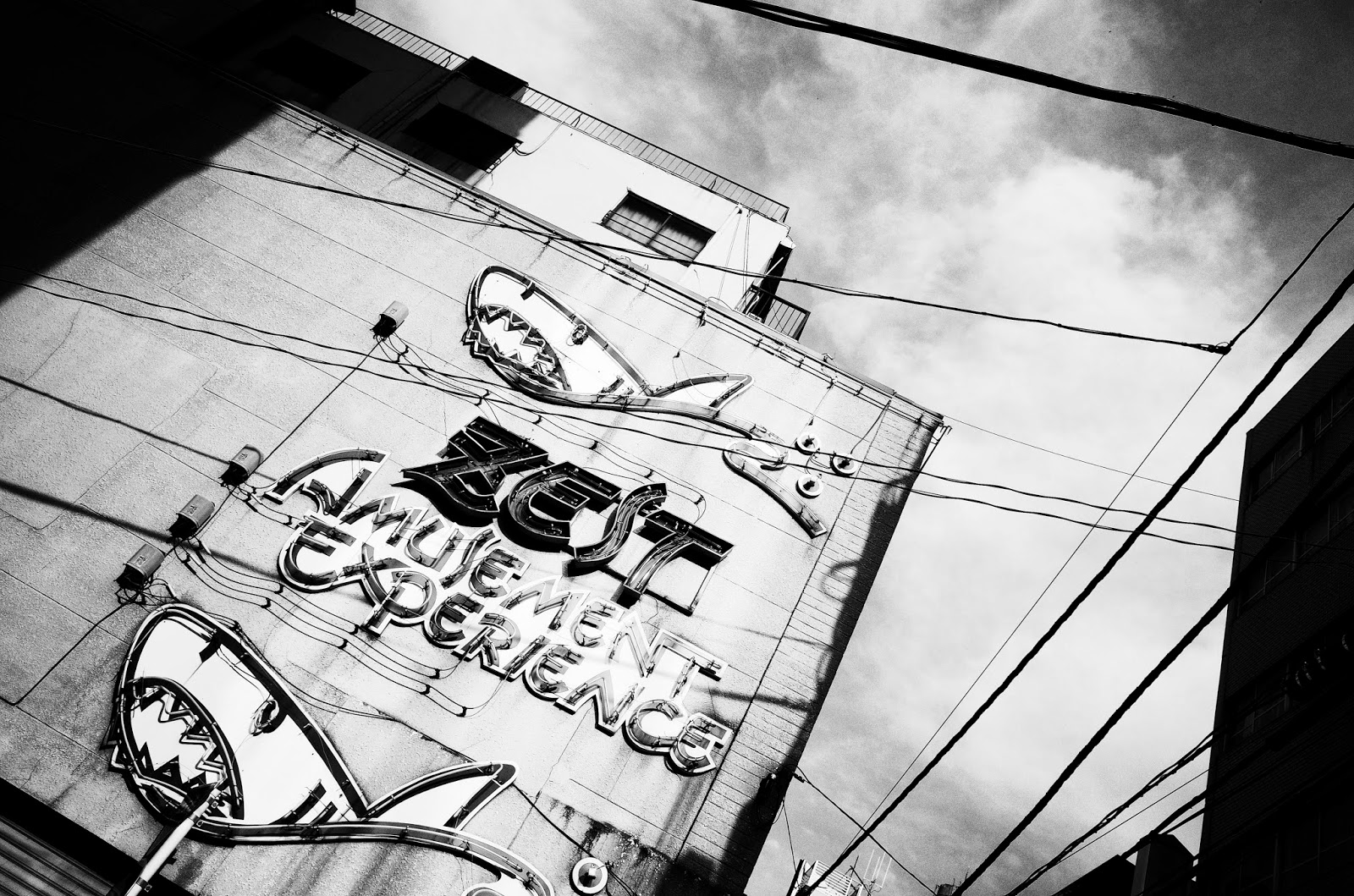
Ricoh GR, Tokyo, "Daido Mode" by Colin Steel on Steve Huff's Site

This is the beauty of modern internet technology and photography blogs. This morning I got to read about a camera I've never handled, used in a place I know well but only see once a year, view photographs that a guy I've never met took and shared on another guy I don't know (but feel like I do)'s blog.
What I mean is that I got to see the awesome images that Colin Steel made in Tokyo with the Ricoh GR, and shared on Steve Huff's site.
Image Source: http://www.stevehuffphoto.com/wp-content/uploads/2013/11/colin4.jpg

In his guest post on Steve Huff's site, Colin Steel shares a series of images he made on a quick three day trip to Tokyo. Apparently at least one day was made up of 24 hours straight wandering the streets of Tokyo, shooting with the Ricoh's high contrast monochrome setting, referred to as "Daido mode," after Daido Moriyama, famous Tokyo photographer who also happened to shoot with Ricoh cameras.

(Click Here) to read Colin's post on Steve Huff's site.

Colin writes about how he and most serious photographers usually ignore the in-camera creative presets. I used to feel the same way until one very important thing happened in the cameras I have that include presets: they started enabling most of the presets to be used in raw+jpeg shooting mode! This means that I can get a jpeg with all of the preset effects, view it on the camera display in the preset way, but have a completely unembellished raw file stored on my card to post-process in any way I see fit later on. I can see a high contrast black and white rendition while I'm shooting, then come home and use the raw file to make a low contrast color print, if I decide to. Flexibility is a great thing.

I won't go into the details of the Ricoh camera, as I honestly have not looked at them. So many cameras, so little time, you know. My two points today are: 1) it's great to be able to see wonderful photography from around the world and people I don't know through the internet, and 2) don't ignore anything on your camera. It may come to creative use if you learn how to use it, and learn about things like having the unaltered raw files available, should you change your mind later.

DMC-365.blogspot.com


Wednesday, December 4, 2013

Different Takes on Autumn Leaves

As I wrote earlier in the season, I've tried to avoid taking the same autumn leaf pictures that I (and many other) photographers take each and every year. For example, I used the kit zoom on my new Panasonic Lumix DMC-GX7 to add some motion blur to shots that would otherwise have been quite static. I made threes separate posts about that:
 
(Click Here) to see my first post on leaves in motion.
 
(Click Here) to see where I developed the concept a little further, with a set that make me feel like I'm being pulled through the treetops up into the clouds.
 
And finally, (Click Here) to see my favorite of the series, where I attempted to get the best combination of detail in the leaves, blur from camera motion, and color.
 
Well, today's images take a less drastic departure from "normal" fall color photography, but I hope still show something a little unique. As in all three posts above, I shot these with the DMC-GX7 and the much-improved 14-42mm Series II kit lens.
 
On my way to have lunch with my lovely wife, I looked to the side of the road and saw this tree. The most important element that drew me to photograph it was not the tree, however, it was the way the leaves on the ground appeared. Because the ground slopes upward behind the tree, the fallen leaves provided a partial background for the image.
 
 
Ground As Background, by Reed A. George
Panasonic Lumix DMC-GX7, Lumix Aspheric 14-42mm f3.5-5.6 Series II Lens at 14mm
iso 200, f8, 1/125 sec.
 
I like the shot above, but it's quite conventional, other than the ground sloping up. Looking for a different perspective, I used the rotatable finder on the GX7 to get down low. I took several shots that way, but nothing that really looked different to me. Finally, I started playing with selective focus from the low angle. Here's an example of what I came up with:
 
Drawn to the Front, by Reed A. George
Panasonic Lumix DMC-GX7, Lumix Aspheric 14-42mm f3.5-5.6 Series II Lens at 24mm
iso 200, f8, 1/125 sec.
 
This shot has only a narrow band of leaves at the very bottom of the image in focus. Personally, I like how it sort of asks a question of the viewer. At first glance, it just looks like a blurry picture of a tree, and at that point, some may stop looking. Looking closer however shows that the leaves at the bottom are perfectly sharp. This draws the attention to the leaves on the ground, which were the element that drew me to the scene in the first place. The tree itself takes on only secondary importance. One could argue about which image is more "pretty," if either fit that bill; I can say that the second shot better communicates how I felt about the scene.
 
DMC-365.blogspot.com


Tuesday, December 3, 2013

Rumor Only - Mini System Camera Based on Leica X-Vario?

Image Source: http://www.the.me/the-leica-mini-m-wont-be-full-frame-itll-be-an-x-vario-system-camera/
 
The Photography Daily THEME has posted that an anticipated compact, more reasonably priced Leica system camera (as compared to the M cameras) will be based on the APS-C sensor X-Vario design.
 
(Click Here) to read the post on THEME.
 
This could make some sense, as the X-Vario was touted (I think quite incorrectly) as the "Mini-M" when first announced. The X-Vario seems to be a fine camera, but an M it is not.
 
THEME also reports that the new system will retain the APS-C sensor size, rather than going to Micro 4/3. That's kind of a shame, as I'd love to see Leica move into Micro 4/3. On the other hand, they're already there through their collaboration with Panasonic, and the Leica-branded Micro 4/3 Panasonic lenses are wonderful. I have the 45mm f2.8 Macro-Elmarit and the 25mm f1.4 Summilux; both are just plain excellent.
 
THEME also mentions that while the new system body is likely to be built in Germany in Leica's new plant, lenses may be sourced from Japan through the same collaboration with Panasonic.
 
More power to both companies! From my perspective, anything that keeps them working together to bring great new alternatives to photographers is a positive thing!
 
DMC-365.blogspot.com


Monday, December 2, 2013

Chinatown San Francisco - Leica M9 and Summicron 50mm f2 v.3 - Whole Lotta Leica

In October, I traveled to San Francisco for the annual meeting of the LHSA (International Leica Society). One of our events was an evening photo tour of Chinatown. All of these shots were made with my Leica M9 and my Whole Lotta Leica lens for October, the venerable Summicron 50mm f2 (version 3).
 
Pre-Tour Briefing, by Reed A. George
Leica M9, Leica Summicron 50mm f2 v.3 Lens
iso 400, f2.8, 1/125 sec.
 
There was enough interest that we split the group into two, and headed out on the short walk from the Marines Memorial, host hotel for our meeting.
 
I have an affinity for Asian culture. You'll see that when I visit a major city, I usually end up in Chinatown. Stayed tuned for a future post of NYC's Chinatown, for example.
 
One of the things I always enjoy is seeing signs written in the native language of the immigrants who live there. To me it means I'm really visiting where these people from a very different culture actually live, not just cook for and sell to Westerners.
 
Native Language, by Reed A. George
Leica M9, Leica Summicron 50mm f2 v.3 Lens
iso 400, f2.8, 1/60 sec.

Straightening the Sign, by Reed A. George
Leica M9, Leica Summicron 50mm f2 v.3 Lens
iso 400, f4.8, 1/350 sec.


Of course, there are plenty of signs and advertisements aimed at welcoming non-Chinese guests to the area:
 
Chinatown Mural, by Reed A. George
Leica M9, Leica Summicron 50mm f2 v.3 Lens
iso 400, f3.4, 1/125 sec.


If you've read my post about tea-tasting at Ten Ren's in Chinatown, here's the back of the tea shop, replete with graffiti:
 
Ten Ren's by Reed A. George
Leica M9, Leica Summicron 50mm f2 v.3 Lens
iso 400, f2.8, 1/125 sec.
 
Far more interesting to me than the signs, however, are the people. Here's a sampling of how I see the people of Chinatown, part of and separate from their city environment.
 
Through the Shop Window, by Reed A. George
Leica M9, Leica Summicron 50mm f2 v.3 Lens
iso 400, f2.8, 1/125 sec.

 
Twins, by Reed A. George
Leica M9, Leica Summicron 50mm f2 v.3 Lens
iso 400, f3.4, 1/125 sec.

 
Fishmonger, by Reed A. George
Leica M9, Leica Summicron 50mm f2 v.3 Lens
iso 640, f2.4, 1/125 sec.
 
Our tour went into the dusk. As the lights come on in Chinatown, the feeling completely changes. I need to work on a night time series in Chinatown at some point, maybe my next visit to San Francisco. I hope that trip comes soon.
 
Chinatown Lights Up, by Reed A. George
Leica M9, Leica Summicron 50mm f2 v.3 Lens
iso 640, f2, 1/125 sec.
As you can see, I decided to shoot with one lens and one camera on this tour, to minimize the need to fiddle with gear. That worked out pretty well for me. There is so much you can do with a rangefinder like the M9 and a fast 50mm lens like the Summicron. The lens is unmatched in my collection.
 
DMC-365.blogspot.com


Sunday, December 1, 2013

What is it About These Old Nikon Film Cameras?

 
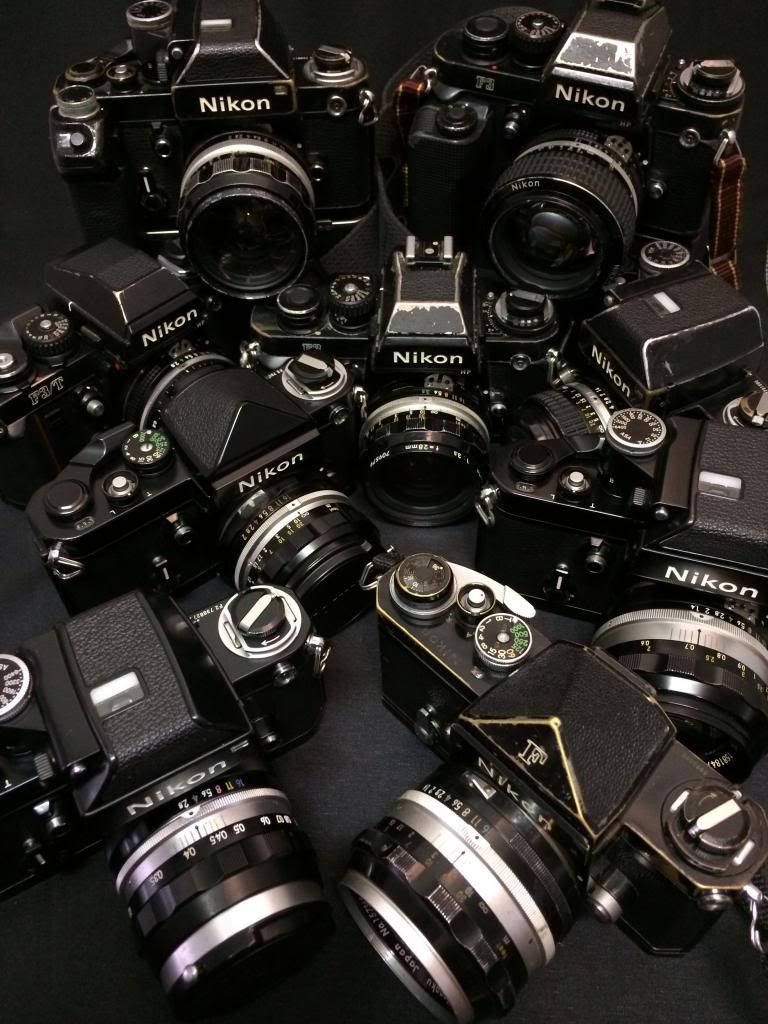
Nikon Addiction, by Frontman on Range Finder Forum
Image Source: http://www.rangefinderforum.com/forums/showthread.php?t=138221
 
Poster "Frontman" on Range Finder Forum has posted about his addiction to old Nikon film cameras. Just reading the responses shows he's not alone in his malady. And neither am I.
 
(Click Here) to read the post on RFF.
 
I have such a strong attraction to old Nikon gear. This post hit me at the opportune moment. Having recently read about the new Nikon Df (Click Here to read about the Df), which can use the very oldest of F mount lenses (pre-AI) to the very latest, I've been wondering how many people like me still have the old pre-AI lenses. I have almost what I consider a full set (still on the lookout for the right 35mm lens), and continue to add once in a while. In fact, I recently bought an absolutely gorgeous Nikkor pre-AI 200mm f4 lens for $75, at a big name camera store. Just too much beautiful glass and metal to walk past.
 
I have not preordered a Df. That doesn't mean I'm not interested. I'm simply not sure that the intersection of what I love about an old Nikon FM2, say, and the awesome D700, is really what I want. It may be mixing the two worlds too much. I've experienced this with my current main camera (if you can call it that, amongst all the others I shoot), the Leica M9. The M9 is a spectacular camera. However, I'm not sure that the overlap between what I love about Leica rangefinders and what's great about digital capture is the perfect marriage for me. I recently proved to myself that I enjoy shooting a film M just as much as the M9. If I were using it for selling images, or events that I had to capture well, then digital would be a requirement. As it is, I use the M9 as I use my film Leicas - out and about with the hope of getting an outstanding image, not a list of images that I must make. I'm thinking the Df may be a similar situation for me.
 
So, in the meantime, I'm hoping to receive today my latest Nikon - an EX condition F2 that I purchased from KEH. Really, $129 for such a machine is just not debatable. For more fun, I also bought what is reputed to be the worst Nikon lens ever, the 43-86mm f3.5 zoom (pre-AI). $29 in EX condition. How can I pass up the chance to try the low end of the price and performance spectrum? I'm sure it won't become my go-to lens. I'm also sure I'll have some fun with it.
 
One possible reason for my attraction to this equipment is simply that as a kid, Nikon was the unreachable golden ring for me. Shooting Pentax SLRs (which, yes, I still love and use), I was in awe of the equipment that pros of the day used. I remember doing a work-study day with our local newspaper's photographers, who both shot F2s. I thought "one day." Well, that day's here, and it only cost me 35 years and now $129.
 
As evidence that I do still have a modicum of restraint, I have so far avoided going into the Nikon rangefinder world. Even though I know they're excellent cameras, and have seen some amazing deals. Mixing what I see as the SLR world (mastered by Nikon, in my opinion) and rangefinders (Leica territory, again in my opinion) may just not be necessary.
 
So, get ready for some Nikon film images in the coming weeks and months here on DMC-365!
 
DMC-365.blogspot.com