Showing posts with label 14-42mm Aspheric f35-56 Series II. Show all posts

Saturday, November 22, 2014

Lumix DMC-GX7 for Live Music

I've been focused on other cameras lately. So many great cameras out there, so little time to shoot them.
 
I read an interesting piece on Steve Huff's blog about using the Lumix GX7 for live music.
(Click Here) to read it, and see some nice GX7 images from bars in Amsterdam.
 
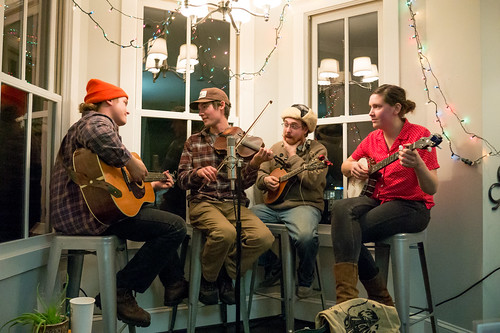
Here are a couple of shots of my friends Jake and the Burtones, shot with my GX7.
 
Jake and the Burtones, Plus Melissa, by Reed A. George
Panasonic Lumix DMC-GX7, Bower 7.5mm Fisheye Lens
iso 3200, f4 (or so), 1/50 sec.
 
 
Burtones, by Reed A. George
Panasonic Lumix DMC-GX7, Lumix 14-42mm f3.5-5.6 Aspheric Series II Zoom
iso 6400, f3.5, 1/100 sec.
 
The GX7 does pretty well in low light, even at iso6400. Not like a full frame Nikon, of course, but respectable. And so much easier to lug around.
 
DMC-365.blogspot.com


Monday, November 3, 2014

Reductionism in Photography, as Covered by Theme

Reduction, by Reed A. George
Panasonic Lumix DMC-GX7, 14-42mm f3.5-5.6 Series II Kit Lens
iso 200, f9, 1/60 sec.
 
I read an interesting post on the blog Theme, about reductionism in photography. It considers the act of boiling down everything that we see, hear, and think to a simple concept. In photography, that translates to reducing composition to the absolute minimum.
 
(Click Here) to read the post about reductionism on the Theme blog.
 
Personally, I'm not sure where the intersection is between reductionism and simplicity. Many photographic texts and teachers stress simplicity in photographic composition. I don't really work that way. I have been told that some of my images have too much clutter, are not simple to understand. In general, I don't mind this, if the image still transmits a message. I don't want my images to be so simple as to be obvious or shallow.
 
The picture above is a rare example of simplicity (or is it reductionism?) for me. I took this one in Provincetown, Massachussetts when I was there for a workshop. To me, it represents a special quality to the light that I experienced there. It also reminds me of the simple yet completely satisfactory room that I stayed in while I was there. Of course, no other viewer will have the benefit of that experience.
 
It was the light that caught my eye, not the subject. I love how the light coming through the holes in the strainer is golden; I didn't set that up in any way. It's just the way it was.
 
Anyway, I'm sure that I can benefit from considering reductionism in my photographic work. I will do that, without losing some of the complexity that I feel when I make a picture. There's something to learn from each and every person's approach to photography and art.
 
But, I still don't really know if reductionism and simplicity are the same concept.
 
DMC-365.blogspot.com
 

Thursday, August 28, 2014

Lone Cypress, Pacific Grove, California

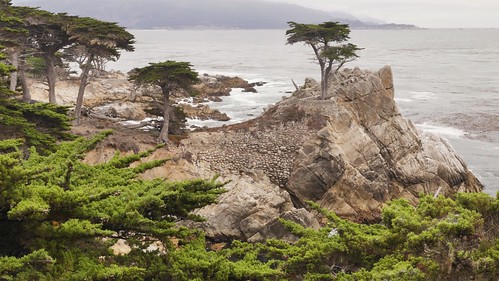
Here's a shot I made this afternoon of the Lone Cypress on the 17 Mile Drive in Pacific Grove (near Monterey) California.
 
Lone Cypress, by Reed A. George
Panasonic Lumix DMC-GX7, Lumix 14-42mm f3.5-5.6 Aspheric Series II Kit Zoom
at 23mm, with 3 stop ND + Polarizing Filter
iso 200, f22, 0.5 sec.
Edited in Snapseed on my iPad
 
This same spot is photographed hundreds or thousands of times every day. I tried to think hard about composition. I used the ND and polarizing filter to allow me to shoot a long exposure (1/2 second), in an attempt to make the water motion smooth and ethereal. It worked at a certain level.
 
What a gorgeous place this is.
 
DMC-365.blogspot.com
 

Tuesday, August 26, 2014

Another Berkeley Favorite - Used Book Stores

Actually, this bookstore (Pegasus) is at Rockridge in Oakland, just across the border from Berkeley. I find used bookstores to be a sign of true culture. Of course, that' just my opinion.
 
View from Pegasus, by Reed A. George
Panasonic Lumix DMC-GX7, 14-42mm f3.5-5.6 Series II Kit Zoom
iso 800, f5, 1/320 sec.
Unedited image straight from the camera
 
The light on this foggy morning was very subtle. It was the soft shadows around the bench the first caught my eye. Then the line of the bookshelves provided a nice lines, intersecting with the window ledge to focus attention near where the people outside were walking by.
 
Not an important shot, but a fun one none and an exercise in composition none the less.
 
DMC-365.blogspot.com


Sunday, August 24, 2014

Newport, California - Upper Newport Bay Nature Preserve

We arrived last night in Newport Beach, California, where we're attending the wedding of a close family friend.
 
I awoke early, being on East Coast time, and decided to find a nice place to take a sunrise walk. Pulling up Google Maps, I immediately found the Upper Newport Bay Nature Preserve, just a couple of miles from our hotel. While the web said it didn't open until 10:00 AM, I took a chance, and was rewarded with an open, yet empty parking lot. Here are a few scenes from the morning walk, all shot with the Panasonic Lumix DMC-GX7 and Series II 14-42mm kit zoom.
 
 
DMC-365.blogspot.com


Tuesday, July 22, 2014

Caught in the Maze

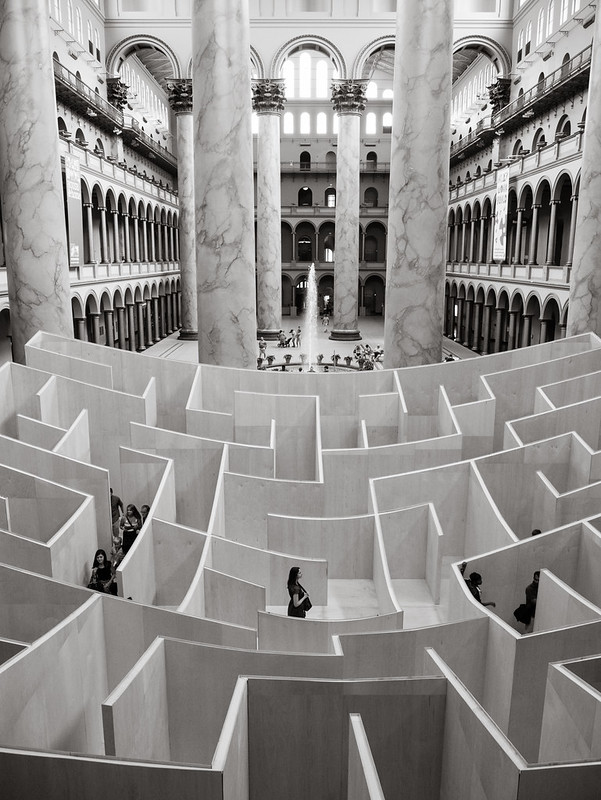
The National Building Museum in Washington, DC is currently hosting an exhibit called the BIG Maze.
 
(Click Here) to read about the museum and the maze.
 
The BIG Maze, by Reed A. George
Panasonic Lumix DMC-GX7, 14-42mm f3.5-5.6 Series 2 Kit Lens
iso 800, f5.5, 1/80 sec.
 
I like the context of the enormous museum interior to help show where the maze is in the larger space. I also like the single person in the very middle of the maze in this picture. She adds a lonesome element. People tended to gather in the center of the maze; I'm not sure why.
 
If you decide to attend this exhibit, be sure to get your maze entry tickets early. We came late and were not able to get it. But, that gave me the opportunity to photograph it from above as we watched others go through.
 
DMC-365.blogspot.com


Sunday, July 20, 2014

Belizean Palm

 
Belizean Palm, by Reed A. George
Panasonic Lumix DMC-G1, Lumix 14-42mm f3.5-5.6 Series II Kit Zoom
iso 800, f11, 1/125 sec.
 
Getting up at sunrise on the final day of our vacation in Belize, I was rewarded with this image. It could only be taken at dawn or dusk, as the contrast would have been excessive at any other time.
 
The Series II 14-42mm kit zoom is really quite impressive. Paired with the diminuitive GX1, they can really deliver in good light such as this.
 
DMC-365.blogspot.com

Wednesday, April 9, 2014

Afternoon Break, New Mexican Style

This very nice lady allowed me to photograh her on her break from working at the shop next door. Her only concern was "I don't have to look up, do I?"
Afternoon Break, by Reed A. George
Panasonic Lumix DMC-GX7, 14-42mm f3.5-5.6 Series II Kit Lens at 34mm
iso 400, f9, 1/800 sec.
 
I simply had to ask if I could shoot her picture. I found the patterns in the tile steps leading up to where she was sitting irresistable.
 
Once again, I'm finding the new Series II kit lens from Panasonic to be very, very good.
 
DMC-365.blogspot.com


Tuesday, April 8, 2014

I Love Meeting Interesting People When I Travel

This is Doc. I met him on my recent trip to New Mexico.
 
Doc, by Reed A. George
Panasonic Lumix DMC-GX7, Lumix 14-42mm f3.5-5.6 Series II Lens at 33mm
iso 200, f5.4, 1/200 sec.
 
Doc had just gotten out of the hospital and ventured into town looking for work. He loves living in New Mexico, and it shows.
 
Doc's Hands, by Reed A. George
Panasonic Lumix DMC-GX7, Lumix 14-42mm f3.5-5.6 Series II Lens at 29mm
iso 200, f5.4, 1/320 sec.
 
As you can see, I was using my Lumix DMC-GX7 on this trip. With the Series II kit zoom mounted, I think of it as a reasonable stand-in for the Leica X-Vario. I find the lens specifications to be extremely similar. While the GX7 has the disadvantage of a smaller sensor, it has the major advantage of interchangeable lenses, making it a much more flexible system camera. I'm quite impressed with the performance of the Series II kit lens.
 
One of my goals on this trip was to bond with the GX7, which I've had for a while now, and used very little. Did I meet that goal? Well, to some extent, yes. I now better respect the imaging capability of the GX7, which is really quite tremendous. I also reminded myself just how compact and light the Micro 4/3 kits can be. I carried two bodies (GX7, GX1), several lenses: a Bower fisheye 7.5mm f3.5, Lumix 20mm f1.7, Lumix 14mm f2.5, Olympus 75mm f1.8, 14-42mm Series II kit lens, a Pentax 55mm f1.8 lens and adapter (just for fun), and a small flash, all in a single messenger bag. It was light and easy to carry.
 
That said, the form factor of the GX7 is just not ideal for me. Can I live with it? Yes, but I do inadvertently hit buttons sometimes. I find the GX1 fits my hand better. Maybe one of the SLR-shaped Lumix cameras, perhaps the DMC-G6, would suit me better. But, the performance in such a small package in the GX series cameras is truly impressive to me.
 
More results to come from the GX7 and GX1 on this trip.
 
DMC-365.blogspot.com
 

Saturday, March 15, 2014

Getting More Acquainted With the Lumix DMC-GX7

I took my Panasonic Lumix DMC-GX7 out for a hike last weekend. It was the first nice weather we've had in quite some time, and I simply had to get out. Hoping to photograph some birds or other wildlife, I packed up my GX7, 100-300mm f4-5.6 OIS zoom, and the new Series II kit zoom (14-42mm f3.5-5.6) and headed for a Virginia State Park known as Sky Meadows.
 
The birds have not yet come back to this part of the world. So, after sitting in the woods for a while (not an altogether bad experience), I walked around some of the old farm buildings at the park. Here's an image I saw and was able to capture in side one of the barns:
 
In the Shadows, by Reed A. George
Panasonic Lumix DMC-GX7, Series II 14-42mm f3.5-5.6 Kit Zoom
iso 200, f8, 1/40 sec.
 
I am quite pleased with the dynamic range of the sensor, and the sharpness of the image overall. There are still a few setup options I need to explore with this camera, but nothing too difficult. The GX7 has several programmable function buttons, and I need to find the optimum setup for them.
 
So far, so good!
 
DMC-365.blogspot.com


Saturday, February 22, 2014

Surviving Buildings at Manassas National Battlefield - A Mini-Project in Micro 4/3

It's mid-winter doldrums here in Northern Virginia, and I decided not to give in to the bad weather today.
 
The heavy snow has passed, but flurries continued today, adding a nice light coat to the base laid down over the past few days. So, I set out to photograph the few remaining buildings that I thought were survivors from Civil War times at nearby Manassas National Battlefield. I had five buildings on my list.
 
It turns out that only three of the five are original buildings. However, the other two retain some interest, so I'll share them as well.
 
Let's start with Henry House. By the way, the picture I took of the Henry House on the 150th anniversary of the First Battle of Manassas won Second Place in a Civil War Trust / History Channel / Google competition, in the division dedicated to celebrating the 150th anniversary of battles in 1861. The image was displayed on the civilwar.org webpage of winning images, and was published in the journal "Hallowed Ground," and featured in the trust's 2012 calendar.
 
Henry House, by Reed A. George
Panasonic Lumix DMC-G1, 3 Shot HDR
 
The rest of the images in this post were shot today in the snow with my DMC-GX7 and the new Lumix Series II 14-42mm f3.5-5.6 zoom lens.


Henry House, by Reed A. George
 
 
The Henry House figured prominently in the First Battle of Manassas (or "First Bull Run"). Poor old Mrs. Henry was too sick to leave her home when the battle moved from Mathews Hill to Henry Hill, where she lived. She was killed by stray fire from the battle, becoming the first civilian to die in the Civil War. She's buried in the front yard of Henry House.
 
Next up is the Brawner Farm, which was the site of the first real action of Second Manassas (1862), barely a year after First Manassas (1861). The Brawner Farm was restored in 2007. I think it's poorly-done, looking like a tract house out in the middle of the historic battlefield with its air conditioning unit being the first thing you see from the trail, and get this, what appears to be vinyl siding! What a shame.
 
In the second shot, you can see the winter fields reflected in the window glass.
Brawner Farm, by Reed A. George
 
 
Third on my list was the Dogan House. Lucinda Dogan, a widow and mother of eight children, lived in this house during both battles. Mrs. Dogan lived to be 93 years old, and is buried in nearby Groveton Confederate Cemetery.
 
The Dogan House is quite difficult to photograph, surrounded as it is by modern roads, telephone wires (bane of the outdoor photographer's existence), and houses.
 
I can just imagine old Mrs. Dogan's hands reaching to put the key in that keyhole.
 
 
Dogan House, by Reed A. George
 
 
Next up, the Stone House. This building is probably the most well-known on the battlefield, and was in the hot zone of both battles, but especially First Manassas. Serving as a field hospital to both union and confederate troops, the building took a lot of fire during the battle.
 
 
Stone House, by Reed A. George
 
 
And finally, a pretty well-kept secret of the National Battlefield, Thornberry House. Located at Sudley Springs Ford, the site where Union General Irvin McDowell took more than a third of his 35,000 troops across Bull Run Creek in the first battle to attack the Confederate left flank, after failiing at their right. They marched right by the Thornberry house. Late that afternoon, after suffering a crushing defeat on Henry Hill and further, some of those troops retreated by this same route, while others made a crazed, confused dash straight back toward Washington, DC. As with many houses near the battlefield, the Thornberry house also served as a field hospital.
 
Sudley Springs was also active in Second Manassas, as Stonewall Jackson's stronghold in the unfinished railroad grade had its eastern end within easy sight of the Thornberry House.
 
Thornberry House, by Reed A. George
 
So, which three of these five buildings are true survivors from the actual days of the battle? The Dogan House, Stone House, and Thornberry House. I was surprised to learn that the Henry House had been entirely rebuilt in about 1870. I was not so surprised to find that the Brawner House was not the original, although it was of correct era construction before the renovation. Apparently an old house was moved onto the site sometime after the Civil War, and after the original farmhouse was gone.
 
So, I did spend the whole day with my Lumix DMC-GX7. I only changed lenses a couple of times, to shoot with my new Bower fisheye lens (more on that later). The majority of the time I used the Series II 14-42mm kit zoom, which I find to be quite impressive. Since it was a pretty bright day, I was able to shoot at iso 200 the whole day.
 
I'm still not completely comfortable with all of the controls of the GX7, and did inadvertently hit buttons on the camera's back more than once. This is probably something I can train myself out of, just by spending more time with the camera. I enjoyed using it today, and am very pleased with the results.
 
DMC-365.blogspot.com


Wednesday, December 18, 2013

Cold, Rain, and Snow - Panasonic Lumix DMC-GX7 and Series II 14-42 Kit Lens

One of my colleagues came to my office this morning, saying that I really needed to get out and shoot some of the plants around our building while they were still covered in ice. That was all the motivation I needed.
 
All of these were shot with the new 14-42mm kit zoom that comes with the DMC-GX7 at iso 200.


Not bad for ten minutes outside with a kit lens!
 
DMC-365.blogspot.com


Wednesday, December 4, 2013

Different Takes on Autumn Leaves

As I wrote earlier in the season, I've tried to avoid taking the same autumn leaf pictures that I (and many other) photographers take each and every year. For example, I used the kit zoom on my new Panasonic Lumix DMC-GX7 to add some motion blur to shots that would otherwise have been quite static. I made threes separate posts about that:
 
(Click Here) to see my first post on leaves in motion.
 
(Click Here) to see where I developed the concept a little further, with a set that make me feel like I'm being pulled through the treetops up into the clouds.
 
And finally, (Click Here) to see my favorite of the series, where I attempted to get the best combination of detail in the leaves, blur from camera motion, and color.
 
Well, today's images take a less drastic departure from "normal" fall color photography, but I hope still show something a little unique. As in all three posts above, I shot these with the DMC-GX7 and the much-improved 14-42mm Series II kit lens.
 
On my way to have lunch with my lovely wife, I looked to the side of the road and saw this tree. The most important element that drew me to photograph it was not the tree, however, it was the way the leaves on the ground appeared. Because the ground slopes upward behind the tree, the fallen leaves provided a partial background for the image.
 
 
Ground As Background, by Reed A. George
Panasonic Lumix DMC-GX7, Lumix Aspheric 14-42mm f3.5-5.6 Series II Lens at 14mm
iso 200, f8, 1/125 sec.
 
I like the shot above, but it's quite conventional, other than the ground sloping up. Looking for a different perspective, I used the rotatable finder on the GX7 to get down low. I took several shots that way, but nothing that really looked different to me. Finally, I started playing with selective focus from the low angle. Here's an example of what I came up with:
 
Drawn to the Front, by Reed A. George
Panasonic Lumix DMC-GX7, Lumix Aspheric 14-42mm f3.5-5.6 Series II Lens at 24mm
iso 200, f8, 1/125 sec.
 
This shot has only a narrow band of leaves at the very bottom of the image in focus. Personally, I like how it sort of asks a question of the viewer. At first glance, it just looks like a blurry picture of a tree, and at that point, some may stop looking. Looking closer however shows that the leaves at the bottom are perfectly sharp. This draws the attention to the leaves on the ground, which were the element that drew me to the scene in the first place. The tree itself takes on only secondary importance. One could argue about which image is more "pretty," if either fit that bill; I can say that the second shot better communicates how I felt about the scene.
 
DMC-365.blogspot.com