Thursday, August 7, 2014

Bike Riding with the Fuji Instax Neo

My wife and I went on an all-too-rare bike ride together last weekend. I took the Fuji Neo along.
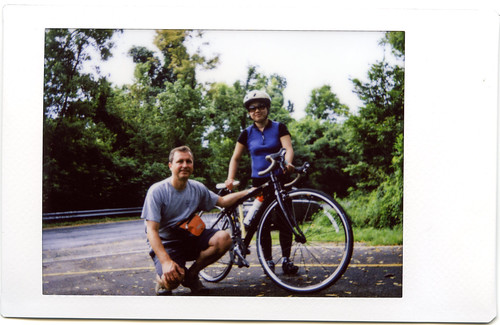
Before the Ride, by Reed A. George
Fuji Instax Neo Instant Camera
 
I carried the Neo around my neck the whole ride. It's very light, so that didn't present a problem at all. I decided to try and capture some motion blur in one of the more wooded sections of the trail. First, I tried the B setting, and overexposed to the point that the image was useless. For my second try, I simply turned off the flash, which resulted in a longer exposure. Here's what I got:
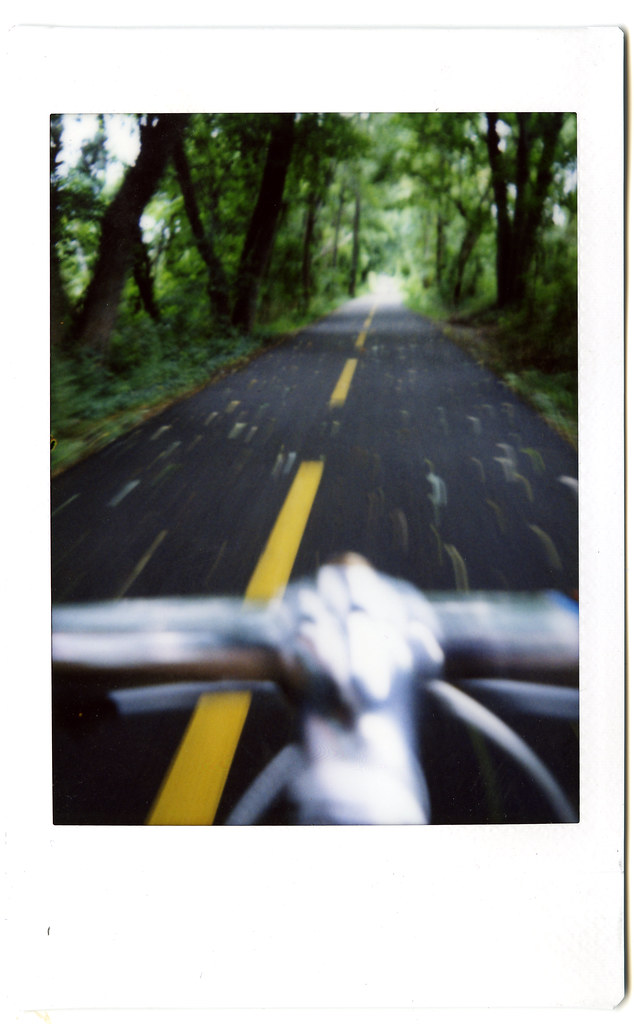
 
Daylight Motion Blur, by Reed A. George
Fuji Instax Neo Instant Camera
 
My wife had some challenges with her biking shoe clips, namely getting them to clip in and then unclip. Here she demonstrates the emergency evacuation procedure, which consists of pulling your foot out of the shoe, leaving it attached to the pedal. No kidding, these shoes were the biggest safety hazard of the ride.
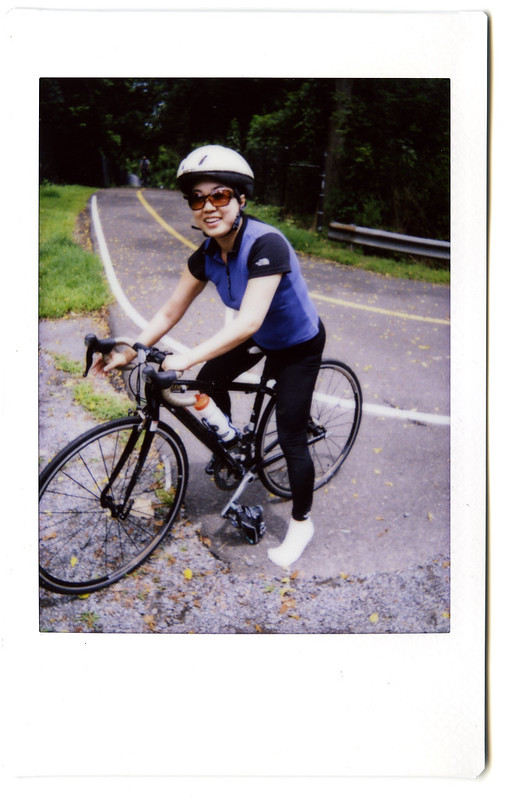
 
Pedal Clip Challenges, by Reed A. George

Fuji Instax Neo Instant Camera

 
I'm really enjoying the little Fuji Neo. I'm hopeful that Instax film for it will be around a while, even while Fuji discontinues it's older pack film. There seems to be a lot of focus on Instax, and I seem them popping up in various places. If you're looking for a fun photographic diversion, give one a try. The Neo happens to have a lot more creative settings than the other models, including B (time exposure), exposure compensation, and the abilty to turn the flash off when you want. Buy yours from my Amazon link below and support my blog!
 
DMC-365.blogspot.com


Wednesday, August 6, 2014

New Leica Store in Kyoto Japan!

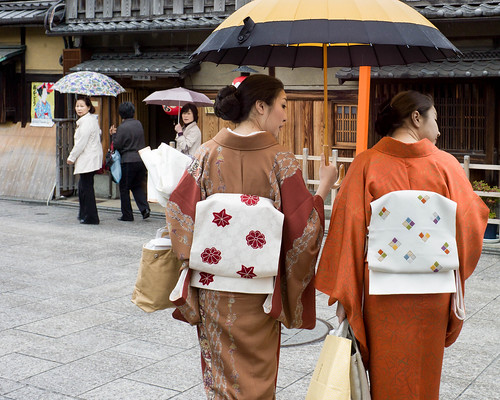
Gion Crossing, by Reed A. George
Leica M9, Summilux 35mm f1.4 Lens
iso 640, f6.7, 1/90 sec.
 
As you probably know, I'm a Leicaphile (meaning I love Leica cameras). I'm also a Japanophile (meaning I love Japan). Today I read that there's a new Leica store in the Gion District of Kyoto, Japan. Excellent news.
 
(Click Here) to see a great 3 minute video about the new store, built into a 100 year old "machi-ya" (traditional Kyoto style house). So beautiful.
 
(Click Here) to read about it on the Leica Camera Blog.
 
I think the craftsmanship of Leica cameras fits perfectly with the deep character of this traditional area of Kyoto.
 

I can't wait to visit!

 
DMC-365.blogspot.com

Tuesday, August 5, 2014

Walter Ulreich Shares His Experience Going Back to a Zeiss Folder

 
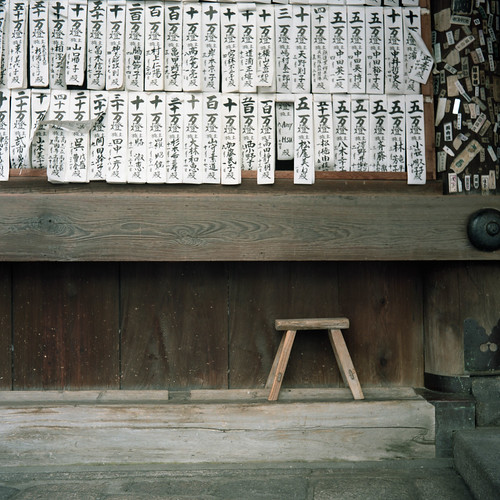
Old Style, Kyoto, by Reed A. George
Zeiss 521/16 Medium Format Folding Camera
 
I love shooting old cameras. I have a few favorites, one of which is the Zeiss 521/16 folder, with Tessar 75mm f3.5 lens, which I used for the shot above.
 
(Click Here) to read more about this particular camera. This is the one that happened to have an old roll of film still in it, with pictures from JFK's Fourth of July speech in Philadelphia. (Click Here) to read about that roll of found film.
 
So, what made me think about this today? Well, as the post title mentions, Walter Ulreich has made a blog post that shares his experience in going back to a Tessar-equipped Zeiss folder after many years. His test images are quite impressive, certainly worth a look.
 
(Click Here) to go to Walter's post.
 
Amazing what a well-preserved old (very old, near 80 years old) camera can do!
 
DMC-365.blogspot.com
 

Monday, August 4, 2014

Water Lily - Imperfections of Film and Long Telephoto

Water Lily, by Reed A. George
Nikon F Film SLR, Sigma 400mm f5.6 (pre-AI) Telephoto
 
I continue to explore the 400mm Sigma lens that I won in the Film Photography Project Walking Workshop giveaway. As you may have seen, it works pretty well on my Micro 4/3 Lumix DMC-GX7. But, it's not of the same quality as the more modern Micro 4/3 lenses. In fact, I think it's much more at home on the type of camera it was designed for, a film SLR.
 
As you can imagine, the shot above was taken from a long distance. 400mm has a very long reach.
 
I like the combination of the tight perspective of the telephoto, the narrow depth of field, and the significant vignetting in the corners. For all its imperfections, this image says what I want it to.
 
DMC-365.blogspot.com
 

Sunday, August 3, 2014

More Fun With the Fujifilm Neo Instant Camera, and a Review

 
Hair, by Reed A. George
Fujifilm Instax Mini Neo 90
 
A couple of weeks back, I posted about the Fujifilm Instax Neo camera that I'd just bought. (Click Here) to see that post, which includes several images.
 
I've gotten more interested in instant photography lately. I really like the Fuji pack films which fit many Polaroid cameras, including my 103. (Click Here) to read about that camera. However, one can only guess that these films are not long for this world. In fact, discontinuation of one of the two types, Fujifilm's black and white FP3000B, has already been announced. FP100C is still being made, but who knows for how long.
 
So, probably the most attractive thing about the new Fujifilm Instax Mini Neo is that there's a good chance this film will be around for a while. Fuji's doing a good job of introducing new cameras, and even some with creative controls like the Neo, so hopefully that will keep the market strong.
 
(Click Here) to read a nice review of the Instax Mini Neo on SnapItSeeIt.com.
 
For not too much money, the Neo is really a nice, fun little camera. Buy yours through my Amazon link below!
 
DMC-365.blogspot.com


Saturday, August 2, 2014

Combining Systems - Micro 4/3 (Lumix GX7) and Nikkor Super Telephoto 500mm f4 AiP Lens

Just for fun, I decided to take out my enormously heavy Nikkor AiP 500mm f4 lens, and mount my Panasonic Lumix DMC-GX7 body to it, for some bird photography. That's right, the body mounts to the lens in my mind, as it's tiny in size compared to the big telephoto.
 
I put the combination on my even heavier Gitzo tripod with Manfrotto gimbal mount, and commenced to photographing wading birds at my local nature walk. I set the GX7's in-body image stabilizer to 500mm, but left it on. You would usually turn it off when using a tripod.
 
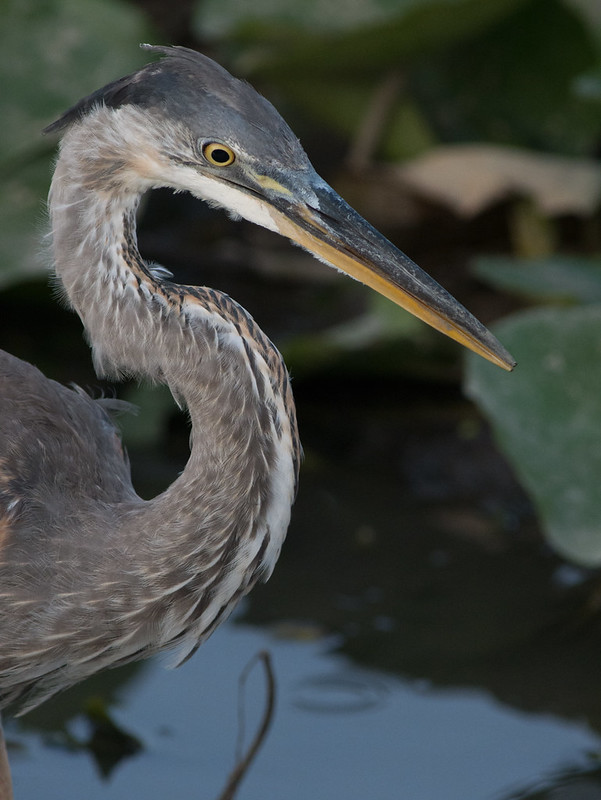
Here's an example shot of a great blue heron.
 
Portrait of a GBH, by Reed A. George
Panasonic Lumix DMC-GX7, Nikkor AiP 500mm f4 Lens (Manual Focus)
iso 1600, f8, 1/1000 sec.
 
With an equivalent field of view to a 1000mm lens on full-frame 35mm, it's obviously a challenge to manually focus this big lens, and hold it steady enough to get a decent shot, even at 1/1000 second exposure. The manual focus magnifier and focus peaking helped immensely, especially the magnifier. The peaking seems to be a little too forgiving, overestimating the depth of field at this long focal length.
 
This bird actually was a little too close for me to get the shot I wanted, not your normal situation in bird photography.
 
Even at iso 1600, the noise levels are quite reasonable with the GX7.
 
So, rather than worry about carrying a tele-converter to get just a little more reach from my 500mm lens, I can just carry the GX7 body! It probably weighs less than a converter, and you don't lose an f-stop of light gathering. Pretty cool.
 
Now that I know it technically works okay, I need to go back and see if I can get some more interesting images with this combination.
 
DMC-365.blogspot.com


Friday, August 1, 2014

Tips for Better Hiking Photography, Skip Spitzer on Luminous Landscape

I love to do outdoor and nature photography. I love to hike. My family hates to hike with me because I do too much photography on our hikes. Balance is important. However, now I have the excuse that I'm just staying aerobic, after reading Skip Spitzer's post on the Luminous Landscape blog.
 
Family Hike at Shenandoah National Park (Will They Ever Go Again?), by Reed A. George
 
In Skip's post, he gives quite a lot of information about how to be a better hiker and photographer at the same time.
 
(Click Here) to read the full post. Here are the points that were most important to me:
 
  1. Have a real relationship with the nature you're photographing
  2. Be skillful enough in your hiking to be at ease, feel the "flow" of the experience
  3. Focus on keeping your energy usage aerobic (go slow, with only short bursts of intense activity)
  4. Learn about the best hiking gear and materials (a cotton shirt isn't the best idea)
  5. Learn to understand, respect, and manage the risks so that you can enjoy the experience
In the post, you'll also see a link to Skip's video program, which you can view for only $10. I'll probably do that when I have time.
 
So, you see, the reason I stop every ten feet or so to shoot several pictures is that I'm trying to stay aerobic. Yes, I quite like that excuse.
 
DMC-365.blogspot.com