Showing posts with label Summilux. Show all posts

Tuesday, October 20, 2015

What Do You See?

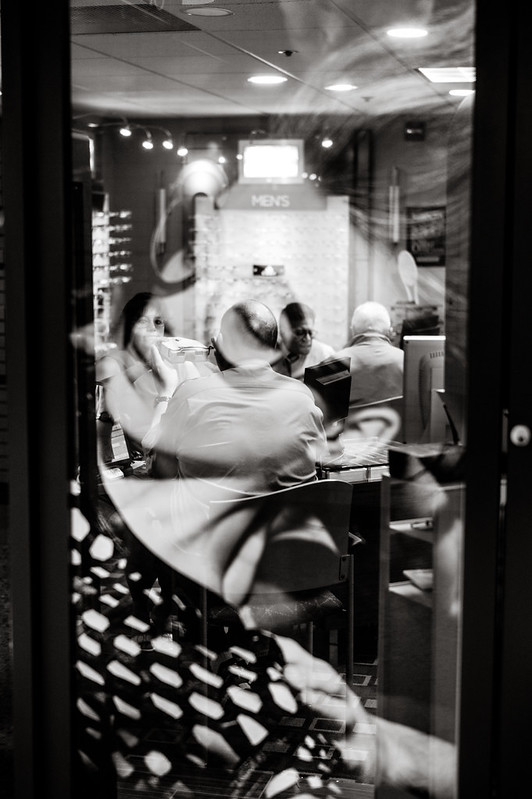
Here's my favorite shot from last weekend's LHSA meeting in Washington, DC.
 
I call it E(ye)nigma.
 
E(ye)nigma, by Reed A. George
Leica Monochrom, 50mm f1.4 Summilux ASPH. lens
iso 1250, f2.4, 1/125 sec.
 
What do you see in this image? I hope you'll see two very different images if you look at it from a distance (or with you eyes squinted a little), and then look close up at some of the details.
 
It's a complicated, busy composition. I know that. That is part of why it works for me.
 
DMC-365.blogspot.com

Sunday, October 18, 2015

I Got to Borrow a Leica Monochrom Camera - and I Liked It!

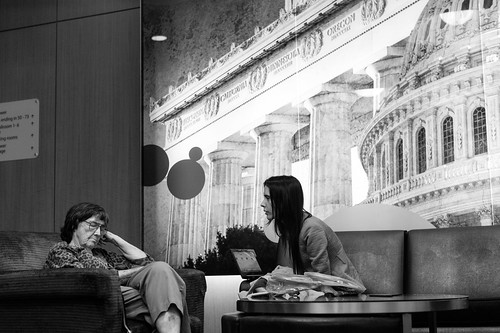
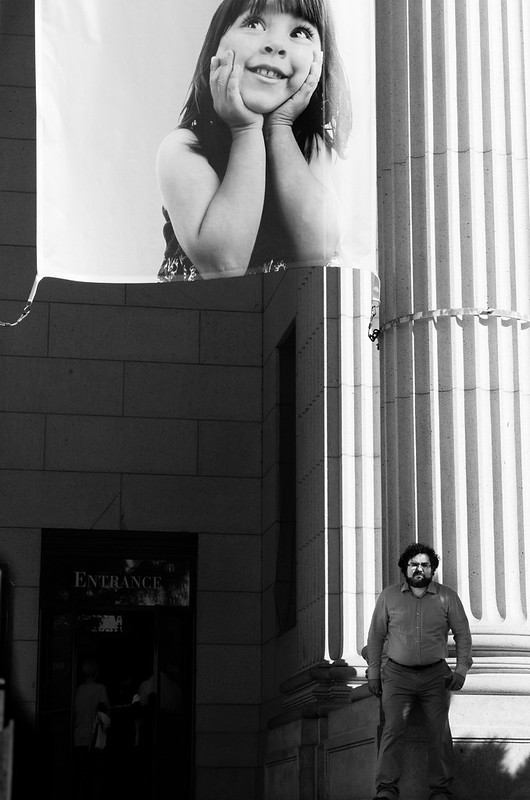
As part of the LHSA (International Leica Society)'s annual meeting in Wahington, DC, Leica camera offered the "Leica On Loan" program to us members. I got to borrow a first version Monochrom camera and 50mm f1.4 Summilux lens. Here are two shots I made with that combo.
 
I am very impressed with the results. Now that the new, improved Monochrom is out, I am really interested in that, too. Purely in an academic sense, that is; I don't have $7,500 laying around...
 
Leica On Loan is a wonderful benefit of being an LHSA member. I thoroughly enjoyed seeing all of my LHSA friends in DC.
 
DMC-365.blogspot.com


Friday, September 11, 2015

Day Sleepers - Cool Project

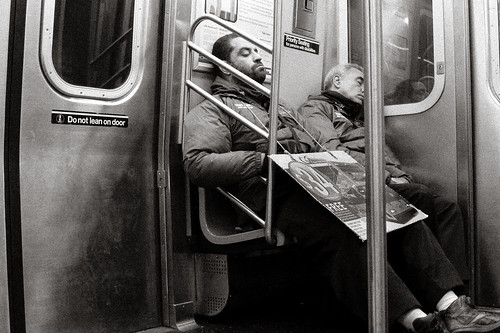
My Day Sleepers (NYC), by Reed A. George
Panasonic Lumix DMC-LX7
iso 800, f1.8, 1/125 sec.
 
I captured these guys sleeping on the subway in NYC. It's interesting to see people sleeping in public places, especially when they're not unfortunate homeless people.
 
I read an interesting piece on the Leica Camera Blog about Eric Leleu, a Frenchman who did an extensive project, photographing "day sleepers" in China. Interestingly, Eric used a Leica M6 for many years, and more recently a digital Leica M240, but in both cases with just one lens - a 35mm f1.4 Summilux.
 
(Click Here) to read the story on the Leica Camera Blog. Knowing he shot all of these with a 35mm wide angle impresses me. He had to get pretty close in many cases.
 
DMC-365.blogspot.com

Wednesday, September 17, 2014

Panasonic Lumix LX100 is Here! Micro 4/3 Sensor is a Huge Upgrade from the LX7.

Well, it's finally here. And the rumors were pretty much true.
 
The Panasonic LX100 has been announced. The big news is the sensor, Micro 4/3 size, more than four times the size in area over the sensor in the DMC-LX7. That's awesome.
Image Source: http://www.dpreview.com/previews/panasonic-lumix-dmc-lx100
 
(Click Here) to read a first-glance review on dpreview.com.
 
The lens is a DC Vario Pana-Leica Summilux Aspheric, 24-75mm equivalent, f1.7-2.8. Not quite as fast as the f1.4 lens on the LX7, the sensor size should more than make up for that difference. It also has a built-in electronic viewfinder (EVF), as opposed to the accessory finder on the LX7.
 
You probably already know that I'm a huge fan of the LX7. That said, I can see no reason not to upgrade to the LX100. This is very exciting news.
 
Actually, I'm not sure "upgrade" is the right way to refer to it. The size of the LX100 seems to be somewhere between the LX7 and, say, the GX7. But, the fixed, fast zoom lens on this size sensor had to result in some increase in overall size.
 
The introductory price is $900. Pretty steep. But, I think that $900 buys you quite a lot of camera.
 
DMC-365.blogspot.com

Wednesday, December 11, 2013

Winter Doldrums? December is Here.

Sunsets on the Month of November, by Reed A. George
Panasonic Lumix DMC-GX7, Pana-Leica Summilux 25mm f1.4 Lens
iso 200, f8, 1/50 sec.

As I write this, it's Sunday morning, December 1, 2013 (I usually write posts several days ahead). Amazing how fast this year has gone; it seems like yesterday we were in January.
 
Yesterday, I went to visit a friend in Warrenton, Virginia, and captured the shot above, the final sunset of November, with my new Lumix GX7 and 25mm Summilux.
 
Oh yeah, while I was out, I got to handle the new Nikon Df at McClanahan's Camera in Warrenton. It's really, really attractive.
 
(Click Here) to got to McClanahan's. Mr. M. has a Df waiting for your purchase; I;m sure he'll be happy to ship it to you.
 
Winter makes it harder to find interesting subjects to photograph, especially outdoors. This just means that I need to focus my lens and efforts elsewhere. People are still interesting in winter, right? And, it's a chance to focus on cleaning up all of the image files I shot all year round, organize my folders for next year, and maybe even do some post-processing and printing.
Last of the Leaves, by Reed A. George
Panasonic Lumix DMC-GX7, Lumix 100-300mm f4-5.6 OIS Lens at 280mm
iso 400, f5.6, 1/400 sec.
 
If you know me at all, you know that organizing files isn't what turns me on about photography. No, it really is December 1, and that means it's time to select my final lens for my monthly series Whole Lotta Leica (that series will end after this month), and pull a neglected camera out of the closet for my Skeletons From The Closet series. The future of SFTC is uncertain at the moment, but I'm thinking of focusing on a few of my favorite cameras next year, for longer than a month. I may even do multiple cameras at the same time. We'll see.
 
So, time to start thinking about some new projects, and continue on some current ones. I'm sure I'll find some good live music being played in the local venues even as it snows outside, for example.
 
DMC-365.blogspot.com


Saturday, November 16, 2013

November's Whole Lotta Leica (WLL) Lens - Canon LTM 50mm f1.4

Canon 50mm f1.4 Lens in Leica Thread Mount (LTM)
ca. ~1972
 
This month's lens is the Canon 50mm f1.4. Some refer to this lens as the "Japanese Summilux." I won't deliberate on whether that's deserved or not. I will say this is one sharp lens. I guess I wouldn't be surprised if it competes well with a Leica Summilux 50mm f1.4 from the same era. I don't have a 50mm Summilux, so I can't say for certain.
 
I have to use a LTM-M mount adapter to use this on my M9; that's no problem at all. They work beautifully, and I've never had a problem with focus shift or anything else when using the adapters.
 
This lens has an odd filter size of 48mm. When I used it on my Leica M8, which required a UV/IR filter, I bought a step-up ring, which allowed me to use a 49mm (much more common size) filter. I still have the adapter on there today, so that I can use a 49mm lens cap. The one I have on there now is a Pentax cap. So, I have a Canon lens mounted to my Leica M9 body, with a Pentax cap. Quite the mix.
 
My copy is a version II, and was made sometime around 1972. I bought it for around $300, and they normally go for $300-$400 on the used market.
 
The original Canon hoods for these lenses are difficult to find. I have seen them listed for $100 or more, which is simply ridiculous. Last year when I went to Japan, I went to a weekend flea market. There was not a lot of camera gear there, and what I did find was expensive. However, I did find a little leather case marked "Canon" at one of the stalls. Opening it up, I could not believe my eyes - there was the exact hood that I needed. One thousand yen (~$13 at the time) later, and it was mine. Very lucky.
 
Anyway, I'll use this lens as my standard lens in November and share the results with you. Results coming soon!
 
DMC-365.blogspot.com


Friday, October 18, 2013

New Pana-Leica Lens! 15mm f1.7 Summilux Aspheric


Pana-Leica 15mm f1.7 Summilux
Image Source: http://panasonic.net/avc/lumix/pressrelease/leica_dg_summilux_15/

Well, it seems that Panasonic and Leica's collaboration continues. I'm pleased to hear it.

While I'm anxiously awaiting the arrival of my newly-ordered Lumix DMC-GX7, Panasonic has just announced the latest addition to the Pana-Leica lens set for Micro 4/3. While 30mm equivalent field of view is a little odd, being neither here nor there between 28mm and 35mm traditional fields of view, I'm sure it's going to be a great lens. It will be a nice addition to my 25mm Summilux and 45mm Macro-Elmarit. A tiny three lens prime kit that covers lots of ground.

As you probably know, I am a Leica nut. I have been focused on shooting my M9 this year, which is appropriate given the investment I made in it. I didn't want to stray from Leica, but my Micro 4/3 lenses have been calling me, albeit with a muffled voice, from inside my equipment drawers. So, I decided to jump back in with the purchase of a DMC-GX7 camera. Now it seems I can really have the best of both worlds - the latest Lumix features and Micro 4/3 size advantage with the highest quality Pana-Leica lenses.

Exciting times in photo equipment!

Now, please, Panasonic. Please ship my GX7!

DMC-365.blogspot.com


Saturday, May 4, 2013

Whole Lotta Leica Results - March's Summilux 35mm f1.4 in Black and White!

 
Kodaiji After Dark, by Reed A. George
Leica M9, Summilux 35mm f1.4 Lens
iso 640, f1.7, 1/15 sec.
 
I've already posted some night street shots taken with March's Whole Lotta Leica lens, the Summilux 35mm f1.4 lens. Here's one more night shot (above), or at least it was after sunset. I love the repeated patterns and lines in this shot.
 
I've been manually entering my lenses into the M9, so it can work its magic on vignette corrections, etc. I'm not sure what happened here, but the image data says I'm using a 35mm Summicron, rather than the Summilux. Therefore, I'm not sure about the f-stop information. I've got to look into that.
 
Here is another low light image (below), this time taken from a moving subway train.
 
Entering the Tunnel, by Reed A. George
Leica M9, Summilux 35mm f1.4 Lens
iso 640, f5.6, 1/4 sec.
 
The shot above could have been made with just about any 35mm lens. I decided that I wanted the motion blur caused by the train movement, set the shutter speed at 1/4 second, and then found the right aperture, which happened to be f5.6. I took several images like this but this is my favorite.
 
Ochanoyu, by Reed A. George
Leica M9, Summilux 35mm f1.4 Lens
iso 1250, f1.4, 1/30 sec.
 
The shot above shows the dreamy quality of the Summilux wide open (or nearly so). Again, due to the lens id issue, I'm not sure exactly what f-stop I used. If I remember correctly, it was f1.4. The lady in front's face and the tea cup are quite sharp, but everything else is smooth and creamy.
 
Finally, here's a shot taken in daylight. This was taken at the Kamo River in Kyoto, where people gather to enjoy the spring weather.
 
Jumping the Turtles, by Reed A. George
Leica M9, Summilux 35mm f1.4 Lens
iso 160, f9.5, 1/180 sec.
 
For the shot above, I decided to do the black and white conversion in Nik's Silverefexpro2. I have been looking for my own settings to emulate Tri-x (Kodak black and white 400 film) for some time, with no real success. For this shot, I used the built-in Tri-x setting in Silverefexpro2. I'm very pleased with the result. I like the line made by the upraised heads of the stone turtles, and the parallel lines of the stones the family is standing on and the stairway and stone wall at the river's edge. The little girl in mid-air between the stones finishes off the composition for me.
 
So, while I really do love the color rendition of my old Summilux 35, it also delivers quite well in black and white.
 
I hope you enjoy these images.
 
DMC-365.blogspot.com


Thursday, April 4, 2013

Whole Lotta Leica - My First Day in Japan with the Summilux 35mm f1.4

Ramen Shop, by Reed A. George
Leica M9, Leica Summilux 35mm f1.4 Lens
 
I am writing at the end of my first full day in Japan. I will be home by the time this posts.
 
We arrived in Japan late last night, and today was a rest day. Tomorrow we're off for Kyoto on a 6:15AM train.
 
Today I went to Akihabara (Tokyo electronics district) to check out new cameras. The Fuji X20 really turns me on. I will likely end up with one of these as some point.
 
I also went to a few used camera stores in Ginza, to talk with them about the Leica Historical Society of America (LHSA), which is now the International Leica Society. I found a beautiful old Rolleiflex D, with a Planar f2.8 lens, which I fell in love with.
 
But, I didn't buy - either the X20 or the Rollei.
 
I did walk around the city and shoot a little today, both with my DMC-LX7 and with my M9.
 
It was raining this evening, and I spent some time shooting the wet streets and people in them. I really like the shot above as I was able to catch the person walking their bike right into the light emanating from the ramen shop on the right.
 
This shot is right out of the camera.
 
DMC-365.blogspot.com


Monday, March 25, 2013

Whole Lotta Leica - March's Summilux 35mm with Acoustic Burgoo at the Opera House

 
Rudy, Erik, and Melissa of Acoustic Burgoo, by Reed A. George
Leica M9, Leica Summilux 35mm f1.4 Lens
iso 1250, f 1.7, 1/60 sec
 
I don't usually get out for live music on weeknights, but The Acoustic Burgoo, one of my very favorite local bands, is the Artist in Residence at the Shepherdstown, West Virginia Opera House this month. They're playing a show every Thursday in March.
 
(Click Here) to go to the Burgoo's website. If you live near DC and like live music, you've gotta see them. They have a wide musical base (most of the first set was Hank Williams tunes last night), and are incredibly talented.
 
(Click Here) to see the Opera House's website. A great little venue.
Before the Show, by Reed A. George
Leica M9, Leica Summilux 35mm f1.4 Lens
iso 1250, f 2, 1/60 sec
 
Dedicated Fan, Rachael, by Reed A. George
Leica M9, Leica Summilux 35mm f1.4 Lens
iso 1250, f 1.4, 1/180 sec
 
 
This was a show where I really needed the fast aperture of the Summilux f1.4. You can see that the Summilux is a little soft (also known as the "Leica glow") at f1.4 and f1.7. I actually really like that look for some images, not for others. By f2, it's quite sharp.
 
Shooting the M9 at iso 1250, which I consider to be about the maximum truly useful iso for the M9, always presents a little challenge. I found an interesting set of forum discussions about the M9 being essentially an "iso-less" camera. The idea is that the amount of light hitting the sensor (number of photons) is not affected by iso settings. It is only determined by f-stop and shutter speed. Raising the iso setting only increases the gain of the sensor, which also increases noise. So, some people believe in keeping iso low, underexposing, and increasing exposure in post-processing (in Lightroom in my case). Here's a quote and source:
 
"This is not actually the case with the M9. The M9 is essentially an ISO-less camera. Pushing ISO 160 three stops in Lightroom 4 yields as good, if not better, results than using ISO 1250. Of course, the more light you get to the sensor, the better, but raising ISO in camera is not actually necessary, in terms of IQ. Granted, if you don't raise ISO in camera, you won't have a usable review image on the camera's LCD, so it may not always be practical."
 
(Click Here) to read the thread on this subject on getdpi forums.
 
I shot all of my images last night at iso 1250, but even at f1.4, I had to underexpose some to get the shutter speed I wanted. So, I had to increase exposure in Lightroom on most of them. The third image was the most extreme example. Shooting where I was literally in the dark, I didn't notice that my shutter speed was set at 1/180. So, I really underexposed that shot. I boosted it 2 full stops in Lightroom, and don't think it suffered too much.
 
One of the things I find is that adjusting the blacks in Lightroom so that you have some true blacks in your image, significantly reduces the appearance of noise.
 
In any case, it was a blast seeing the Burgoo and shooting the M9 and Whole Lotta Leica lens for this month. More to come with the Summilux!
 
By the way, on the way home I was pulled over for doing 68 mph in a 50 zone. The officer told me he was going to his car to write the citation, then came back and told me since I had a good driving record he would reduce it to a warning. Thank you very much, officer! I got home feeling like it must be my lucky day.
 
DMC-365.blogspot.com


Friday, March 8, 2013

March's Whole Lotta Leica Lens - The Leica Summilux 35mm f1.4

This month, I'll shoot my most valuable Leica lens - the Summilux 35mm f1.4. This, the second version of 35mm Summilux, was made from 1967-1995. Mine was made in 1972.
Leica Summilux 35mm f1.4 Lens
 
This is one of those lenses that Leicaphiles will kill for. Wide open, at f1.4, it has a dreamy, soft look. By f2.8 it's extremely sharp. It's also a very small lens, great for travel.
 
Since I'm traveling to Japan in March, I want to take one of my very best lenses on my M9. To be honest, I haven't used the Summilux all that much, since my normal tendency is toward 50mm lenses. In fact, I bought this lens as a package deal with the best 50mm I've ever owned, my Summicron 50mm f2.
 
I'm taking the Summilux to Japan this year, as I want to give my self the chance to fall in love with this lens.
 
I will probably also take a telephoto along for the M9, either the 90mm Elmarit f2.8, or Canon 135mm f3.5.
 
In addition to the M9 and a couple of lenses, I'll rely on my Panasonic Lumix DMC-LX7 for wide angle, macro, etc. I want to travel light this year. Of course, I'll also be carrying my Skeletons From The Closet camera, the Zeiss Ikonta medium format folder.
 
So, stay tuned for some results later this month and early next month. I hope that I can take some images that live up to the reputation that the Summilux has amongst Leica fans.
 
DMC-365.blogspot.com


Tuesday, February 19, 2013

I Succumbed to a GAS Attack - Lumix DMC-LX7

If you don't know what GAS is, it stands for Gear Acquisition Syndrome. Most photographers suffer from it. I have it bad.
 
You probably know that I'm a Panasonic Lumix fan. I've written about my favorite ultra-compact camera, the Lumix DMC-LX5 several times. Up until now, I have refrained from upgrading to the latest model, the DMC-LX7. Yesterday, I gave in and ordered one.
Image Source: http://panasonic.net/avc/lumix/compact/lx7/index.html
 
So, if I'm content with the LX5, what made me do it? Well, first off, the LX7 comes with a Pana-Leica Summilux f1.4 lens, a full stop faster than the LX5's Summicron. With small sensors like the one in the LX5 and LX7, high iso noise is always a concern. With an extra full f-stop over the LX5, the LX7 will allow me to stay a full iso level lower, drastically reducing noise. The LX7 also has a CMOS sensor, rather than the CCD in the LX5. This may end up being a compromise, as CCD sensors can yield sharper images, while CMOS is better at high iso. We'll just have to see about that when it arrives.
 
(Click Here) for a nice review and table summarizing the other differences between the LX5 and LX7 on dpreview.com.
 
The other reason I bought on the spur of the moment? The LX7 is drastically marked down at Adorama. With a list price of $448, it is now available for $150 off at Adorama, for $298. Hard to decline.
 
Now, here's the only dilemma left for me - do I need the new DMW-LVF2 electronic viewfinder that goes with the LX7? Unfortunately, very unfortunately, the DMW-LVF1 that I have for my LX5 (and for my old Micro 4/3 DMC-GF1) won't work on the LX7. The new one, the LVF2, is supposed to be much better in resolution, but it's also larger. That matters on a compact camera like the LX7.
 
From my experience with the LX5, I do enjoy the LVF1. However, I would say that I more often use an old optical finder, a Russian model, with the zoom set to 35mm equivalent. This makes a great, bright, fast little street shooter out of the LX5; I expect to do the same with the LX7. So, for now, I'm not buying the LVF2. If I found out that the new DMC-GX2 Micro 4/3 camera (if and when it's finally announced) used the LVF2, then I'd be very tempted. It's not at all clear that will be the case. By the way, the LVF2 isn't cheap. It costs around $160.
 
There is a great set of information about the LX7 on Panasonic's website, including nice descriptions of the features, galleries of images, and a nice video of Charlie Waite using the LX7 to shoot in Holland.
 
(Click Here) to see the LX7 on Panasonic's site.
 
I have been sharing pictures from the LX5 occasionally on the getdpi forum. Some of us are making the transition to the LX7, and there's a relatively new link where others have shared some very nice LX7 images. I will be adding to this thread soon.
 
(Click Here) to see the LX7 image post on getdpi.
 
One final clincher for me? The LX7 uses the same battery as the LX5. So, I can use my existing set of batteries!
 
I anticipate writing my second e-book soon. The one I wrote on how to set up and use the Lumix DMC-G3 has been very popular, with thousands of downloads. So, I'll commit to writing one on the LX7 soon. I'll have to do it soon, as the next model in this line will undoubtedly come around soon. Stay tuned for that.
 
DMC-365.blogspot.com
 

Saturday, January 12, 2013

Studying Color - The Color Wheel and Complementary Colors

 
The Color Wheel
Image Source: http://en.wikipedia.org/wiki/Color_wheel
 
Reading a new series of posts about on JPG Magazine's blog has me remembering middle school art class, and thinking about color schemes.
 
(Click Here) to read about the complementary colors red and green (for the holidays) on JPG Magazine's blog.
 
Complementary colors are defined as those that will make gray when combined. In a simpler sense, they are colors that lie opposite (or near opposite) one another on the color wheel. Use of complementary colors can make for dramatic images.
 
There are some very nice examples in the blog link above.
 
So do I have any examples of using complementary colors in my own work? Here's one:
 
Koi and Lily, by Reed A. George
Panasonic Lumix DMC-G1, Lumix 45-200mm f4-5.6 at 97mm
iso 100, f5.6, 1/60 sec
 
And here's one you may have seen posted here before.
 
Beautiful Obsolesence, by Reed A. George
Panasonic Lumix DMC-G3, Pana-Leica 25mm f1.4 Summilux
iso 160, f5.6, 1/160 sec
 
I like the JPG blog. There is already a follow-up post on other complementary colors. I don't think that I consciously picked this color combination in the shots above, but they must have caught my eye.
 
DMC-365.blogspot.com


Wednesday, December 26, 2012

Street Portraits by airfrogusmc on Rangefinder Forum - Leica M Monochrom, 35mm f1.4 Summilux FLE

 
Image Source: http://www.rangefinderforum.com/forums/showthread.php?t=127307
 
Rangefinder Forum member airfrogusmc has posted a very nice series of street portraits, all made with Leica's new "black and white only" M Monochrom rangefinder. The idea of this camera is that by removing the color filters used to make a color image from their sensor, they make an exquisitely sensitive black and white imaging system. For people who aren't obsessive about black and white images, an $8,000 camera that doesn't shoot color seems crazy; maybe it is. But, there you have it.
 
(Click Here) to see all of the great images posted on the Rangefinder Forum post.
 
The photographer shot all of these using a Leica Summilux 35mm f1.4 FLE (which means "floating lens element") lens. This is one of Leica's crowning achievements in lens design. The floating lens element helps to solve a classic problem in lens design, which is the fact that the focus point shifts depending on how far you are from your subject. Most lenses are optimized to focus at a certain distance. The FLE is accurate at all distances, or very nearly so.
 
I always go back and forth on which lens is best for street use. Certainly, if I were going out to do street portraits, I would choose a 50mm over a 35mm focal length. On the other hand, if portraits were not my main objective, but just street scenes, I may choose the 35mm. This post shows the flexibility of the 35mm focal length for any type of street photography.
 
Great equipment, great shots! Thanks, airfrogusmc.
 
DMC-365.blogspot.com


Monday, December 17, 2012

Barcelona's Placa De Sant Felip Neri

 
Placa De Sant Felip Neri, Barcelona, by Reed A. George
Panasonic Lumix DMC-G3, Pana-Leica Summilux 25mm f1.4
iso 1600, f5, 1/320 sec
 
Placa De Sant Felip Neri, located in the Barri Gotic neighborhood of Barcelona, is a special place with a deep history. Originally the site of a Jewish cemetery, a baroque church was built here in the mid 1700s and still stands.
 
On January 30, 1938, during the Spanish Civil War, a bomb fell on the square, killing 42 civilians, including 20 children who were taking shelter in the basement of the church. In the images below, you can see the significant damage that the bomb did to the stone walls of the square.
 
While the shot above was taken with the Lumix DMC-G3, the remaining pictures in this post were taken at night with my Leica CL, Minolta Rokkor 40mm f2 lens, and Kodak Tmax 400 film. I did not use a tripod, and most were shot at 1/15 second exposure.
 
My goal was to capture the feeling that the place gave me as darkness fell. It is not a sinister place, but certainly has a dark history.
 
 
There is still an elementary school in the square. The children in these pictures were meeting their parents, and playing before walking home. While the pictures look dark and threatening (which was my intention), the kids were quite happily running around the square.
 
 
If the soul exists, many have flown skyward from this place. Remnants of those flights persist. Like a tidepool that stays intact after the tide has receded, this place holds memories for those old enough to remember, only vague shadows and moods for those too young.
 
I thoroughly enjoyed trying to capture the impression Placa De Sant Felip Neri made on me. The Leica CL was the perfect tool for it, even though I had to work carefully with iso 400 film and low light levels.
 
DMC-365.blogspot.com


Thursday, November 22, 2012

New Olympus OM Blog


Today I found a new blog. Being a Micro 4/3 fan, I'm always looking for others using Micro 4/3 cameras and posting lots of pictures. Today I found the OM Experience, an Olympus OM-D focused blog, by Matthew, who lives in the Baltmore, Maryland area.
 
(Click Here) to see Matthew's blog.
 
Matthew is posting a lot of pictures - key to a great photography blog. He posted a nice set of images from the Maryland Renaissance Fair, which runs through late October. I guess I've missed it again this year. I have been planning to go for quite some time.
 
Anyway, for my friends out there that use the Olympus OM-D, this will be a great blog to follow. He also uses Panasonic lenses, including the Pana-Leica Summilux 25mm f1.4. So, you Lumix fans won't be left out.
 
DMC-365.blogspot.com


Saturday, November 17, 2012

Landscape Photographer of the Year - First Winner Loses Title Due to Overmanipulation of Image


Landscape Photographer of the Year 2012 Stripped of Title for Too Much Shoppin winner

The New Winner - Landscape Photographer of the Year, Simon Butterworth
Image Source: http://www.petapixel.com/2012/11/02/landscape-photographer-of-the-year-2012-stripped-of-title-for-too-much-shoppin/
 
 
"Take A View" (www.take-a-view.co.uk) has announced a new winner for Landscape Photographer of the Year. Originated by photographer Charlie Waite, the competition is in its seventh year.
 
Unfortunately, the initial image selected for first place this year was disqualified after the fact for over-manipulation.
 
(Click Here) to read the original posting, and see the excellent image that ended up being disqualified.
 
The website reports that the original winner, David Byrne, had not intentionally misled the judges; they simply found too much manipulation in the image to suit the requirements of their contest.
 
This is an important lesson for photographers. We all (or very nearly all) do some manipulation of our images. In fact, manipulation in the darkroom certainly precedes Photoshop. But, it's important to know the limits. And, the limits are different, depending upon the competition or venue.
 
I like to think that I use "straight photography" techniques, and don't rely too heavily upon manipulation. That said, I certainly have examples in my mind as I write this where the original image was, well, "ho-hum," until I got it into Lightroom for cropping, levels adjustment, conversion to black and white, and toning. Now it's one of my recent favorites. I would not consider it "manipulated" by today's standards, but it's certainly not straight out of the camera. Here's my image in question.
 
Forest Edge, by Reed A. George
Panasonic Lumix DMC-G3, Pana-Leica Summilux 25mm f1.4 lens
iso 160, f8, 10 secs
 
Personally, I think what I've done here is quite acceptable, as all of these things could have been done easily in a wet darkroom. But is that the right measure? We also know that composites (made from multiple original images) can be made in the darkroom. I would think that's too much (obviously).
 
Where do you think the limits of acceptable manipulation are? I guess as long as we're honest about it when we're done, it's always up to each of us.
 
DMC-365.blogspot.com
 
 
DMC-365.blogspot.com
 
DMC-365.blogspot.com
 
DMC-365.blogspot.com
 
DMC-365.blogspot.com
 
DMC-365.blogspot.com
 

Saturday, November 10, 2012

APhotoContributor Author Shares His Fuji XPro-1 Experience. He's Left Leica Digital Behind.


Chris, author at the blog APhotoContributor, has posted a detailed summary of his shift from Leica digital to the Fuji XPro-1.
 
(Click Here) to read Chris' complete post.
 
Chris is a retired engineer, turned photographer and blogger. He was an initial beta-tester for the Leica M9, and took an amazing number of images (>100,000) with the M9. He always used the M9 in conjunction with either Canon or Nikon DSLRs, which he considered as more reliable. In particular, Chris had problems with the M9 hanging up while writing images to memory cards. I've never seen this with my M9, but I have maybe 1% of the M9 images under my belt that he does.
 
Chris says he's not a Leica hater, and continues to use a Leica MP (film camera) regularly. I would stretch to say that he's a "Leica-guy" hater, though. He includes a lot of disparaging comments about Leica photographers worrying more about whether their straps match their jackets than about their images, Leica photographers being those who "want to shoot in Cuba" (I admit, I'd love to shoot in Cuba), and being people who "wear a camera" instead of using it. He is also very rough on Thorsten Overgaard, a strong Leica digital proponent. To check out Thorsten's blog, (Click Here). I think Thorsten seems like a pretty good guy; Chris uses the phrase "king of dilettantes." Oh well, to each his own. Diversity makes the world more interesting.
 
On to the meaningful part of the post. Chris has been using the Fuji XPro-1, and is obviously pleased. He has had no problems with the camera writing files to cards, ever. He is a strong proponent of autofocus in digital cameras, and finds Leica's continued production of manual focus-only bodies an anachronism. Along those lines, he's not interested in adapting his Leica lenses (including the awesome 35mm Summilux) to the Fuji body. He is fond of the Fuji 18mm lens. According to Chris, the latest firmware update for the XPro was transformational, and made the autofocus on the camera "really good."
 
Chris also finds the XPro quieter than the M9.
 
Many times, critical reviews of the Leica M9 come from people who secretly wish they could have an M9, so go very far to find reasons why they'd never want one ("I'm sure those grapes were sour, anyway."). Not in this case. In fact, Chris still pairs his Fuji XPro-1 with the venerable Leica MP for street shooting.
 
Personally, I am very intrigued with where Fujifilm is going. I think the XPro-1 looks like a beginning of a great system. I'm not sure if I could get used to the hybrid finder system. Playing with it just a little made it seem a little clunky to me, but I certainly haven't given it a chance. In concept, it's a great idea. I also believe that Fuji is capable of making lenses that are every bit as good as Leica. They've made gorgeous optics for many, many years. I once had a Fuji G690 medium format rangefinder, with 100mm f/3.5 lens that was just plain incredible. Known as the "Texas Leica," the camera gave absolutely beautiful results, but was just a little too cartoonish for me to carry. It truly looked like a prop for a geeky photographer halloween outfit.
 
As you probably know, I do love my new (used) Leica M9. That said, I'm keeping my eye on Fuji. I think we're going to continue to see interesting new products from them.
 
DMC-365.blogspot.com
 
 
DMC-365.blogspot.com
 

Sunday, November 4, 2012

Autumn Walk at Shenandoah National Park

My family and I took a walk at White Oak Canyon in the Shenandoah National Park. Rather than take the typical drive along Skyline Drive, which can tend to be drier and browner, we hiked along the creek.
 
October in Shenandoah National Park, by Reed A. George
Panasonic Lumix DMC-G3, Pana-Leica Summilux 25mm f1.4
iso 200, f5.6, 1/160 sec.
 
Since it took nearly two hours to drive out, we didn't catch great early morning light. It was still pretty good when we started the hike a little before 10:00 am, but most of the hike was in direct overhead sunlight.
 
 
All the Golds, by Reed A. George
Panasonic Lumix DMC-G3, Pana-Leica Summilux 25mm f1.4
iso 200, f5, 1/200 sec.
And Some Reds, by Reed A. George
Panasonic Lumix DMC-G3, Pana-Leica Summilux 25mm f1.4
iso 200, f4, 1/100 sec.
 
 
These conditions - bright blues skies and deep forest shadows - really pushed the dynamic range of the Lumix G3.


Looking Downstream, by Reed A. George
Panasonic Lumix DMC-G3, Pana-Leica Summilux 25mm f1.4
iso 200, f11, 1/40 sec.
 
Dynamic range is one of the aspects of Lumix sensor design that is promised to improve, most specifically with the DMC-G5 (even though it reportedly doesn't gain much in high iso performance), and more so in the newly-announced DMC-GH3.
I made an attempt at high dynamic range (HDR) imaging in one case of excessive contrast. I must say that I'm not satisfied with the result, but have some trouble putting my finger on why. Here it is:
Pool in HDR, by Reed A. George
Panasonic Lumix DMC-G3, Lumix 14mm f2.5
iso 200, f16, 5 Image HDR
 
Maybe there's just too much drawing the eye around in this shot? Is it cluttered with detail? What caught my eye was the band of fallen leaves in the foreground, and the reflection behind. Maybe I should have focused on just that, rather than trying to take in the whole scene?
 
Anyway, it was a very nice day in the forest. We caught the fall colors quite nicely.
 
DMC-365.blogspot.com


Sunday, October 14, 2012

Leica M9 Goes to the Circus

 
Big Apple Circus, by Reed A. George
Leica M9, Canon LTM 50mm f1.4
iso 640, f2, 1/90 sec
 
My family, a friend, and I went to the Big Apple Circus. I always enjoy photographing there because the lighting is dramatic, the action and subject matter always interesting. Usually, I bring a fast(ish) telephoto, like my Nikon 300mm f4. This time, I decided to bring only my Leica M9 and a single lens, the Canon 50mm f1.4 (a Leica thread mount lens, also known as the "Japanese Summilux").
 
I found that I was able to shoot at wide apertures at iso 640 or 1250, with reasonably fast shutter speeds (1/90 or faster).
 
 
Enter the Contortionist, by Reed A. George
Leica M9, Canon LTM 50mm f1.4
iso1250, f2.8, 1/350 sec
The pictures I brought home are very different from what I usually get. Wider angle, of course. But also, a little wider in sharing the context of the event. I even took the opportunity to walk a little during the intermission, which yielded the following shot:
 
Glowing, by Reed A. George
Leica M9, Canon LTM 50mm f1.4
iso 1250, f1.4, 1/60 sec

This shot was taken in deep darkness. Amazing what f1.4 can do.

I was a little concerned about how the noise would creep in at iso 1250 on the M9. I must say I'm very pleased. Even in a shot like the one above, with lots of black space around the subjects, I don't find the noise objectionable. Lightroom's exposure adjustments (namely, making the blacks even blacker) and noise reduction work beautifully with the M9's files.

And here is my favorite shot from the event:
The Moment, by Reed A. George
Leica M9, Canon LTM 50mm f1.4
iso 1250, f2, 1/125 sec

This one's worth looking at full-size, to see the details.

With my normal gear, I may have captured one or two of the horses in great detail. This image shows how the performer is conducting the full coordinated motion of the magnificent animals. That would have been missed. I also felt it when I captured the exact moment that shows their strength, concentration, and timing. This is why I love shooting rangefinders. The constraints force me to make better images than complete flexibility in focal lengths allows. I know, that sounds strange. But, I would certainly have elected to go for details in this scene if I'd had a telephoto lens with me.

DMC-365.blogspot.com