Friday, April 11, 2014

Dreaming in Monochrom(e) - Mink's Miracle Medicine Show

My friends Rudy, Melissa, and Erik, former members of the band Acoustic Burgoo, came together to play a show under Melissa's new band name, Mink. The show was at Cristina's Cafe in Strasburg, Virginia.
 
(Click Here) to find Cristina's. If you're ever passing through Strasburg, stop in for a "Sexi Mexi Combo!"
 
I shot the show with my "Dreaming in Monochrom(e)" camera, the Leica M4-2, and my new favorite black and white film approach, using Ilford Delta 3200 exposed at iso 1600, and processed by The Darkroom.
(Click Here) to learn about The Darkroom, the best film processing service I've ever used.
 
Melissa Finishing Up the Set List, by Reed A. George
Leica M4-2, Ilford Delta 3200 Film
 
I shot with two lenses, the Zeiss C-Sonnar 50mm f1.5, which is a modern remake of the classic Sonnar design, with the latest materials, technologies, and optical coatings. The second lens was my Leica Summilux 35mm f1.4 version 3, from the 1970s.
 
Mink and Friends, by Reed A. George
Leica M4-2, Ilford Delta 3200 Film
 
This was a very laid back show, which is sometimes nice. I got to hang out with my friends, have some excellent Mexican food, and move around and shoot as much as I liked.
 
Erik Burnham, by Reed A. George
Leica M4-2, Ilford Delta 3200 Film
 
We saw various combinations of the three performers, and when not playing on stage, Erik stayed busy playing off-stage, dancing with our lovely waitress (whose name I didn't get, sorry!).
 
Dance, by Reed A. George
Leica M4-2, Ilford Delta 3200 Film
 
Rudy B. and Erik, by Reed A. George
Leica M4-2, Ilford Delta 3200 Film
 
Erik and Rudy are in another band, The Plank Stompers. You'll see images from my frequent attendance at their shows as well here at DMC-365.blogspot.com. The shot below is from behind them on stage. That's Britt in the audience (with the beard).
 
 
Mink and Friends, by Reed A. George
Leica M4-2, Ilford Delta 3200 Film

Here is a shot that took advantage of the stage lights to play with some internal reflections and unpredictable properties of optics. Chance rather than design, I like how it turned out.

Erik and Rudy, by Reed A. George
Leica M4-2, Ilford Delta 3200 Film
 
I think I have a style for many of my concert images now, at least the ones I want to shoot in monochrome.
 
I'm in the process of testing a new color film (CineStill), to see if it can be an equally satisfying solution for color. I shot two 36 exposure rolls of it last night at a house concert; we'll see how that turns out in a week or so.
 
DMC-365.blogspot.com
 

Thursday, April 10, 2014

More Fisheye Images - Panasonic Lumix DMC-GX7

I've always thought of a fisheye lens as a novelty. I never really owned one, other than a toy fisheye film camera, and I only used that once or twice. Over the holidays, I found the Bower 7.5mm f3.5 fisheye lens for Micro 4/3 for an amazing low price, and bought it.
 
I decided to take it with me on my trip to New Mexico. Another place where Micro 4/3 compactness shines. I don't think I'd ever carry a lens like this with a full-sized DSLR kit. The probability of use : weight ratio would be too low.
 
Anyway, I used it. The shot below is the only interesting one I could make at sunset over the city. Instead of a beautiful desert sunset, on this evening the clouds were rolling in, and the color just wasn't there. So, I pointed the fishey upward, got right to the base of the tree, and shot this.
Upward Reach, by Reed A. George
Panasonic Lumix DMC-GX7, Bower 7.5mm f3.5 Fisheye Lens
iso 200, 1/125 sec., f-stop unrecorded
 
The Bower lens is also marketed under other names. I believe it's identical to one sold under the Samyang and Rokinon name. It's a manual focus lens, but with the depth of field you get with a 7.5mm lens on Micro 4/3 sensors, that really isn't a drawback at all. At far less than half the cost of a Panasonic fisheye lens, I think it's a reasonable compromise.
 
Here's a shot I made outside a church in New Mexico:
 
Sacred Tree, by Reed A. George
Panasonic Lumix DMC-GX7, Bower 7.5mm f3.5 Fisheye Lens
iso 200, 1/800 sec., f-stop unrecorded
Here again, the fisheye perspective allowed me to make a somewhat interesting image, even in midday sun. The distortion of the lens works with the tree branch arching overhead, with its crucifixes hanging down. Mother Mary makes a nice off-center focal point.
 
So, this lens has my vote. I enjoyed using it on the GX7 quite a lot.
 
Click on my Amazon link below to buy yours, and support this blog!
 
DMC-365.blogspot.com


Wednesday, April 9, 2014

Afternoon Break, New Mexican Style

This very nice lady allowed me to photograh her on her break from working at the shop next door. Her only concern was "I don't have to look up, do I?"
Afternoon Break, by Reed A. George
Panasonic Lumix DMC-GX7, 14-42mm f3.5-5.6 Series II Kit Lens at 34mm
iso 400, f9, 1/800 sec.
 
I simply had to ask if I could shoot her picture. I found the patterns in the tile steps leading up to where she was sitting irresistable.
 
Once again, I'm finding the new Series II kit lens from Panasonic to be very, very good.
 
DMC-365.blogspot.com


Tuesday, April 8, 2014

I Love Meeting Interesting People When I Travel

This is Doc. I met him on my recent trip to New Mexico.
 
Doc, by Reed A. George
Panasonic Lumix DMC-GX7, Lumix 14-42mm f3.5-5.6 Series II Lens at 33mm
iso 200, f5.4, 1/200 sec.
 
Doc had just gotten out of the hospital and ventured into town looking for work. He loves living in New Mexico, and it shows.
 
Doc's Hands, by Reed A. George
Panasonic Lumix DMC-GX7, Lumix 14-42mm f3.5-5.6 Series II Lens at 29mm
iso 200, f5.4, 1/320 sec.
 
As you can see, I was using my Lumix DMC-GX7 on this trip. With the Series II kit zoom mounted, I think of it as a reasonable stand-in for the Leica X-Vario. I find the lens specifications to be extremely similar. While the GX7 has the disadvantage of a smaller sensor, it has the major advantage of interchangeable lenses, making it a much more flexible system camera. I'm quite impressed with the performance of the Series II kit lens.
 
One of my goals on this trip was to bond with the GX7, which I've had for a while now, and used very little. Did I meet that goal? Well, to some extent, yes. I now better respect the imaging capability of the GX7, which is really quite tremendous. I also reminded myself just how compact and light the Micro 4/3 kits can be. I carried two bodies (GX7, GX1), several lenses: a Bower fisheye 7.5mm f3.5, Lumix 20mm f1.7, Lumix 14mm f2.5, Olympus 75mm f1.8, 14-42mm Series II kit lens, a Pentax 55mm f1.8 lens and adapter (just for fun), and a small flash, all in a single messenger bag. It was light and easy to carry.
 
That said, the form factor of the GX7 is just not ideal for me. Can I live with it? Yes, but I do inadvertently hit buttons sometimes. I find the GX1 fits my hand better. Maybe one of the SLR-shaped Lumix cameras, perhaps the DMC-G6, would suit me better. But, the performance in such a small package in the GX series cameras is truly impressive to me.
 
More results to come from the GX7 and GX1 on this trip.
 
DMC-365.blogspot.com
 

Monday, April 7, 2014

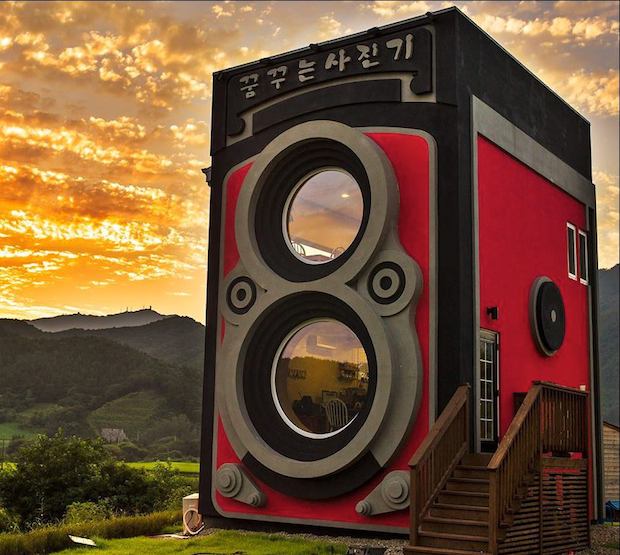
Twin Lens Coffee Shop in Korea

Quick post today. My friends Charlie and Bill sent me this funny little piece of photographic fun.
Image Source: http://petapixel.com/2014/03/29/coffee-shop-south-korea-shaped-like-rolleiflex-camera/
 
Now there's a place I'd like to sit and have a cup of coffee. Apparently, they don't open until 11AM, so I'll have to remember that if I'm ever in South Korea and want to have breakfast in a twin lens reflex (TLR) camera-shaped coffee shop.
 
(Click Here) to read a little more about this on Petapixel.
 
I think it's interesting how certain forms stick with us and find application in unpredicted ways. I've seen restaurants made from boats and train cars, both iconic shapes that people have interest in. I suppose if you're going to make one from a camera, the TLR is the way to go. Basically a rectangular box, the TLR offers a very traditional interior layout. If it weren't for the two big porthole windows, you may forget that you're inside a camera.
 
DMC-365.blogspot.com


Sunday, April 6, 2014

Will Springtime Ever Come to Virginia? Stephen L. Tabone Finds Spring Owls

It just seems to keep coming at us. Snow this week. We've had a couple of hints of Spring, but nothing to count on. I recently read a quote that I really like:
 
"All winters turn to spring."
Stephen L. Tabone is one of the best wildlife photographers I've seen. This week, he posted images of barred owls that he was able to kayak to here in Virginia.
 
Image Source: http://stevetaboneblog.com/2014/03/26/barred-owls-2/
 
(Click Here) to read Stephen's post and see several excellent pictures of the barred owls.
 
I like this post on several levels. First, I love owls. I have only successfully photographed one; I have not been too successful at finding them, though Stephen gives me a clue with finding his near a creek entry to a lake.
 
Here's the one I was lucky enough to find some time back:
 
Barred Owl, by Reed A. George
Panasonic Lumix DMC-G3, Lumix 100-300mm f4-5.6 Lens at 300mm
iso 400, f6.3, 1/800 sec.
 
Beyond the subject, I really like that Stephen was able to approach his owls by kayak, one of my favorite ways to get out and photograph nature. I'm looking outside at the rain and 40 degree temperatures, but know that it won't be long before I can get out in my kayak as well.
 
Stephen's images are always first-rate. For this post, he was shooting a Nikon D800 and 80-400mm lens. I'm not sure whether he has the older or the new version of this lens. The new one is quite spectacular, which I say based on playing with one for a few minutes only. Stephen also uses a flash and flash extender ("Better Beamer") in some of his shots. I have a version of the Beamer, but always seem to get white eyes in birds that I shoot with it. So, I almost never use it. The solution is to get the flash further off-camera, so that the light reflected from the bird's retinas doesn't come right back into the lens. But, with a big old flash, Beamer attached, it gets quite clumsy to try and either hand hold the flash off-camera (with a long lens attached), or use some kind of bracket. It's tough enough shooting birds like this, near impossible with unwieldy camera gear. That said, my shot above could have used just a tiny amount of fill flash to bring the left side of the owl's face up in brightness.
 
In any case, Spring is on the way to Virginia! Thanks for reminding me, Stephen.
 
DMC-365.blogspot.com
 

Saturday, April 5, 2014

Nikkor 5cm f1.4 Rangefinder Lens on Leica M9

I mentioned that I'd purchased a very nice old Nikon S rangefinder camera, Nikkor 5cm f1.4 lens, and Amedeo adapter to mount the lens on my Leica M9. Here are some quick test shots to show what that Nikkor lens can do on the M9 body. All of these are jpegs right out of the camera, no editing.
 
First, I shot these three shots at the same exposure, but at three different f-stop settings (f1.4, f2, f2.8) to show sharpness and depth field.
 
Nikkor 5cm f1.4 at f1.4, 2, and 2.8
 
At this size, the most obvious effect of closing down the aperture is eliminating vignetting (darkening around the edges of the image). This lens vignettes quite significantly at f1.4. It clears up pretty well by f2.8.
 
How about sharpness? Here are crops of the same three shots, showing focus at the three f-stop settings:
 
 
Crops at f1.4, 2, 2.8
 
I think it's pretty sharp, even wide open. By f2.8, it's very sharp.
 
But, of course, none of that matters too much. If I was going to ultimate sharpness, a modern lens would be the best bet, not a lens from the 1950s. What really matters is whether or not I like the look the lens produces. Well, I'm not sure yet. But, here's an early hint:
 
 
Just a Quick Shot
 
This shot was also made wide open at f1.4. I'm definitely looking forward to shooting some more with this lens. I also need to explore how it renders color. I'm also interested in seeing how it does on the Nikon film body it was designed for.
 
DMC-365.blogspot.com