Showing posts with label Holga. Show all posts

Saturday, March 18, 2017

A (Holga) Day in the Life

I decided to pull out an old, neglected camera today, the cute little Panasonic Lumix DMC-GX1.  I was in the mood for some low-thought, low-effort shooting, so I mounted the 25mm f8 Holga plastic toy lens.  Here is what I captured today:


DMC-365.blogspot.com

Monday, February 16, 2015

Brownie Reflex 127 - Some Results

Remember when I posted the question pondering why cheap old cameras are so much fun? (Click Here) if you don't remember, or want to see what the Brownie Reflex looks like.
 
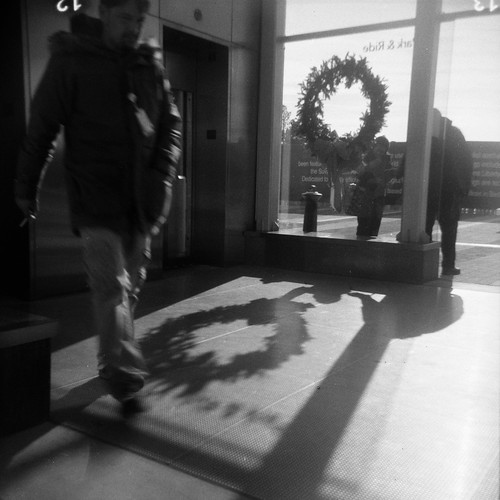
Here are a couple of results from my first roll of Efke 127 (I bought it a couple of years back), developed by Dwayne's. The first is just an odd perspective of the new Metro station in Reston, Virginia. I actually like the way the film exposure numbers show up at the top (who knows why?).
 
Metro, by Reed A. George, Kodak Brownie Reflex Camera
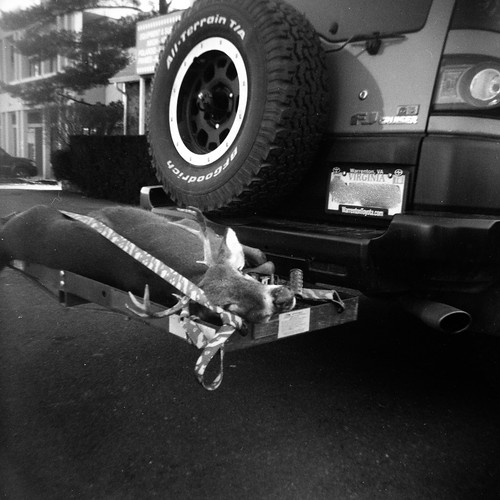
And here's a scene you may have seen before, as I shot it with both the Brownie and my new Nikon Df. (Click Here) to see the Df version.
End of the Season, by Reed A. George, Kodak Brownie Reflex Camera
 
I like the randomness of shooting with very basic old cameras. They're cheap, and I think at least as much fun as shooting with a Holga. Once you've loaded film, the only variable in your control is composition. Exposure and focus are fixed.

This Brownie Reflex was $10, and cleaned up very nicely. However, getting 127 film is not easy, and it's expensive ($11-$12 per roll, twelve exposures). The only place I know to get it reliably is The Frugal Photographer (frugalphotographer.com). I bought a few rolls last time, including some black and white and some color.
 
You can still get 127 developed with no problem. This time, I used Dwayne's. But, I'm not as happy with their work as I am with The Darkroom (thedarkroom.com). Just my opinion. It's good to have them both as options.
I've got a few more images to share from this first roll, so stay tuned!
 
DMC-365.blogspot.com

Tuesday, June 24, 2014

Holga 25mm f8 Lens on Lumix Micro 4/3 - Down by the Riverside

I attended the Shenandoah Riverside Festival in Brunswick, Maryland last weekend.
 
(Click Here) to read a little about the festival, and hosting organization, Earth Korps.
 
In addition to my Nikon D700 kit, I brought along the tiny Panasonic Lumix DMC-GX1 and a couple of specialty lenses, including a plastic toy lens, the Holga 25mm f8. I had some fun with that, and here are the results.


And here's my favorite:
 
Fun with the Holga 25mm f8 Lens for Micro 4/3, by Reed A. George
All Images Made with Panasonic Lumix DMC-GX1
 
For $20, the Holga lens is worth a try. See below for a link to yours on Amazon.
 
Recently, I've been having fun with low tech. Not only cameras that were once state-of-the-art but happen to be from the age of film, but also things that started out low tech, like the Holga lens and my pinhole camera.
 
I've got an exhibit in mind along these lines. Just a concept, I need to work through writing an artist's statement and see if it holds up. It's time for a new project.
 
DMC-365.blogspot.com


Saturday, July 27, 2013

Barcelona - A Changing City, Wonderful Place to Photograph

 
Glimpse of a Memory in Barcelona, by Reed A. George
Panasonic Lumix DMC-G3, Holga Micro 4/3 Lens
 
I read an article by Beatriz Silva on the blog Theme today, about how Barcelona is changing. Beatriz is a Chilean photographer, living in Barcelona.
 
(Click Here) to read the piece on Photography Daily Theme.
 
Silva makes the case that while Barcelona is one of the richest cities in Spain, the European financial crisis is taking its toll. Poverty and homelessness are high, and on the rise. There is also a cultural loss going on in Barcelona, with the example being bookstores giving way to McDonalds. That is happening everywhere. In fact, I don't have a bookstore within a 20 mile radius of my home in Northern Virginia anymore. Amazing.
 
In any case, I visited Barcelona last November, and just really loved it. It is a photographer's dream. While I shot my Lumix DMC-G3s a lot, I also did a series of evening street shots with my Leica CL and 40mm Rokkor f2. I've submitted these for publication in the LHSA (International Leica Society) magazine, The Viewfinder. They're accepted, and will be published in the next issue!
 
If you get the chance to go to Barcelona, take it. So much culture, history, and style in one place.
 
DMC-365.blogspot.com


Friday, June 7, 2013

Low Tech Wonder - the Debonair from the Film Photography Project

 
The Plastic Filmtastic Debonair from the Film Photography Project
Image Source: http://filmphotographyproject.com/store/fpp-plastic-filmtastic-120-debonair-camera
 
I've gotten hooked on a podcast from the Film Photography Project (FPP). It's a regular audio podcast put together by a group of friends in Findlay, Ohio. Part comedy, part film photography infocast, these guys keep it light and interesting.
 
(Click Here) for information on the podcast.
 
They also have an online store, with great pricing and availability on film. In fact, their Kodak film prices match the big New York warehouses. I like to support FPP.
 
(Click Here) to go to the FPP store.
 
While you're looking through the store, you may notice the "Plastic Filmtastic Debonair." An all-plastic medium format (120 film) camera, the Debonair is reminiscent of a Holga. With its fixed "Super lens," which is a 60mm f8 (no f-stop adjustment available), the Debonair shoots vertical (portrait) orientation 6x4.5 cm images. You get 16 images per roll of 120. Shot spacing is accomplished through a red window in the camera back, so you'll need to put some black tape over that if you use high speed film. The shutter speed is fixed somewhere around 1/100 sec on the sunny setting. There's also a cloudy setting that seems to be close to the same, maybe 1/60 sec. The lens has three focus settings - close, medium, far.
 
This camera allows you (forces you) to put your mind on seeing images, rather than technical settings. Composition becomes king. Sharpness is out the window, of course.
 
Most importantly, the Debonair costs $19.99. It's worth at least $19.99, maybe even $20.00.
 
Here are some images from my first roll of film through the Debonair, shot on Konica Centuria 100 print film, which expired in 2006.


Plastic Filmtastic Debonair Images, by Reed A. George
 
Obviously, I didn't spend any time post-processing these. I did increase the exposure a little after scanning them, but that's it. I think iso 200 film would be better for daylight pictures.
 
As usual, I used my favorite processing house for these, The Darkroom.
 
(Click Here) to check out The Darkroom. They process 35mm and 120 film for $10 per roll, including putting scans online for you. I'm a dedicated customer. You can print out a prepaid mailing label, or they'll send you a prepaid envelope if you contact them. I have sent them a lot of film, and always been happy with the results.
 
So, spend $20 with the good people at FPP and get yourself a Debonair. See what forgetting about f-stops, shutter speeds, and focusing points can do for your creative side!
 
DMC-365.blogspot.com


Wednesday, April 10, 2013

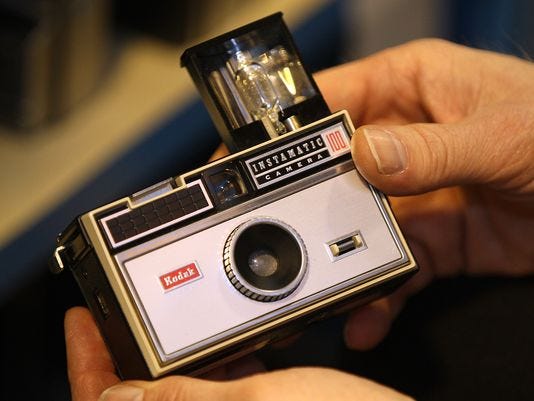
The Kodak Instamatic Turned 50 in March

Image Source: http://www.usatoday.com/story/tech/2013/03/29/instamatic-camera-50-years/2034585/
 
I read this morning that the Kodak Instamatic camera was first introduced in March, 1963. That's about seventeen months before I was introduced to the market (being born in December, 1964). My first camera ever was a Kodak Instamatic, which hardly distinguishes me - Kodak sold 50 million of them!
 
There's an interesting post about the Instamatic, a camera designed to be easy to use at the cost of image size, lens quality, and just about everything else, on The Online Photographer blog. But, easy to use it was! The 126 cartridge film and flash cube were truly foolproof. You had to intentionally bust open a cartridge (or remove it mid-roll) to accidentally expose your film.
 
(Click Here) to read about the Instamatic and chief designer, Hubert Nerwin (a post-war transplant from Carl Zeiss in Germany) on The Online Photographer. In this article, the author Mike makes the case that the Instamatic gave Kodak the misplaced confidence to bring out other compromised products, including the Disc Camera and APS systems.
 
As I remember it, the APS was really kind of cool. Most APS cameras could rewind your film mid-roll, and remember where they were, automatically getting you back to the correct frame when reinserted in the camera. That was pretty advanced for the time. I would like that feature on my 35mm cameras.
 
I also think Mike left out the most compromising development in cheap cameras, the 110 film cartridge. Truly a miniscule negative, you were beat before you ever started if you wanted to take a quality image with 110. Yes, I know the Pentax Auto 110 was a cool little camera outfit. It was like if Panasonic produced a system camera based on a 640x640 pixel tiny sensor, rather than Micro 4/3.
 
And, amazingly, 110 film is back! At least it's in the right hands now, those of people who understand and even enjoy its limitations. Yes, I mean the Holga / Diana crowd, where medium format cameras with light leaks are welcomed, for example. I really like this crowd - as I often say, constraints (or limitations) can sometimes drive creativity, and I think the toy camera user groups are often creative.
 
Want to know more about 110 film, where to get it, and how to get it processed?
 
(Click Here) to read about it at the Film Photography Project (FPP). This article should get you started. They sell 110 film in the FPP store. Or, see my link below to buy it at Amazon.
 
DMC-365.blogspot.com


Friday, December 21, 2012

Diptych - Barcelona

 
Barcelona Couple, by Reed A. George
Panasonic Lumix DMC-G3, Holga 25mm f8 Plastic Lens
iso 400, f8, 1/100 sec
 
You may have already seen my previous post of shots taken with the Holga plastic lens for Micro 4/3 cameras. The two above give me fond memories of walking "La Rambla," a major pedestrian thoroughfare in Barcelona. I shot these two shots seconds apart, as I walked past this couple at the subway station.
 
I pay attention to the pace of my shooting. Sometimes, I really enjoy taking a lot of time, setting up a shot, attempting perfection. I find that style of shooting relaxing and rewarding. On the opposite end, another of my favorite styles is street shooting, where I typically set the camera up with manual range focusing (no autofocus), preset exposure (sometimes I'll use Aperture priority, but use Manual more often than not), and use the camera to capture extremely brief little moments. This is a real challenge, and there's no time for fiddling with the camera. The result is just that - captured moments. Imperfect, spontaneous. Sometimes the imperfections add to the image, sometimes not.
 
In the case above, the imperfections are clear - thanks to using a $20 plastic lens with fixed f-stop and only very rough focus control. Personally, I love the result. It is very close to the level of detail in my memories of that morning, walking down La Rambla.
 
Thanks again to Andrea Costa for pointing me towards this great creative tool (the Holga lens).
 
DMC-365.blogspot.com
 
 
DMC-365.blogspot.com
 

Tuesday, December 18, 2012

Interesting Photo Challenge - Simplify, Focus on Framing and Timing

Here's a challenge, presented on the facebook page of Next Cameras (http://www.facebook.com/NextCameras?ref=stream
 
"...Hmmm. So here's a simple technique to try: shoot like a Reuter's PJ next time you head out. Bring a wide angle zoom and start with it at the widest focal length. Set aperture priority with your fastest aperture. Change only one camera setting: ISO value to keep your shutter speed in a range you're comfortable that you'll get sharp images from (and if
you're really following the rules, set your Nikon body to one-stop increments for ISO ;~). Spend all your remaining energy on just three things: framing, focus, and timing. Note that "framing" may mean moving forward, backward, and sideways! You, not the zoom. (For those that think landscape photography can't be done this way, think again. It's actually very close to the way I learned from Galen Rowell and still practice, only we don't usually set maximum aperture, but rather something like f/8.

I'll make a small wager: you get better images by concentrating this way. PJs do, so why should you be any different? ;~)
Thanks to Thom Hogan for the idea."
I like this. It reminds me of the shooting I recently did with my new Holga lens on the Lumix DMC-G3.


Shot With Holga 25mm f8 Lens on Lumix DMC-G3
Sometimes it's just plain good to narrow the variables. I will try Thom's suggestion above.
 
DMC-365.blogspot.com


Wednesday, December 5, 2012

Why Is This So Bloody Fun? Holga Plastic Lens on Micro 4/3.

So, on a whim and a suggestion (from Andrea Costa, one of my readers), I recently picked up a Holga plastic lens for my Lumix DMC-G3 Micro 4/3 camera. Total cost? $22 including shipping, and a couple of weeks waiting for shipment from Hong Kong.
 
(Click Here) to go to Holga Direct if you want one.
 
I used mine on our last day in Barcelona. I can't really explain why, but it's sort of freeing to not worry about the technical quality of your images. It's a blast to just snap whatever comes in front of your eyes. One very rough focus knob is all there is. The f-stop is always f8. I used aperture priority sometimes, manual shutter speed settings, other times. Most of the time I used iso 400, but went up to 3200 in dark places.
 
This shot was taken from the cable car going up to Montjuic Castle. These guys were working on the roof of a building in the part.
Roof Repairs, by Reed A. George
Panasonic Lumix DMC-G3, Holga 25mm f8 for Micro 4/3
Going Up, by Reed A. George
Panasonic Lumix DMC-G3, Holga 25mm f8 for Micro 4/3

I find that this lens works best with bold shapes and colors. Maybe that's one of the things I like about using it. It just kind of captures blurry little memories of what you're experiencing. I really, really like using it.
Vines, by Reed A. George
Panasonic Lumix DMC-G3, Holga 25mm f8 for Micro 4/3

Montjuic Castle Arches, by Reed A. George

Panasonic Lumix DMC-G3, Holga 25mm f8 for Micro 4/3

 
Lamps, by Reed A. George
Panasonic Lumix DMC-G3, Holga 25mm f8 for Micro 4/3
Tomatoes, by Reed A. George
Panasonic Lumix DMC-G3, Holga 25mm f8 for Micro 4/3

I highly recommend that you get one of these. I can feel it being a great solution for creative block, when I just can't think of anything to shoot, or what to say with my photography. I wondered about whether I'd regret using it on a trip to Barcelona - didn't I want all nice, sharp images? The answer is no. The Holga lens really added to my trip, and the shots here will be part of my memories of the trip.

DMC-365.blogspot.com


DMC-365.blogspot.com
 

Monday, October 22, 2012

Wanna Turn Your Nice Micro 4/3 Camera Into A Holga? Olympus Body Cap 15mm Lens.

 
Olympus 15mm f8 "Body Cap" Lens
Image Source: http://www.photographyblog.com/news/olympus_15mm_f_8_body_cap_lens_for_micro_four_thirds/
 
Well, not quite a Holga. This little lens has a focus knob. But, if you push that to infinity, set your iso to 400, and shutter speed to 1/100 second, you've got yourself a "no-touch" craptastic camera, just like the Holga.
 
If you're not familiar with the Holga cheap plastic camera movement, (Click Here) to see the Lomography site.
 
That's right. This tiny little fix f8 (very slow, needs a lot of light) lens fits onto your Micro 4/3 body and can serve as both a body cap, and a rather constrained lens.
 
I found a nice post on Pekka Potka's blog about using the lens on walks with his dog. Pekka indicates all of the limitations of the lens, but still decides to have some fun with it.
 
(Click Here) to read Pekka's blog entry about this lens and see plenty of example images.
 
For me? Certainly not. But, at least Olympus is keeping it interesting.
 
DMC-365.blogspot.com