Thursday, May 7, 2015

Worldwide Pinhole Day 2015 - Closeup with the Nikon Df and Finney Pinhole Cap

Sunday, April 26, 2015 was Worldwide Pinhole Day. (Click Here) to learn more about this fun event.
My friend, Bill, and I went out to the National Arboretum for some pinhole shooting on that day. Because I like to shoot black and white film in my Reality So Subtle 6x17 panoramic pinhole camera, I decided to also bring along my Nikon Df DSLR, fitted with an f/180, 50mm focal length pinhole bodycap.
 
My pinhole cap was made by a company called Finney; I'm not sure if they still exist. I bought it some years back, and have used it very little. On a sensor as small as even the full-frame Nikon Df, pinhole makes very soft images. Now, pinhole photography isn't about sharpness, but the large format film pinhole cameras I normally use make much sharper images. Anyway, I brought it along so that I could capture some spring color.
 
Here are some images I captured closeup with the Df and pinhole body cap:
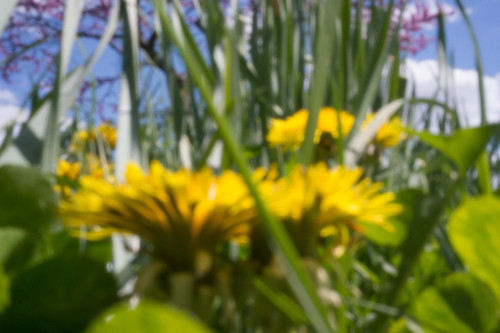
 
Dandelions, by Reed A. George
Nikon Df, Finney f/180 Pinhole Body Cap
iso 3200, 1/60 sec.
 
As you can see, I was able to shoot handheld with the Df, since I cranked the iso up to 3200. With my film pinhole cameras, I usually shoot iso 100, which requires serious stability. Exposures are in whole seconds to sometimes even hours.
 
Pinholes have extremely small apertures, which means lots of depth of field. In this case, that means that everything, no matter how far from the camera, is the same degree of blurry. But, I do kind of like the effect.
 
Here's another shot, showing another member of the dandelion micro environment, a wasp.
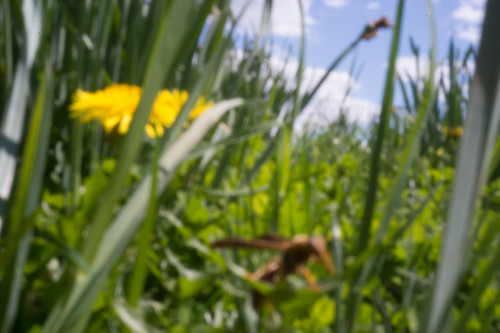
 
Dandelion and Wasp, by Reed A. George
Nikon Df, Finney f/180 Pinhole Body Cap
iso 3200, 1/60 sec.
 
Worldwide Pinhole Day only allows each entrant to post a single picture. I haven't selected my single best image yet, but will continue to share several others that I made with the Df on that day.
 
I find it very interesting that low tech can actually add interest to my images. I'm seeing it more and more, and find myself taking the technical edge off of much of my work. I know it's not for everyone, but hey, I'm doing this for my own creative development. And I'm enjoying it. If you're stuck in a photographic rut, I highly suggest that you step back, relax, and take some blurry pinhole images. It can be rewarding.
 
DMC-365.blogspot.com
 

Wednesday, May 6, 2015

How to Get Better Pinhole Images

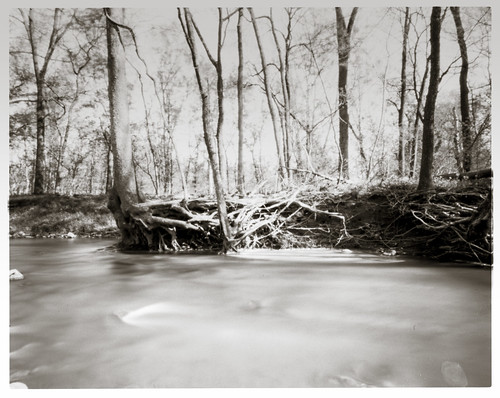
Bull Run Creek, by Reed A. George
4x5 Pinhole Camera
 
Today (the day I'm writing this, April 26, 2015) is World Pinhole Day.
 
(Click Here) to read about World Pinhole Day. You've missed this one, but read up and be prepared for the next one!
 
My friend, Bill, and I went put and shot pinhole images today at the National Arboretum in Washington, DC. I used my 6x17 panoramic pinhole camera for black and white. But, since there were so many great colors there because of spring, I also shot quite a lot with a pinhole body cap on my Nikon Df. I'll be posting some of those in the near future.
 
(Click Here) to read about the Reality So Subtle 6x17 panoramic pinhole camera that I use a lot these days.
 
After returning this evening, I did a web search to read a little more about pinhole techniques. I found a post on The Phoblographer (Click Here to read it), listing five keys to better pinhole photos:
 
  1. Shoot in black and white
  2. Use a tripod
  3. Use high contrast film
  4. Compose to guide the viewer through your image
  5. Use a lightmeter
 
I agree with most, but not all of these points. As I've already said, I do like to shoot color as well as black and white in my pinhole cameras. Also, I strongly recommend using a smart phone app, instead of a light meter. Personally, I use a great one called "Pinhole Meter" on my iPhone. It is very simple to use, and doesn't require me to mentally calculate anything. Better than a traditional lightmeter.
 
I had a great time shooting on World Pinhole Day. Now to process film, select a single image, and get it posted to the website!
 
DMC-365.blogspot.com


Tuesday, May 5, 2015

Is Photojournalism Really Dead? NY Times' Blog "Lens" Discusses Storytelling and Honesty

 
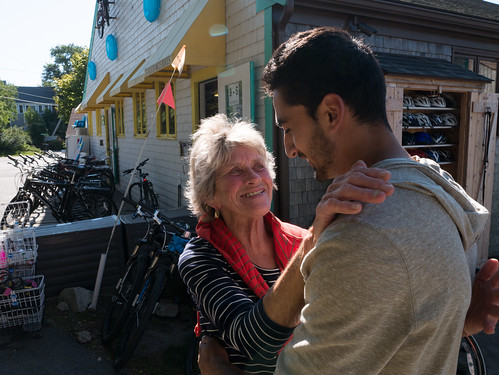
End of Summer Goodbyes, by Reed A. George
Panasonic Lumix DMC-GX7, 14-42mm Series II Kit Lens
iso 400, f11, 1/500 sec.
 
I just read an interesting article entitled "Modern Photography," about the state of photojournalism (PJ) today on the NY Times' blog, "Lens."
 
The piece compiles the thoughts of several photographers, curators, and editors, including Maggie Steber, who I recently had the great fortune to meet at the LHSA (International Leica Society)'s Spring Shoot in New Orleans. Maggie was our keynote speaker.
 
I used the photograph above for this post, as it is a piece of honest PJ that I shot, of a lady in Provincetown, Massachussetts, saying goodbye to a young man from Bulgaria who was returning home after his summer employment there. The change in P-town's population during the tourist season was a subject of interest to me.
 
More importantly, perhaps, I asked this young man to carry his suitcase out of his place of work for me, so that I could get a shot of him leaving. Actually, he was leaving the next day. He wasn't able to do that for me, but if he had, would that have been too much staging to qualify as PJ? Upon reflection, I think it would have been. These are tough lines to see and stay within.
 
Some of the interesting points in the Lens Blog post:
 
  • In earlier times, PJ could be used simply to show or prove that something was occurring outside the direct view of some readers. But, those events - war, famine, crime, etc. are now known to everyone. We don't need proof. Now, the photographer needs to somehow go further, to tell a story, to make it more "real" for the viewer/reader.
  • In fact, because the events represented are now known to everyone, a picture of the event can have the effect of trivializing the situation. Sort of "Oh, another famine," rather than engage the viewer in what it really means.
  • Because of this point, at least one authority states that "photojournalism is dead."
  • Many photographers engage in long term projects, where they certainly do affect the poses of their photographic subjects, move to better light, etc. This is where the lines get blurry.
  • The most important thing is for the photographer to be honest about how they produced their pictures. Admit what they are and are not showing.
  • When it comes to honesty, it used to be that a professional photojournalist would lose all credibility, and probably their job, if they were dishonest in representing a subject. Now, there's very little risk to most photographers, especially those who just happen to have a camera with them and capture events as they happen.
  • Honesty in photography has been a problem ever since photography was invented. We now know that some famous civil war photographers staged scenes, and even used the same body twice - once as a Union soldier, another time as a confederate.
These were the things that I found most interesting about the Lens Blog piece. (Click Here) to read it for yourself.
 
DMC-365.blogspot.com


Monday, May 4, 2015

Nick DeMarco (Rangefinder Chronicles) Uses His Hasselblad Xpan on the Street


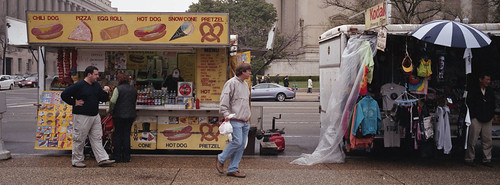
DC Street Vendors, by Reed A. George
Hasselblad Xpan
 
I used to a Hasselblad Xpan panoramic camera. Shooting 24x65mm images on regular 35mm film, it was interesting. I've always been partial to panoramic images.
 
I sold mine, for two major reasons: 1) it was worth too much money for the amount I used it, and 2) I found a panoramic back for my Bronica ETRS. I feel like I had just begun to get how to compose with the XPan when I sold it. Probably too soon. And, I have not used the Bronica pano back nearly as much as I expected.
 
What I did shoot with the Xpan was mostly landscapes.
 
I recently read a post on Nick DeMarco's Rangefinder Chronicles blog about how he uses the Xpan for street photography. (Click Here) to read about it on Nick's blog. He's got some great work there.
 

This doesn't have me back in the market for an Xpan, but it does make me motivated to get out with the Bronica. It's been sitting for far too long.


DMC-365.blogspot.com


Sunday, May 3, 2015

Finding Space in the Big City of Tokyo - with Leica IIIG

 
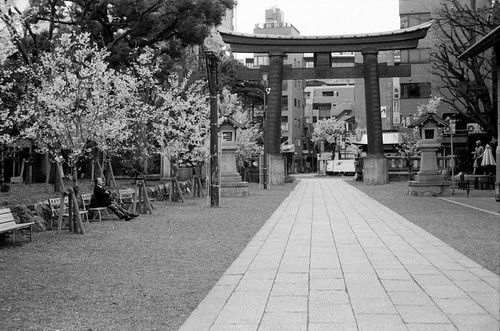
Urban Space, by Reed A. George
Leica IIIG, Ilford HP5 Film
 
This gentleman on left was out early in the morning at the Tomioka Hachiman shrine in Tokyo. The lesser shrines are always a good place to go for some space and relaxation. The big ones, like Meiji Shrine, are frequently very crowded. The secret in either case is to be out early.
 
I find this to be true in almost any big city. New York City, Barcelona, Tokyo, they're all pretty quiet in the early mornings.
 
Here's another shot from the shrine. I focused on the cherry blossoms, rendering the fountain slightly out of focus with shallow depth of field. There was no one else in sight when I shot this.
Quiet Morning, by Reed A. George
Leica IIIG, Ilford HP5 Film
 
So, if the crowds in the big city get to you, simply get up early! Jet lag sure helped with that while I was in Tokyo.
 
DMC-365.blogspot.com
 

Saturday, May 2, 2015

I Love Slow Photography - Jim Austin Shares "SloFo" on Film Photography Project Blog

Slow, by Reed A. George
Mamiya Universal Press Camera
 
I love slow photography. Probably my favorite camera for ultra-slow, contemplative photography is the Mamiya Universal Press (MUP). You just don't hurry this camera up. It's big, heavy, and stubborn. It makes me do photography it's way.
 
Jim ("Jimages") Austin has written a nice blog post on the Film Photography Project's blog about slow photography, which he refers to as "SloFo." I'm not sure why we need a new term for it, but I enjoyed Jim's post nonetheless. Jim was shooting in the Bahamas with a selection of Konica, Nikon, and Nikonos film cameras.
 
(Click Here) to read the blog post on the Film Photography Project's page. Be sure to watch the video that's linked to from the text; it shares different pictures than are used in the text. Plus, it's kind of fun to see Jim paddling his boat to shore.
 
If you're a rapid-fire high speed continuous shooter, you owe it to yourself to try some slow photography. Personally, I find it much more rewarding and useful in sharing my creative vision.
 
DMC-365.blogspot.com

Friday, May 1, 2015

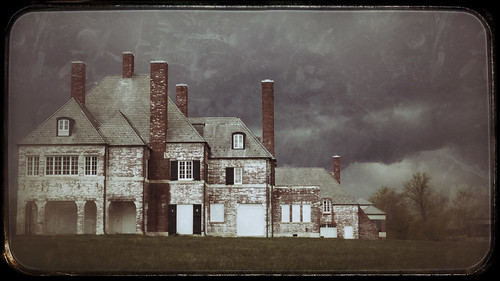
Storm Approaches the Manor House - Lumix DMC-LX100 and Snapseed

I ventured out from the office today as a storm approached. Here's my interpretation of the scene.
Storm Approaches the Manor House, by Reed A. George
Panasonic Lumix DMC-LX100
iso 200, f8, 1/250 sec.
Manipulated in Snapseed on iPad
 
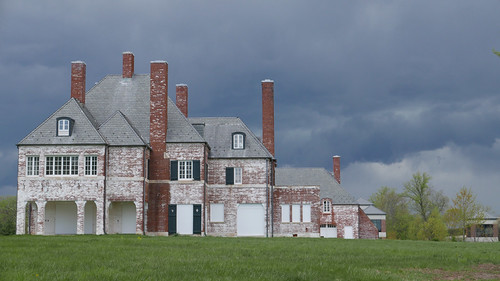
Here's the original image from the LX100.
 
The springtime seasonal allergies are killing me right now, so I paid the price for being outside. But, the clouds were so dramatic, I had to run out and get the shot. The Panasonic DMC-LX100 made that very easy.
 
DMC-365.blogspot.com