Showing posts with label DMC-G3. Show all posts

Saturday, September 27, 2014

Nice Summary of Six Years of Micro 4/3 on m43photo.blogspot.com

Dancing, Golden Gate Park, by Reed A. George
Panasonic Lumix DMC-G1, Voigtlander 28mm f2 Ultron Lens
 
 
I have spent a lot of time shooting, and thinking about, the Micro 4/3 format. In fact, my blog is named in observance of the standard "DMC-XX..." camera model designation of Panasonic's Lumix cameras. For Panasonic, the DMC-G1 was the first Micro 4/3 camera. I made good use of that one. Then, for an entire year, I focused mostly on shooting a pair of DMC-G3s.
 
I have ventured far and wide since that first year of 2012, but still regularly include Micro 4/3 gear and images in my posts.
 
The blog m43photo.blogspot.com, started in 2009, has been focused on Micro 4/3 longer, and more exclusively than my own, but with fewer overall blog posts. Now they have posted a brief retrospective of what's gone on in terms of camera and lens development over the past six years.
 
(Click Here) to read the post on m43photo.blogspot.com
 
I have been ambivalent over the years about whether or not the Micro 4/3 sensor size was the right compromise between sensor size (larger would provide better image quality) and equipment size (smaller sensors lead to smaller cameras and lenses). About a year or two ago, it seemed that APS-C was about the smallest you could go and still expect truly excellent image quality at higher iso settings. Now, I'm beginning to once again think that Micro 4/3 may turn out to be an ideal size.
 
In the Magnum workshop that I just attended, I shot with both my Leica M9, a full frame digital rangefinder, and the Lumix DMC-GX7, a Micro 4/3 camera. As it turned out, I used the GX7 for most of my shooting, which included a lot of bike rides around the Cape Cod National Seashore; most of the images in my final project submission were shot on Micro 4/3. There were certainly no complaints about image quality.
 
In fact, at the same workshop, David Alan Harvey showed us his new book Based on a True Story. The cover shot was made with a Lumix GF1 Micro 4/3 camera. It's hard to argue with the image quality he achieved.
 
It will be interesting to see how the evolution of Micro 4/3 proceeds over the coming several years.
 
DMC-365.blogspot.com

Wednesday, July 30, 2014

Eastern Market Flea - Mirrors, Mirrors, Mirrors

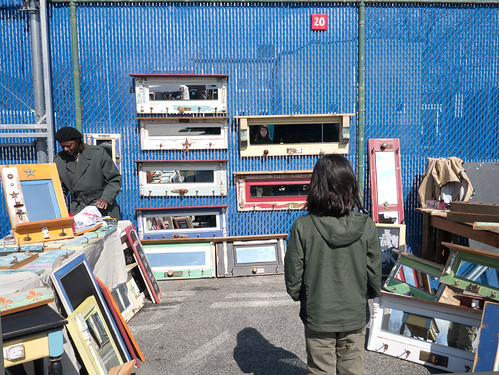
Eastern Market is a great place to do street photography in Washington, DC. In the weekend flea market, there are a couple of vendors who sell mirrors of various designs. I have shot them several times myself, and see them pop up in my friends' portfolios pretty often as well.
 
Here's one shot I made there in 2012, of my daughter looking into one of the mirrors. Hard to believe how much she's changed in the intervening two years.
 
Eastern Market Mirrors #1, by Reed A. George
Panasonic Lumix DMC-G3, Lumix 14mm f2.5 Lens
iso 160, f8, 1/400 sec.
 
Here's a more recent shot from Eastern Market, taken last weekend.
 
Eastern Market Mirrors #2, by Reed A. George
Leica M9, Leica Summilux 50mm f1.4 Aspheric
iso 400, f5.7, 1/500 sec.
 
And no, the second image isn't of my daughter; she hasn't changed that much in two years! I like how the lady provides a nice focal point, and how my camera shows up in a couple of the mirrors, along with various parts of other bystanders.
 
DMC-365.blogspot.com
 

Friday, February 21, 2014

Reminder That Micro 4/3 is Capable of Low Light Excellence

 
Acoustic Burgoo, by Reed A. George
Panasonic Lumix DMC-G3, Lumix 100-300 f4-5.6 OIS at 100mm
iso 6400, f4, 1/100 sec.
 
Lately, I've been shooting live music with cameras other than Micro 4/3. Mostly my Nikon D700, but also with Leica, and even with film.
 
I read an interesting post by Kevin Paris, where he shares a lot of live music photography from Belgium, all shot with Micro 4/3 cameras.
 
(Click Here) to read Kevin's post and click on the flickr link to see his images. He's included a lot of black and white images. I really like some of his results.
 
Anyway, this got me looking back on images I'd made with Micro 4/3. The shot above was made with several generations of Lumix sensor back - the DMC-G3. It's amazingly good for iso 6400. I can only imagine what my DMC-GX7 would do in this situation. I can only imagine because I haven't tried it. That's inexcusable, and I'll remedy that situation soon.
 
DMC-365.blogspot.com


Saturday, December 21, 2013

How to Shoot a Stranger's Photograph - 8 Easy Steps by Valerie Jardin on Digital Photography School

I love to photograph people on the street, people I don't know. Weird? Okay, I can accept that.
 
Sometimes, I really want to photograph people going about their business, hopefully oblivious to me and my camera. This is where a small, discreet camera comes in. Other times, I feel a little more outgoing, and enjoy meeting and talking with the people I come across. That's a very different type of photography, and it's not for everyone.
 
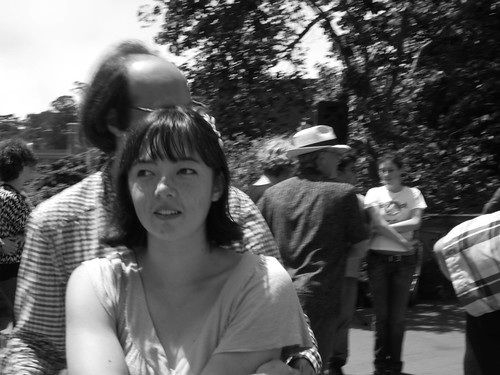
Matching Glasses, by Reed A. George
Panasonic Lumix DMC-G3, Lumix 14mm f2.5 Lens
iso 160, f8, 1/160 sec.
 
Digital Photography School has posted a piece by Valerie Jardin, outlining 8 "easy" steps to taking portraits of strangers.
 
(Click Here) to read the post on Digital Photography School.
 
Here are the steps, and my thoughts on each:
 
  1. Practice without a camera. This may not work well for me. In fact, many times, the camera gives me a reason to talk with someone. I'm sure that I would not have spoken to the young ladies in the photo above if I didn't have a camera and a picture in mind. But maybe that's just me.
  2. Photograph street performers. This is great advice. If you want to interact with your subject, this is a very good way to go. Performers are doing just that - performing. They generally love to have their pictures taken, and it shows.
  3. Take a friend along when you go to shoot. This one really doesn't work for me. I do so much better interacting with strangers when I'm alone. For one thing, they're not outnumbered. I think that can be threatening (it would be to me).
  4. Don't hide behind a long lens. Great advice, again. If you use a spy lens, you get a spy image. Sometimes that can be okay. Usually not. It's tough to interact with your subject from across the street.
  5. Be confident. Great advice, if you can pull it off. If it's not natural to you, this advice is like telling a tall person "be short." Some days it comes natural to me; other days, I don't want to talk to anyone.
  6. Take your time. This is a real lesson. I don't know how many times I've overcome the hesitancy to talk to someone, finally went ahead with it, then rushed the shot. When this happens, I think how great it could've been if I'd tried just one more angle, checked the exposure more carefully, asked another question, etc. Pay attention to this one.
  7. Enjoy the experience. I couldn't agree more. If talking to strangers is about as fun as having a tooth pulled, stop doing it! If you genuinely enjoy meeting new people, well then, enjoy it.
  8. Share the results. Totally. Share your pictures with your subjects, if they want. Share them with others. Let us see your work!
DMC-365.blogspot.com


Wednesday, October 9, 2013

Photographing Paintball With the Panasonic Lumix DMC-G3 and 14-140 mm Zoom

My twelve year old daughter has taken up a new sport - paintball. Until now, I've merely dropped her off to play, but have wanted to try my hand at photographing the action. I finally followed up and did it.
 
Assassin, by Reed A. George
Panasonic Lumix DMC-G3, Lumix 14-140mm f4-5.8 Lens at 140mm
iso 400, f10, 1/320 sec.
 
 
So, I found a UV filter to fit the 14-140 lens, custom fit a plastic freezer bag to fit around the edge of the filter and cover the body, and headed out. By the way, this approach worked perfectly; I took a direct hit in the hand while holding the camera. Orange paint splattered the bag, but not the camera. The filter would have protected the lens front element as well.
 
Most of the people out playing paintball are not middle school girls. Many are military people, and they take it pretty seriously.
 
Intense Focus, by Reed A. George
Panasonic Lumix DMC-G3, Lumix 14-140mm f4-5.8 Lens at 140mm
iso 400, f11, 1/125 sec.

 
Here is the best action shot I captured that day:
 
Gunsmoke, by Reed A. George
Panasonic Lumix DMC-G3, Lumix 14-140mm f4-5.8 Lens at 140mm
iso 400, f13, 1/500 sec.


I heard comments about how my little girl is a "badass," "a warrior," "a little ninja," and several other things, all positive. One guy said, "she's on my team, and it seems like everywhere I go, she just pops up." She's quickly gaining the respect of this group.
 
Who's That Little Girl?, by Reed A. George
Panasonic Lumix DMC-G3, Lumix 14-140mm f4-5.8 Lens at 140mm
iso 400, f14, 1/500 sec.


Here's what it can look like when you take a direct shot.
 
Face Shot, by Reed A. George
Panasonic Lumix DMC-G3, Lumix 14-140mm f4-5.8 Lens at 140mm
iso 400, f5.3, 1/500 sec.
 
Cover, by Reed A. George
Panasonic Lumix DMC-G3, Lumix 14-140mm f4-5.8 Lens at 140mm
iso 400, f13, 1/500 sec.

Point and Shoot, by Reed A. George
Panasonic Lumix DMC-G3, Lumix 14-140mm f4-5.8 Lens at 140mm
iso 400, f11, 1/500 sec.
This was a fun photographic outing. I rarely use shutter priority on any of my cameras, but knew that I wanted a fast shutter speed for this type of action. So, I set the G3 to "S" and generally 1/500 second, letting the meter choose the aperture for me. That worked quite well.
 
Because I had to wear a protective mask on the field, it was necessary to shoot from the LCD, rather than through the electronic viewfinder. That was more of a challenge, but it worked okay.
 
Shooting the wide range zoom, which goes from wide angle to telephoto, was also very handy. Next time, I may try getting out on the field with a 35mm equivalent lens. We'll see.
 
DMC-365.blogspot.com


Saturday, June 1, 2013

My Shot of The Acoustic Burgoo Wins the Piedmont Virginian Photo Contest!

The Acoustic Burgoo, by Reed A. George
Panasonic Lumix DMC-G3, 100-300mm f4-5.6 at 100mm
iso 6400, f4, 1/100 sec.
 
My photo of the local band, The Acoustic Burgoo has won first place in the Arts/Music category in Piedmont Virginian's 2012 photo contest!
 
(Click Here) to go to the Piedmont Virginian's website.
 
The hard copy magazine will be on shelves in early July.
 
Once again the Lumix G3 comes through for me, even at high iso settings!
 
DMC-365.blogspot.com


Tuesday, May 7, 2013

Spring is Really Here! Time To Get Back Out in the Field!

 
Fossil Hunting Crew, by Reed A. George
Panasonic Lumix DMC-G3, Lumix 14-140mm f4-5.6 OIS Lens at 25mm
iso 160, f11, 1/160 sec., fill flash on
 
Cabin fever has finally reached its end. Today (Saturday, April 27, 2013), I had the pleasure of taking my daughter and two of her friends out fossil hunting with PaleoQuest founders Jason Osborne and Aaron Alford, and Science writer Kerry Klein. It was a perfect day to be out at Calvert Cliffs, on the Chesapeake Bay.
 
PaleoQuest is a non-profit organization, focused on bringing science, particularly Paleontology, into the hands of students.
 
(Click Here) to check out PaleoQuest's very active approach to improving science education.
 
I shot this fun little video (click on it) of the kids showing what it's like to find a fossil shark tooth. Really, it just gave them a chance to goof off:
Video by Reed A. George
Panasonic Lumix DMC-TS3
 
Here's an example of one of the fossil shark teeth found on this beach, from the largest shark that ever lived, Carcharocles megalodon:
 
Megalodon Tooth, by Reed A. George
Panasonic Lumix DMC-TS3
iso 400, f10, 1/800 sec
 
These are the cliffs, the source of all of the fossil material that ends up in the Bay and on the beach. This is a beautiful place, and I always enjoy being there.
The Cliffs, by Reed A. George
Panasonic Lumix DMC-G3, Lumix 14-140mm f4-5.6 OIS Lens at 19mm
iso 400, f8, 1/160 sec.
 
 
Kerry recorded audio and took some photographs of the outing. Hopefully, we'll see and hear more of the trip in one of her upcoming podcasts.
Kerry Recording Audio, by Reed A. George
Panasonic Lumix DMC-G3, Lumix 14-140mm f4-5.6 OIS Lens at 17mm
iso 160, f5.6, 1/1250 sec.
 
This was a great day. I find it increasingly difficult to find an activity that pleases three twelve year olds; this one did the trick. It was a blast to get out and combine family, friends, science, and photography into a single day!
 
DMC-365.blogspot.com


Wednesday, April 3, 2013

Changing My Micro 4/3 Kit - A New Type of Bottom-Feeding


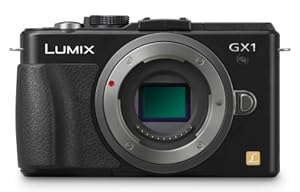
Old Technology (?) - the Panasonic Lumix DMC-GX1
Image Source: http://www.amazon.com/gp/product/B00604YTFM/ref=oh_details_o00_s00_i00?ie=UTF8&psc=1
 
If you've followed my blog for very long, you'll know that I am a frequent user of Micro 4/3 equipment, specifically Panasonic Lumix cameras. My standard kit for the past year or so has been two DMC-G3 bodies, a great collection of mostly Lumix prime lenses (plus one Olympus lens, the spectacular 75mm f1.8), and a couple of zooms (Lumix 14-140mm and 100-300mm). I have enjoyed the convenience of having two identical camera bodies, small enough to carry together without any back pains, and allowing me to minimize lens swaps.
 
Well, I am in the process of making a change. While I have been watching new cameras come out, I haven't sprung for the latest and greatest. That's where the bottom-feeding comes in.
 
Bottom-feeding in camera gear usually means buying very inexpensive equipment, typically used. I'm doing my own type of bottom-feeding, taking advantage of the amazing price drops that come along for cameras that are, or are near to being, one generation back.
 
As you probably have read, I recently bought a Lumix DMC-LX7 compact camera brand new for less than $300. Amazing. This camera is so powerful it is the bargain of the year, in my opinion. In fact, it is so good I wrote an eBook about how I set it up for my uses.
 
(Click Here) or use the Amazon link below to get my LX-7 eBook.
 
Well, when I got the LX-7, I also bought the accessory live viewfinder, the Panasonic DMW-LVF2. This is where Micro 4/3 comes in. The LVF2 also fits the Lumix DMC-GX1, cousin to my G3s, with the same sensor, but in a more compact body, without an integral finder. The GX1 has a few features that the G3 does not, but it's the form factor that interests me most. It is very reminiscent of a rangefinder (though it's not), and extremely similar to the older DMC-GF1, a camera that I really enjoyed in its time. So, of course, I began looking at the GX1.
 
I know, if I'm going to upgrade, why not to the latest sensor technology, either the Lumix DMC-GH3, or maybe even an Olympus OM-D? Two reasons:
 
  1. The GX1, a camera that sold for $699 a year ago, is now available brand new on Amazon for $275! Can't touch an OM-D or GH3 for that price!
  2. Amazon will give me over $250 buy-back value for my G3!
Additionally, I don't like the large size of the GH3. Small size is why I got into Micro 4/3 in the first place.
 
Sure, I had to include my completely unused 14-42 mm kit lens to get the full buy-back value of the G3, and the new GX1 is body only. No problem.
 
So, for essentially no cost (even shipping for both cameras is free), I get to trade in a one year old (still in mint condition) G3 and kit lens for a brand new GX1 body. Since I already have the LVF2 finder, this is a no-brainer for me.
So, I'll let you know how this works out for me. Not having identical bodies may have some drawbacks. I think I will probably use the GX1 with my smaller lenses, like the 20mm f1.7 and 14mm f 2.5. I expect the small size of the GX1 to appeal to me, even though the LVF2 does take away from that characteristic.
 
I am not yet ready to invest in the latest sensor technology, even though I know the benefits are large. Maybe the GX2, if it ever gets announced (and especially if it also uses the same lvf2 finder) will change that.
 
DMC-365.blogspot.com


Saturday, March 30, 2013

Joshua Tree National Park - Lumix In The Desert

 
Prickly, by Reed A. George
Panasonic Lumix DMC-G3, Lumix 20mm f1.7 Lens
iso 160, f4.5, 1/500 sec
 
Desolate, by Reed A. George
Panasonic Lumix DMC-G3, Lumix 20mm f1.7 Lens
iso 160, f5.6, 1/250 sec
 
The detail in the twisted tree in the foreground contrasts nicely with the smooth, weather-worn cliffs. The dry riverbed gives the eye something to follow.
Namesake Joshua Trees, by Reed A. George
Panasonic Lumix DMC-G3, Lumix 100-300mm f4-5.6 Lens at 162mm
iso 200, f8, 1/160 sec
 
The space between features at Joshua Tree makes composition a challenge. In this case, I decided to shoot from afar with the 100-300mm, to compress the Joshua Trees a little closer together in perspective.
 
I decided to put the 45mm f2.8 Macro-Elmarit on and shoot some macros:
 
Wood Detail, by Reed A. George
Panasonic Lumix DMC-G3, Pana-Leica 45mm f2.8 Macro-Elmarit
iso 200, f5.6, 1/25 sec
 
 
Monarch's Demise, by Reed A. George
Panasonic Lumix DMC-G3, Pana-Leica 45mm f2.8 Macro-Elmarit
iso 200, f5.6, 1/30 sec

 
Radial, by Reed A. George
Panasonic Lumix DMC-G3, Pana-Leica 45mm f2.8 Macro-Elmarit
iso 200, f4, 1/320 sec
 
Miniature Flower, by Reed A. George
Panasonic Lumix DMC-G3, Pana-Leica 45mm f2.8 Macro-Elmarit
iso 200, f4, 1/200 sec

 
Skeleton, by Reed A. George
Panasonic Lumix DMC-G3, Pana-Leica 45mm f2.8 Macro-Elmarit
iso 200, f11, 1/60 sec
 
Wherever there is water, life abounds. These are fan palms at a small spring.
Fan Palms, by Reed A. George
Panasonic Lumix DMC-G3, Lumix 100-300mm f4-5.6 Lens at 300mm
iso 200, f5.6, 1/200 sec
 
Ocotillo, by Reed A. George
Panasonic Lumix DMC-G3, Pana-Leica 45mm f2.8 Macro-Elmarit
iso 200, f4.5, 1/800 sec

My trip was a little early in the year for the short-lived desert bloom. The ocotillo (above) was well on its way, though.
 
The desert is an amazing place to shoot. It's challenging. You really have to tune in to see what to photograph. I find it stimulating. It stretches me beyond my normal shooting situations, which is always a good thing.
 
 
Earth's Spine, by Reed A. George
Panasonic Lumix DMC-G3, Lumix 14mm f2.5 Lens
iso 200, f5.6, 1/640 sec


Split Rock, by Reed A. George
Panasonic Lumix DMC-G3, Lumix 14mm f2.5 Lens
iso 200, f11, 1/320 sec

 
Window To The Horizon, by Reed A. George
Panasonic Lumix DMC-G3, Lumix 14mm f2.5 Lens
iso 200, f11, 1/200 sec
Wispy Clouds, by Reed A. George
Panasonic Lumix DMC-G3, Lumix 14mm f2.5 Lens
iso 200, f8, 1/320 sec
 
 
This little guy is called a side-blotched lizard:
Side-Blotched Lizard (Uta stansburiana), by Reed A. George
Panasonic Lumix DMC-G3, Lumix 100-300mm f4-5.6 Lens at 300mm
iso 200, f8, 1/1600 sec
 
Even though it was only about 75 degrees fahrenheit on this day, as the sun rose directly overhead at mid-day, it was brutal. I got sunburned much more quickly than I expected. I also stepped off the trail, and got myself into a walk several miles longer than planned. The desert is no place to mess around. Stay on the trail. Period.
 
Mid-day Shadows, by Reed A. George
Panasonic Lumix DMC-G3, Lumix 14mm f2.5 Lens
iso 160, f16, 1/200 sec
 
I hope you enjoyed this little tour of the desert. I will take any opportunity to go back and shoot here again.
DMC-365.blogspot.com


Wednesday, March 20, 2013

Great Blue Heron Nesting - Nikon 500mm f4, Nikon D300, and Lumix DMC-G3

I got the rare opportunity to get reasonably close to a rookery of nesting great blue herons yesterday. A local real estate developer opened their undeveloped property to nature enthusiasts, at an event they called HeronFest. It was a very nice event for birdwatchers and nature photographers, getting us close enough to shoot (with long lenses) without disturbing the nesting birds.
 
I took out my Nikon Ais-P 500mm f4 manual focus lens, Nikkor 1.4x tele-converter, and two bodies - the Nikon D300 and Panasonic Lumix DMC-G3. With the D300, I think my equivalent focal length was about 1000mm, with f5.6 (due to the one stop loss of the tele-converter). With the G3, I got an amazing equivalent field of view of 1400mm, with the same f5.6!
 
I took the G3 along almost as an afterthought. I wasn't sure how it would perform with a tele-extender, a lens adapter, and manual focus. It turns out that the manual focus aid in the G3 (where it magnifies a portion of the image to allow more accurate focusing) works wonderfully with this big lens setup. I'm pretty pleased with the results.
 
Nesting Great Blue Herons, by Reed A. George
Panasonic Lumix DMC-G3, Nikkor Ais-P 500mm f4 + 1.4X tele-extender
iso 400, f5.6, 1/640 sec.
 
It was an overcast day, which is a mixed blessing and curse. It allowed for nice even lighting, but very little dramatic contrast. The colors of the birds rendered nicely, but the sky (the only background available) was milky white and ugly. I guess it worked out okay.
 
Herons Building Their Nest, by Reed A. George
Panasonic Lumix DMC-G3, Nikkor Ais-P 500mm f4 + 1.4X tele-extender
iso 400, f5.6, 1/640 sec.
I love the composition of the shot above. Unfortunately, it's a pretty major crop from the original, and would not print well above about 8"x12" or so. Most of the others are closer to full frame, and would print well.
 
Here are a couple of shots from the Nikon D300.
 
Herons Building Nests, by Reed A. George
Nikon D300, Nikkor Ais-P 500mm f4 + 1.4X tele-extender
iso 800, f5.6, 1/750 sec.

 
The shot above reminds me of an Audubon painting. He always caught interesting bird poses. I heard some time back that Audubon was a "shotgun naturalist," sometimes killing the birds he wanted to paint, and posing them as he saw fit. Rest assured, none of the birds in my pictures were injured.
 
The D300 handles high iso better than the G3. But, the gap is narrowing. In fact, I wonder if the new DMC-GH3 doesn't perform better than the D300, which is a few versions old for Nikon. The D300 is a very nice camera, which is really meant as a backup to my D700 (one of my very favorite cameras). However, the D300 has a smaller sensor, which has the benefit of extending the telephoto effect based on the crop factor. I knew I would need all the reach I could get, so chose the D300 over the D700 for this shoot.
 
Nesting Pair, by Reed A. George
Nikon D300, Nikkor Ais-P 500mm f4 + 1.4X tele-extender
iso 800, f8, 1/1000 sec.

I like how the flying bird's head is contrasted against the shadow under his wing in the shot above. It was the best I could do with a pure white sky. I used f8 to attempt to get a little more depth of field, which is hard to accomplish at 1000mm!
 
Delivering Nesting Material, by Reed A. George
Nikon D300, Nikkor Ais-P 500mm f4 + 1.4X tele-extender
iso 800, f8, 1/1000 sec.
 
We got a few glimpses of sunlight toward the end of the event. This shot was taking during one of those brief shining moments. I like the tension of the two birds placed diagonally in the shot, looking at each other.
 
These shots, and a couple of additonal ones, can be seen on my other website, creativeobjective.com.
 
(Click Here) to go to the HeronFest photo set on creativeobjective.com
 
DMC-365.blogspot.com


Saturday, March 16, 2013

Documentation of an Artist's Day - Yoshirou Shinkawa, Hill of Carnation Blog


Yoshirou's blog, hillofcarnation.blogspot.com, is in Japanese language. Therefore, I can't tell you much about this entry. I can refer you to this post:
 
(Click Here) to experience a day in the life of an artist, presumably in Japan.
 
The picture above really catches my eye. It is beautifully done - the colors are understated and real. The focus is in exactly the right place, and the background blurred, so as not to draw too much attention, yet retaining enough detail to make it interesting. A great environmental portrait.
 
I love to photograph people who are into their art. Here's one such person, who I found painting at an outdoor music festival:
 
Artist, by Reed A. George
Panasonic Lumix DMC-G3, Lumix 12-35 f2.8 Lens at 19mm
iso 400, f4, 1/500 sec
 
Artistic people are usually interesting.
 
DMC-365.blogspot.com
 

Friday, March 15, 2013

Climb! Fun With the Lumix DMC-G3 in the Desert

Climbing, by Reed A. George
Panasonic Lumix DMC-G3, Lumix 100-300 f4-5.6 OIS Lens at 150mm
iso 160, f6.3, 1/4000 sec.
 
I shot this image in Joshua Tree National Park over the weekend. It was the first time I'd had the G3 kit out for a while. After spending so much time with it last year, I guess I needed a break. This trip reminded me just how flexible Micro 4/3 is.
 
In a single waist bag I was able to carry a G3 body, 20mm f1.7, 14mm f2.5, 90mm Macro-Elmarit f2.8 and 100-300mm f4-5.6 lens. Amazing.
 
On the subject of the 100-300mm lens, it's is such a great lens. I was pretty far from the scene above, walking across the flat desert floor. With a very quick change of lenses from the 20mm to the 100-300mm, I was able to capture this moment. Sometimes it's good to not be restrained by your equipment. This shot would not have been the same without the reach of a nice telephoto.
 
I'll be posting more pictures from the desert soon.
 
DMC-365.blogspot.com


Thursday, March 14, 2013

43rumors Posts Olympus and Panasonic Roadmap in Micro 4/3 for 2013


I don't usually give much thought to the sites that publish rumors about the camera industry. However, I have found 43rumors to be reasonably accurate, and they usually know when the rumor is likely to be incorrect.
 
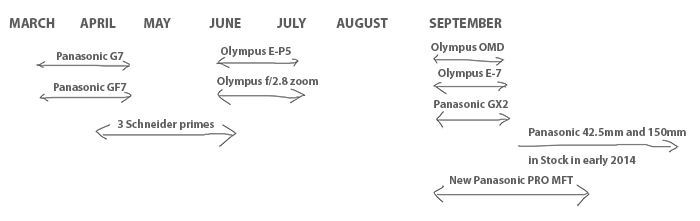
This post is a little more fun than most on the rumor sites. The roadmap above shows what 43rumors thinks is coming in the Micro 4/3 arena from market leaders Panasonic and Olympus in this calendar year (and maybe a little later).
 
The fun thing is, you can vote on which three items on the roadmap interest you most, and see what the total voting results are so far.
 
(Click Here) to go to 43rumors.com and place your vote.
 
This tells me that the Panasonic Lumix DMC-GX2 isn't coming out anytime soon. I don't know what to think of the G7 coming out soon. The G5 was not very impressive to me. If the G7 has the GH3 sensor (or better), I may be interested, as long as the body doesn't grow too much in size from the G3. A "pro" grade Lumix may be interesting as well, but I have a feeling it'll be Nikon DSLR size, just to prove it's pro equipment. Finally, a 42.5mm f1.2 lens could be fun. Of course, characteristically, I'm focused on Panasonic more than Olympus. The OM-D is already a huge win for Olympus, and I'm sure it only gets better.
 
DMC-365.blogspot.com


Monday, March 11, 2013

Nice DMC-GH3 Image - Am I Missing Micro 4/3?

Image Source: http://www.mu-43.com/f56/pier-sunrise-gh3-40421/
 
Brian G posted the shot above, taken with the Lumix 20mm f1.7 lens and new DMC-GH3 camera.
 
(Click Here) to read Brian's post on mu-43.com
 
As I've recently written, I have not been exercising my Micro 4/3 gear much this year. Not at all, really. I am beginning to think the only reason is that I have so many other fun choices, and because I overdid it a little last year, focusing too much on that format.
 
I am planning a one day add-on to a business trip coming up, to go shoot in the California desert. In thinking about what gear to take, my first thought was Nikon DSLR. I want the ultimate image quality that the full frame D700 affords me, and everything from wide to macro to telephoto lenses. However, that would be a big, heavy pack. Hmm. Maybe. I think I would likely take a wide (20 or 24mm f2.8), 35mm f2, 50mm f1.4, and one zoom - the 70-300mm AF-S VR. I could cover the wider focal lengths with a single 24-85 zoom, but believe the tradeoff in optical quality makes it less sensible to go Nikon in that case. I am becoming even more dedicated to primes as time passes.
 
Alternatively, I could carry my DMC-G3 kit, with the following lenses: 14mm f2.5 (tiny), 20mm f1.7 (tiny), 45mm f2.8 macro (no macro in the Nikon kit above), and Olympus 75mm f1.8. I get faster apertures, great optics, and a very light kit, particularly if I don't carry a second body. The only tradeoff (and it's a big one) is sensor quality.
 
On the subject of Micro 4/3 image quality, the DMC-GH3 is the top of the line for Panasonic. The shot above is one of very few I've actually seen posted. Maybe it's just early in the GH3 life cycle. But, I have also read that many people don't like the increased size of the GH3. I'm certainly in that boat. If I don't get the tiny size of previous Micro 4/3 cameras (like my G3s), I will certainly carry a full frame Nikon.
 
So, you may see some new Micro 4/3 shots from me in the near future. I think I've recovered from last year's Lumix focus, with some good old Nikon, Leica, and even film camera therapy. I'm ready to get the G3s out again. And I'm still waiting on that DMC-GX2 announcement...
 
DMC-365.blogspot.com


Friday, February 15, 2013

Philippine Festivals - Shot by krijtin on mu-43.com with Panasonic Lumix DMC-G3, Plus One of My Festival Shots

krijtin of mu-43.com has posted a series of images captured at two separate festivals in the Philippines. Both were shot with the Lumix DMC-G3. The first, the Sinulog Festival, was covered with the Lumix 20mm f1.7 lens.
Sinulog Festival, by krijtin on mu-43.com
Panasonic Lumix DMC-G3, Lumix 20mm f1.7 Lens
 
The second festival, Dinagyang, was shot with the G3 and kit lens (14-42mm):
 

Dinagyang Festival, by krijtin on mu-43.com
Panasonic Lumix DMC-G3, Lumix 20mm f1.7 Lens
 
I thoroughly enjoy shooting events like this. krijtin has done a nice job with the G3 here, especially with the kit lens, which I find quite limiting due to its small maximum aperture. Here's one I shot at a Japanese Obon festival in Fairfax, Virginia, using the G3 and 20mm f1.7:
Japanese Obon Festival, by Reed A. George
Panasonic Lumix DMC-G3, Lumix 20mm f1.7 Lens
iso 200, f4, 1/125 sec
 
 
DMC-365.blogspot.com