Monday, April 7, 2014

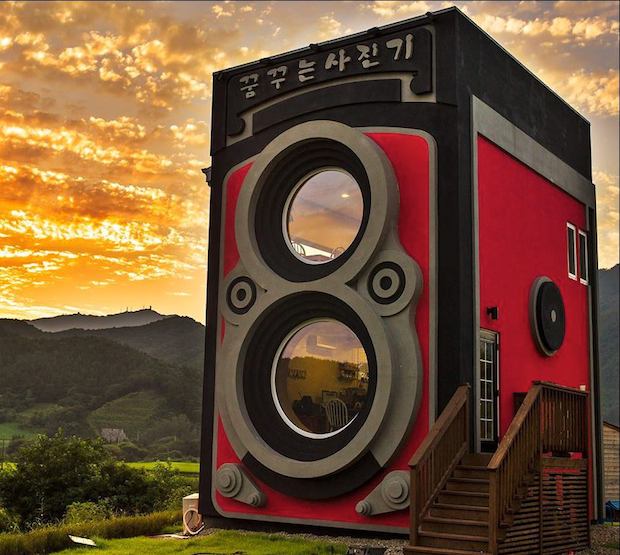
Twin Lens Coffee Shop in Korea

Quick post today. My friends Charlie and Bill sent me this funny little piece of photographic fun.
Image Source: http://petapixel.com/2014/03/29/coffee-shop-south-korea-shaped-like-rolleiflex-camera/
 
Now there's a place I'd like to sit and have a cup of coffee. Apparently, they don't open until 11AM, so I'll have to remember that if I'm ever in South Korea and want to have breakfast in a twin lens reflex (TLR) camera-shaped coffee shop.
 
(Click Here) to read a little more about this on Petapixel.
 
I think it's interesting how certain forms stick with us and find application in unpredicted ways. I've seen restaurants made from boats and train cars, both iconic shapes that people have interest in. I suppose if you're going to make one from a camera, the TLR is the way to go. Basically a rectangular box, the TLR offers a very traditional interior layout. If it weren't for the two big porthole windows, you may forget that you're inside a camera.
 
DMC-365.blogspot.com


Sunday, April 6, 2014

Will Springtime Ever Come to Virginia? Stephen L. Tabone Finds Spring Owls

It just seems to keep coming at us. Snow this week. We've had a couple of hints of Spring, but nothing to count on. I recently read a quote that I really like:
 
"All winters turn to spring."
Stephen L. Tabone is one of the best wildlife photographers I've seen. This week, he posted images of barred owls that he was able to kayak to here in Virginia.
 
Image Source: http://stevetaboneblog.com/2014/03/26/barred-owls-2/
 
(Click Here) to read Stephen's post and see several excellent pictures of the barred owls.
 
I like this post on several levels. First, I love owls. I have only successfully photographed one; I have not been too successful at finding them, though Stephen gives me a clue with finding his near a creek entry to a lake.
 
Here's the one I was lucky enough to find some time back:
 
Barred Owl, by Reed A. George
Panasonic Lumix DMC-G3, Lumix 100-300mm f4-5.6 Lens at 300mm
iso 400, f6.3, 1/800 sec.
 
Beyond the subject, I really like that Stephen was able to approach his owls by kayak, one of my favorite ways to get out and photograph nature. I'm looking outside at the rain and 40 degree temperatures, but know that it won't be long before I can get out in my kayak as well.
 
Stephen's images are always first-rate. For this post, he was shooting a Nikon D800 and 80-400mm lens. I'm not sure whether he has the older or the new version of this lens. The new one is quite spectacular, which I say based on playing with one for a few minutes only. Stephen also uses a flash and flash extender ("Better Beamer") in some of his shots. I have a version of the Beamer, but always seem to get white eyes in birds that I shoot with it. So, I almost never use it. The solution is to get the flash further off-camera, so that the light reflected from the bird's retinas doesn't come right back into the lens. But, with a big old flash, Beamer attached, it gets quite clumsy to try and either hand hold the flash off-camera (with a long lens attached), or use some kind of bracket. It's tough enough shooting birds like this, near impossible with unwieldy camera gear. That said, my shot above could have used just a tiny amount of fill flash to bring the left side of the owl's face up in brightness.
 
In any case, Spring is on the way to Virginia! Thanks for reminding me, Stephen.
 
DMC-365.blogspot.com
 

Saturday, April 5, 2014

Nikkor 5cm f1.4 Rangefinder Lens on Leica M9

I mentioned that I'd purchased a very nice old Nikon S rangefinder camera, Nikkor 5cm f1.4 lens, and Amedeo adapter to mount the lens on my Leica M9. Here are some quick test shots to show what that Nikkor lens can do on the M9 body. All of these are jpegs right out of the camera, no editing.
 
First, I shot these three shots at the same exposure, but at three different f-stop settings (f1.4, f2, f2.8) to show sharpness and depth field.
 
Nikkor 5cm f1.4 at f1.4, 2, and 2.8
 
At this size, the most obvious effect of closing down the aperture is eliminating vignetting (darkening around the edges of the image). This lens vignettes quite significantly at f1.4. It clears up pretty well by f2.8.
 
How about sharpness? Here are crops of the same three shots, showing focus at the three f-stop settings:
 
 
Crops at f1.4, 2, 2.8
 
I think it's pretty sharp, even wide open. By f2.8, it's very sharp.
 
But, of course, none of that matters too much. If I was going to ultimate sharpness, a modern lens would be the best bet, not a lens from the 1950s. What really matters is whether or not I like the look the lens produces. Well, I'm not sure yet. But, here's an early hint:
 
 
Just a Quick Shot
 
This shot was also made wide open at f1.4. I'm definitely looking forward to shooting some more with this lens. I also need to explore how it renders color. I'm also interested in seeing how it does on the Nikon film body it was designed for.
 
DMC-365.blogspot.com


Friday, April 4, 2014

Nikon Rangefinder - I Finally Bought In

I have sworn off owning any Nikon rangefinder cameras, since it means yet another lens mount system. However, I've always wanted to try one. Not too long ago, I talked myself out of buying a Nikon S3 2000 set, which was in mint condition. A reintroduction of the classic S3 by Nikon in the year 2000, this would have been one gorgeous camera. But, I didn't want a collector's item; I wanted a Nikon rangefinder that I could take out and shoot.
 
Well, I recently found a very nice Nikon S with the legendary Nikkor 5cm f1.4 rangefinder lens for a reasonable price.
 
Nikon S
Image Source: http://en.wikipedia.org/wiki/Nikon_I,_M_and_S
 
 
Mine happens to be one of the rare "8 digit serial number" cameras. Interesting story. Nikon started the Nikon rangefinders with a serial number of the form 609XXXX, which allowed them to go up to camera number 6099999 before they had to change. Well, they liked the 609 prefix, so for about 1230 cameras (mine's number 60911216), they just added an eighth digit. So, mine's one of about 1230 cameras of this particular series.
 
(Click here) to read about the S and the 8 digit cameras.
 
I'm part of the way through my first roll of film in the S. At first, I felt that the focusing patch was a little squinty as compared to my Leicas, especially my Leica Ms. Now that I've used it a little, I don't notice much of a difference. I think I was simply trained on the Leica and the Nikon is different, not worse, especially compared to Barnack (screwmount) Leicas.
 
Of course, I found it necessary to buy an adapter so that I can use the Nikkor 5cm f1.4 (Sonnar design) on my Leica M bodies. I bought one directly from Amedeo in Venezuela.
 
(Click Here) to find Amedeo on the web.
 
Amedeo responded to my email quickly. He told me that the economy in his country is very bad right now, and finding shops to chrome plate his adapters has been an issue. He sold me one with minor cosmetic issues for a discounted price. It arrived in just a few days, free Fedex shipping. Amedeo is working on setting up his own chroming process, so maybe this problem will go away soon.
 
I've now tested the Amedeo adapter on my Leica M9, and found the focus to be spot-on with the Nikkor 5cm lens, even wide open at f1.4. Note that these adapters are for Nikkor rangefinder lenses of 5cm (50mm) or longer focal length. I'll share some test shots from the Nikkor on the M9 in my next post.
 
So, I broke my own rule and decided to give the Nikon rangefinder a try. Even if I decide I don't like the camera, I'm pretty impressed with what the lens produces on my Leica M9.
 
DMC-365.blogspot.com


Thursday, April 3, 2014

Japan in the 1950s - Cool Picture of Nikon Lens Manufacturing

I saw a post on Rangefinder Forum with a link to The Atlantic Monthly's site, sharing images of Japan in the 1950s. The first image below really caught my attention. It's a Nikon factory worker, assembling rangefinder lenses. Very cool.
 
The second image is a press conference in Japan. Not a Nikon (or any other) rangefinder in sight. Instead, we see movie film cameras, and a lot fo 4x5s, mostly American, if I'm not mistaken. I'm sure I see a lot of Graflex Speed Graphics in that crowd.


Image Source: http://www.theatlantic.com/infocus/2014/03/japan-in-the-1950s/100697/#img12

(Click Here) to see the images on The Atlantic Monthly.
 
Thanks to Rangefinder Forum member VTHokiEE for the post (Click Here) with this link.

DMC-365.blogspot.com

Wednesday, April 2, 2014

Art for the Sake of Art - From the Broad Creativity Files

Sand drawings. Andres Amador makes them, mostly for his own creative release. And the phrase "sand drawings" really isn't grand enough for what he produces.


Image Source: http://blog.chasejarvis.com/blog/2014/03/the-key-characteristic-shared-by-all-the-most-creative-people-i-know-andres-amador-interview/?utm_source=feedburner&utm_medium=feed&utm_campaign=Feed%3A+ChaseJarvis+%28Chase+Jarvis+Blog%29
 
I read about Andres' artistic pursuits on Chase Jarvis' blog.
 
(Click Here) to read the story and see several great examples on Chase's blog.
 
There are two things that really strike me about this work. First, as Chase emphasizes, the best art is done because the artist simply must do it, as opposed to doing it for money, prestige, etc. Second, this particular expression impresses me because of the inherent impermanence of it. The article mentions that it's somewhat like Tibetan Buddhist mandala sand paintings, where monks spend weeks making intricate paintings from colored sand, and then destroy them.
 
(Click Here) to read more about sand mandalas. I've always wanted to see one of these being made.
 
DMC-365.blogspot.com
 

Tuesday, April 1, 2014

Taking Advantage of the Lumix GX7 Silent Shutter

New Mexico Diner, by Reed A. George
Panasonic Lumix DMC-GX7, Lumix 20mm f1.7 Lens
 
The GX7 has an electronic (silent) shutter feature, which is very nice. The first thing I do when setting up any digital camera is find the controls to make all of the beeps and sounds go away. Permanently. Up until the GX7, all of my Lumix Micro 4/3 cameras have had a mechanical shutter, which is not all that quiet. The GX7 gives you the option of using either the mechanical shutter, or the silent electronic option.
 
The electronic shutter is not always appropriate. It doesn't work with flash (which I use as sparingly as possible, anyway), and it reportedly has problems with specific wavelengths of fluorescent lighting. But, as you can see above, it can really be handy in the right situation. I had the camera on my table, and simply pointed it in the right direction and pushed the shutter release. This was shot wide open at f1.4 f1.7 (thanks to Dennis Gallus for pointing out my typo). The image is right from the camera (unedited jpeg).
 
DMC-365.blogspot.com