Showing posts with label 45mm Panasonic Leica Macro-Elmarit f28. Show all posts

Tuesday, October 28, 2014

Asian Archery - Japan and Korea

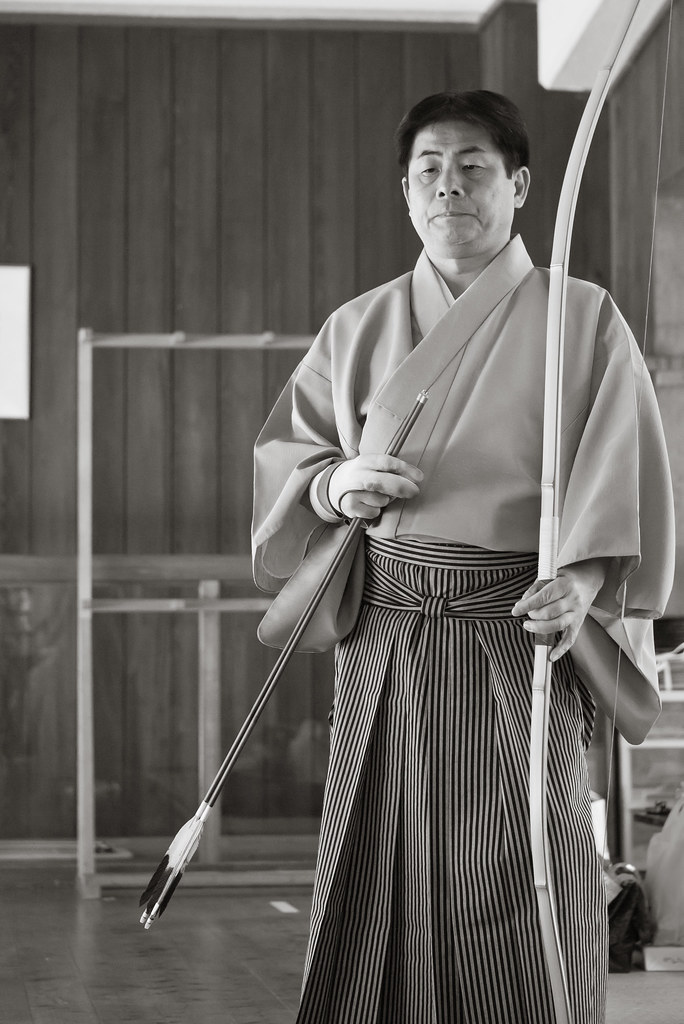
Japanese Kyudo Practitioner, by Reed A. George
Panasonic DMC-G1, Pana-Leica 45mm f2.8 Macro-Elmarit Lens
iso 400, f2.8, 1/50 sec.
 
Japanese archery, known as kyudo, has been practiced in Japan since prehistory. It first shows up in art a few hundred years B.C. No longer a part of military weaponry, kyudo in Japan is a contemplative art form, as well as a sport.
 
I found a related post on Walter Ulreich's blog, in his case writing about archery in Korea.
 
(Click Here) to see images of Korean archery, both today, and in some photojournalist's photos Walter found from 1961. Very cool.
 
Ulreich's blog reports the following:
 
"In the year 1894 bows were excluded from military use, but Emperor Gojong gave command to use archery for the cultivation of mind and body of the Korean people. As a result of that command, the Hwanghakjeoung pavilion was built in the Royal Palace and opened to the public. It is said, that Emperor Gojong personally enjoyed archery and often visited Hwanghakjeoung."

So, it seems that archery has made a similar transition from warfare into mental and physical concentration exercise in Korea, as it did in Japan.
 
DMC-365.blogspot.com
 

Monday, July 14, 2014

Bug Closeups with the Micro 4/3 Panasonic-Leica 45mm f2.8 Macro Elmarit

I have had the Pana-Leica 45mm f2.8 Macro Elmarit lens for quite some time. When I purchased it, the Macro-Elmarit was the only medium telephoto available for the Micro 4/3 mount. Had the Olympus 45mm f1.8 been out at the time, I probably would have bought that instead.
The extra >1 f-stop of the Olympus would be nice. That said, the macro ability of the Pana-Leica is great. I like to be able to take closeups of details when I travel.
I have not really explored the capabilities of this lens in more classical macro applications. Yesterday, I had the time and opportunity to go bug hunting while my wife practiced free swimming in a local quarry. I decided to see what the Macro-Elmarit could do. So, I mounted it on my Panasonic Lumix DMC-GX7, set up the touch screen to focus and trigger exposure (I rarely use the touch screen features of the GX7), and connected my Nissin flash with a remote cord. Having mounted the camera on a sturdy tripod, I was ready to go.
Well, it was hot, and the bug hunting was a little tough. After waiting an eternity (okay, about 30 minutes) for a gorgeous dragonfly to return to a particular perch to no avail, I started stalking. By the way, dragonflies usually will come back to exactly the same spot over and over. I think maybe I was just too close for comfort. This is where a longer macro focal length would come in handy, giving me more working distance.
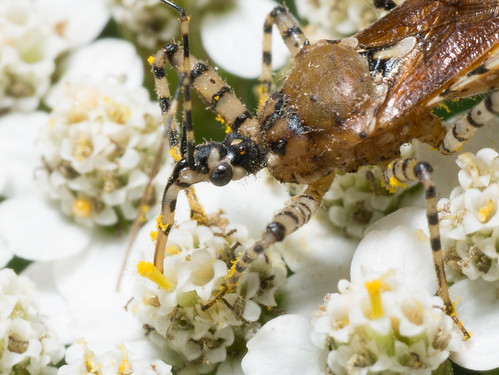
My stalking actually resulted in finding a stationary dragonfly, but my best subject of the day was this bug you see below. I'm not sure of his exact species, but guess that he's part of the hemiptera family of true bugs.
Bug, by Reed A. George
Panasonic Lumix DMC-GX7, Pana-Leica 45mm f2.8 Macro Elmarit, Remote Flash
iso 200, f11 1/100 sec.
 
I used a mini softbox mounted on the flash head, and handheld the flash. Even with the camera on a tripod, I had too many things to hold, and the flash-to-subject distance wasn't well controlled with my hand holding method. I should work on mounting the flash to a bracket if I continue this line of imaging. I did use the touch screen to identify where to focus and trigger the exposure. I must admit it's a pretty cool tool, as long as the camera is held stationary. It was a little difficult to get the focus point just right, on the bug's head, at this magnification. But, I did get it a few times.
 
I was not at the closest focus distance of the lens, but was at about the shortest useful working distance for this subject. Here's a 100% enlargement of the same image (a little clarity and sharpness applied in Lightroom):
 
100% Crop of Image Above
 
So, I'd say this lens is pretty capable in the true macro realm. I don't shoot a lot of nature macro images like this, and would normally tend toward the large sensor of my Nikon D700, and either my true macro 60mm Micro-Nikkor f2.8, or a longer lens (say 105mm f2.5) with extension tubes. The longer lens would make the working distance more reasonable. Now I know that the Micro 4/3 sensor in my GX7 and Macro-Elmarit are quite capable in this realm.
 
On top of that, the Macro-Elmarit is a reasonably good portrait lens (limited in its shallow depth of field potential by the relatively small maximum aperture of f2.8), and an excellent lens for capturing closeup details when on travel.
 
DMC-365.blogspot.com

Saturday, March 30, 2013

Joshua Tree National Park - Lumix In The Desert

 
Prickly, by Reed A. George
Panasonic Lumix DMC-G3, Lumix 20mm f1.7 Lens
iso 160, f4.5, 1/500 sec
 
Desolate, by Reed A. George
Panasonic Lumix DMC-G3, Lumix 20mm f1.7 Lens
iso 160, f5.6, 1/250 sec
 
The detail in the twisted tree in the foreground contrasts nicely with the smooth, weather-worn cliffs. The dry riverbed gives the eye something to follow.
Namesake Joshua Trees, by Reed A. George
Panasonic Lumix DMC-G3, Lumix 100-300mm f4-5.6 Lens at 162mm
iso 200, f8, 1/160 sec
 
The space between features at Joshua Tree makes composition a challenge. In this case, I decided to shoot from afar with the 100-300mm, to compress the Joshua Trees a little closer together in perspective.
 
I decided to put the 45mm f2.8 Macro-Elmarit on and shoot some macros:
 
Wood Detail, by Reed A. George
Panasonic Lumix DMC-G3, Pana-Leica 45mm f2.8 Macro-Elmarit
iso 200, f5.6, 1/25 sec
 
 
Monarch's Demise, by Reed A. George
Panasonic Lumix DMC-G3, Pana-Leica 45mm f2.8 Macro-Elmarit
iso 200, f5.6, 1/30 sec

 
Radial, by Reed A. George
Panasonic Lumix DMC-G3, Pana-Leica 45mm f2.8 Macro-Elmarit
iso 200, f4, 1/320 sec
 
Miniature Flower, by Reed A. George
Panasonic Lumix DMC-G3, Pana-Leica 45mm f2.8 Macro-Elmarit
iso 200, f4, 1/200 sec

 
Skeleton, by Reed A. George
Panasonic Lumix DMC-G3, Pana-Leica 45mm f2.8 Macro-Elmarit
iso 200, f11, 1/60 sec
 
Wherever there is water, life abounds. These are fan palms at a small spring.
Fan Palms, by Reed A. George
Panasonic Lumix DMC-G3, Lumix 100-300mm f4-5.6 Lens at 300mm
iso 200, f5.6, 1/200 sec
 
Ocotillo, by Reed A. George
Panasonic Lumix DMC-G3, Pana-Leica 45mm f2.8 Macro-Elmarit
iso 200, f4.5, 1/800 sec

My trip was a little early in the year for the short-lived desert bloom. The ocotillo (above) was well on its way, though.
 
The desert is an amazing place to shoot. It's challenging. You really have to tune in to see what to photograph. I find it stimulating. It stretches me beyond my normal shooting situations, which is always a good thing.
 
 
Earth's Spine, by Reed A. George
Panasonic Lumix DMC-G3, Lumix 14mm f2.5 Lens
iso 200, f5.6, 1/640 sec


Split Rock, by Reed A. George
Panasonic Lumix DMC-G3, Lumix 14mm f2.5 Lens
iso 200, f11, 1/320 sec

 
Window To The Horizon, by Reed A. George
Panasonic Lumix DMC-G3, Lumix 14mm f2.5 Lens
iso 200, f11, 1/200 sec
Wispy Clouds, by Reed A. George
Panasonic Lumix DMC-G3, Lumix 14mm f2.5 Lens
iso 200, f8, 1/320 sec
 
 
This little guy is called a side-blotched lizard:
Side-Blotched Lizard (Uta stansburiana), by Reed A. George
Panasonic Lumix DMC-G3, Lumix 100-300mm f4-5.6 Lens at 300mm
iso 200, f8, 1/1600 sec
 
Even though it was only about 75 degrees fahrenheit on this day, as the sun rose directly overhead at mid-day, it was brutal. I got sunburned much more quickly than I expected. I also stepped off the trail, and got myself into a walk several miles longer than planned. The desert is no place to mess around. Stay on the trail. Period.
 
Mid-day Shadows, by Reed A. George
Panasonic Lumix DMC-G3, Lumix 14mm f2.5 Lens
iso 160, f16, 1/200 sec
 
I hope you enjoyed this little tour of the desert. I will take any opportunity to go back and shoot here again.
DMC-365.blogspot.com


Tuesday, August 7, 2012

Gecko - Not An Insurance Ad! - Shot With Lumix DMC-G3, Pana-Leica 45mm f2.8 Macro Elmarit

 
Hawaiian Gecko, by member foxtail1 on mu-43.com
Panasonic Lumix DMC-G3, Pana-Leica 45mm f2.8 Macro-Elmarit
Image Source: http://www.mu-43.com/f54/colorful-hawaiian-gecko-30228/
 
foxtail1 on mu-43.com posted a series of pics of this cool little gecko from Hawaii. The image above isn't the best one; it's the only one I could link to for some reason.
 
(Click Here) to see them all.
 
That is one great lens. I use mine as a short telephoto / portrait lens a lot. I need to do some macro work with it. The serious competition for the Pana-Leica 45mm in Micro 4/3 mount is the Olympus 45mm f1.8. The Oly lens is faster and smaller. It offers great results. The only things the Oly lens doesn't provide is image stabilization (because Olympus builds that into their bodies), and macro capability. I love the Pana-Leica lens, personally.
 
DMC-365.blogspot.com


Wednesday, August 1, 2012

Japanese Obon Festival - Fairfax Station, VA

Obon Dance, by Reed A. George
Panasonic Lumix DMC-G3, Lumix 20mm f1.7 Lens
iso 160, f6.3, 1/13 sec.
 
My family and I recently attended a local Japanese Obon Festival at Ekoji Temple in Fairfax Station, Virginia.
 
(Click Here) to read about the event online.
 
We had the pleasure of meeting up with some friends there, letting the kids run wild, and relaxing a little.
 
The Obon festival focuses on honoring the spirits of your ancestors. It is a common time for family reunions in Japan. The bon dance is always a highlight.
 
 
A Little Stage Fright, by Reed A. George
Panasonic Lumix DMC-G3, Lumix 20mm f1.7 Lens
iso 400, f2, 1/400 sec.
 
The dance and music went into the evening, and at dusk there was a nice memorial ceremony for those departed ancestors.
 
Candlelit Stone Lantern, by Reed A. George
Panasonic Lumix DMC-G3, Pana-Leica Macro-Elmarit 45mm f2.8
iso 1600, f2.8, 1/20 sec.
 
I have always respected how the Japanese can combine solemn events with fun. I love the idea that we were able to honor a recently-deceased family member while the kids ran, played, and enjoyed the evening.
 
In photographic terms, this was really just a chance for me to take my camera along on a family event. I realized that I have been neglecting the 20mm f1.7 lens, since receiving my Summilux 25mm f1.4. They are very different lenses, and the 20mm is so compact, it is a pleasure to use. One of the main applications of the 20mm for me is street photography, which I have not been doing much lately. This gives me the bug to get back out there - maybe a bus ride up to New York City is in order. The G3 and 20mm pancake lens are a very non-threatening combination to carry around for street photography. Maybe I'll give myself a challenge and take no other equipment with me.
 
Anyway, I digress. It was fun to use the 20mm at this event, and I need to do it more.
 
DMC-365.blogspot.com
 
DMC-365.blogspot.com
 

Thursday, July 26, 2012

Music Festival Photography - Timely Piece on ePhotoZine

 
"The Shakedown," by Reed A. George
Panasonic Lumix DMC-G3, Lumix 14mm f2.5
iso 200, f5.6, 1/60 sec
 
There's an entry on the ePhotoZine blog about festival photography. This is timely, as I'm heading out to Floyd Fest starting tomorrow (by the time you read this, I'll be at the festival).
 
(Click Here) to see the Floyd Fest webpage.
 
It's a five hour drive from home, and I'll be staying for three nights.
 
Okay - so what does ePhotoZine have to say about festival photography? Here are the main points:
 
  1. Get a high vantage point if possible.
  2. Arrive early - good advice for any event.
  3. "Good Zoom" - this means to be ready to use a range of focal lengths to me, not necessarily a zoom. They also mention waterproof cameras or cases at this point. I'll be bringing my Panasonic Lumix DMC-TS3 underwater camera to this show; I hope I don't need it.
  4. Steady hands - some tips on minimizing vibration when shooting
  5. Have a plan - this one is a must, especially at a large festival. There is no way that I'll cover all the bands at Floyd Fest. In fact, there's no way that I'll cover the whole day, every day, during a four day music festival. My goal is to see the bands that I know and like, and hopefully add a few new favorites.
(Click Here) to read the original piece on ePhotoZine.


My plan for this show is to take only Lumix gear, plus maybe one film camera. I will take two DMC-G3s, Lumix 12mm f2.5, Pana-Leica 25mm f1.4 and 45mm f2.8, Lumix 100-300mm f4-5.6 and Voigtlander 75mm f2.5 manual focus Leica Thread Mount (LTM) lenses, and Nissin flash. I am receiving my new Lumix 12-35mm f2.8 zoom today. If I'm comfortable with its operation, it may replace all the primes for this trip, but I doubt it. It's never a good idea to rely too much on a new lens on a trip.
 
In terms of a film camera, I'm planning to carry a Leica CL and adapted LTM 3.5cm Elmar f3.5. I hope to use that for candid shots of festival-goers.
 
DMC-365.blogspot.com


Sunday, July 1, 2012

Jordan Steele's Spider Project on Admiring Light - Find Projects Wherever You Are

 
Orchard Spider, by Jordan Steele
Olympus E-M5, Pana-Leica 45mm f2.8
Image Source: http://admiringlight.com/blog/backyard-spiders/
 
I have cross-posted some of Jordan's work in the past. He has begun a project centered on spiders. Macro photography is challenging, exacting work. Jordan has a great start on this one.
 
(Click Here) to see the project on Jordan's blog - Admiring Light
 
The image above is especially cool, as the orchard spider has been caught in the act of spinning its web. You can see the silk coming from the abdomen. How cool.
 
This reinforces how a creative photographer can find a meaningful project wherever they are.
 
For these shots, Jordan used the new Olympus E-M5 Micro 4/3 camera body, and the excellent Panasonic-Leica Macro Elmarit 45mm f2.8 lens. He also used the clip on flash from Olympus.
 
Excellent! Thanks for sharing, Jordan.
 
DMC-365.blogspot.com


Wednesday, June 20, 2012

Waiting For The New Lumix 12-35mm f2.8 To Become Available, and Thinking..

Panasonic Lumix 12-35mm f2.8 X lens
Image Source: shop.panasonic.com
 
 
I am watching daily (obsessively?) for the new Panasonic Lumix 12-35mm f2.8 zoom lens to become available for purchase. And, the wait is making me think more about it.
 
 
I have always preferred shooting with prime (fixed focal length) lenses. It's been said many times that primes are smaller, lighter, and generally faster than zooms. It is often argued that they produce better image quality. However, I think this is largely a holdover from the past. Lens technology is so good now that a state-of-the-art zoom is extremely capable.
 
(Click Here) to read a current post on mu-43.com where others are discussing their reasoning for wanting or not wanting the new 12-35mm f2.8 zoom.
 
One of the questions in the post above is whether a kit zoom like the 14-42mm lens minimizes the need for a fast zoom like the new 12-35mm. I say emphatically, no. The kit lenses really are the cheapest lenses out there, and don't fall into "state-of-the-art" in my opinion. Their variable, slow f-stop is a showstopper for all but the very best lighting situations.
 
(Click Here) for a post of one of the rare times I have used my kit zoom. I was not displeased with the results, but the lens was certainly limiting in which scenes I could record. For example, inside the mill, it was nearly useless without a tripod.
 
So, since I have a great set of prime lenses, why am I considering the new 12-35mm zoom? Well, to be honest, it's because I get tired of changing lenses in the field. And, especially at events, I do occasionally miss a shot while I'm fumbling to change lenses. This is why I now regularly carry two bodies - two identical Panasonic Lumix DMC-G3s. One is usually attached to a normal lens (Pana-Leica 25mm f1.4 Summilux, most commonly), and the other has either a short telephoto (Pana-Leica 45mm f2.8 Macro-Elmarit) or wide angle (Panasonic Lumix 14mm f2.5). I even find myself changing between wide angle and telephoto on the second body more often than I would like.
 
Right now, I am working on two long-term projects - 1) the Civil War Sesquicentenial and 2) local live music. Will this new zoom help me in those?
 
Well, I can honestly say that the 12-35mm f2.8 will be great for the civil war project. The majority of that project involves shooting in daylight, outdoors, and at events where things change reasonably quickly. Sometimes in working around crowds of spectators, or composing carefully to not include modern elements around re-enactors, for example, the flexibility of a zoom would be great. And, back to the example of the mill, I could have gotten by with f2.8 (not the f3.5-5.6 of the kit lens).
 
For shooting live music, I cannot see relying on f2.8 to be fast enough for shooting inside dark bars and music venues. I'm sure I'll stick to my Pana-Leica Summilux 25mm f1.4 for that. This is where the other lens I'm waiting on, the Olympus 75mm f1.8, comes in. Many times, I'd like more reach than the 25mm can provide.
 
I also enjoy travel photography a lot. The 12-35mm would be very helpful for that.
 
So, will the new 12-35mm stay on my camera all the time? No. But, I think it will certainly fill a gap for event and travel photography. How's that for rationalizing? :).
 
DMC-365.blogspot.com


Wednesday, June 13, 2012

Pairing the Pana-Leica 45mm f2.8 Macro-Elmarit With the Olympus E-M5

 
Olympus E-M5 and Pana-Leica 45mm  by Frank B on dpreview
Image Source: http://forums.dpreview.com/forums/read.asp?forum=1041&message=41605970
There has been an enormous amount of buzz about the new Olympus E-M5 Micro 4/3 body. It is a very attractive camera, with retro styling sure to appeal to the Olympus film SLR user, and superb image quality.
 
(Click Here) to see the Olympus E-M5 review on dpreview.com
 
I found the following post by Frank B on dpreview's Micro 4/3 forum, pairing the E-M5 with the Pana-Leica 45mm f2.8 Macro-Elmarit:
 
(Click Here) to see the original post and one more macro image.
 
Right now, I'm planning almost the opposite - pairing my Panasonic body (Lumix DMC-G3) with Olympus lenses. In particular, I'm very much looking forward to the new Olympus 75mm f1.8 becoming available for purchase.
 
(Click Here) to see a preview of the Olympus 75mm f1.8 on dpreview.
 
I think that handful of fast glass will be great for my low light concert photography, giving me a combination of more reach than my Pana-Leica 45mm and faster aperture than my Lumix 100-300mm f4-5.6. By the way, the 100-300 works pretty well if the stage lights are bright enough. But, the new Oly lens will do fine in near darkness. C'mon, Olympus, ship those lenses to the US market!
 
DMC-365.blogspot.com


Saturday, May 26, 2012

New Lumix 14mm User's Results

 
Image Source: http://www.mu-43.com/f38/pana-14-reasons-cheerful-25723/

Poster kevinparis on mu-43.com posted some results of a walk in Venice Beach, California with his new Lumix 14mm f2.5 lens. It seems that Kevin shoots a Panasonic Lumix DMC-GH2 body.

(Click Here) to read the original post. Be sure to click through to the flickr set. It's got 17 more images to see.

He comments that he wasn't sure how this lens would work out for him. I can see that he's going to have some fun with this lens.

I really like the little 14mm f2.5. It is so small, carrying it along is basically like putting an extra filter or two in your bag. I thnk f2.5 is fast enough to be very useful, even for those tight interior space shots. It's a great companion to the 20mm f1.7 for an incredibly small 2-lens kit (especially with a DMC-GF1 or GX1 body). Unfortunately, since I always like a little more reach in my bag, I usually can't get by with just those two lenses. I carry the Pana-Leica 45mm f2.8 Macro-Elmarit, but if I really wanted to slim down my 3-lens kit, I would get the highly-celebrated Olympus 45mm f1.8. Those three lenses (Lumix 14, Lumix 20, and Olympus 45) would make quite the tiny, useful setup.

Anyway, my close friend James has just ordered his 14mm f2.5. I can't wait to see his results!

DMC-365.blogspot.com


Saturday, May 19, 2012

Fun Little Article About Wildlife in Tokyo

 
Mandarin Ducks in Tokyo
Mandarin Ducks (Oshidori in Japanese)
Image Source:
http://www.japantimes.co.jp/text/ek20120430a1.html?utm_source=feedburner&utm_medium=feed&utm_campaign=Feed%3A+japantimes+%28The+Japan+Times%3A+All+Stories%29

The Japan Times recently ran a bilingual piece about wildlife in Tokyo. It explains the Japanese concept of an annual awakening day for wildlife (keichitsu in Japanese), which usually occurs around March 4 or 5. It is surprising how much wildlife really does exist in Tokyo, with its heavily developed land and industry-lined waterways.

(Click Here) to read the full story.

Of course, there are typical pests in the city, including the ubiquitous crows (karasu in Japanese), but the parks do still harbor many species of waterfowl, and at least three species of turtles are found within the city limits.
 
Here are a couple of wildlife shots I took on my recent trip to Tokyo:
 
 
Tokyo Turtles, by Reed A. George
Taken at Kiyosumi Garden Park
Panasonic Lumix DMC-LX5, iso80, f3.5, 1/400 sec


Waterfowl, Ueno Park, Tokyo, by Reed A. George
Panasonic Lumix DMC-G3, Pana-Leica 45mm f2.8 Macro-Elmarit
iso400, f2.8, 1/2500 sec

DMC-365.blogspot.com


Wednesday, May 16, 2012

Civil War Event - John Mosby's Rangers at Mount Bleak, Virginia

 
Paris, Virginia, by Reed A. George
Panasonic Lumix DMC-G3, Pana-Leica Summilux 25mm f1.4
iso160, f8, 1/250 sec

On Sunday, May 13, 2012, I attend a Civil War historical event at Sky Meadows State Park in Delaplane, Virginia. This is amazingly serene countryside, as the panorama of nearby Paris above demonstrates.

This area was deeply involved in the Civil War, and was home to John S. Mosby, a confederate officer turned vigilante, who constantly tested and perturbed federal forces in the heart of Virginia. Mosby was known as the "Gray Ghost," based on his rangers' ability to appear and disappear seemingly instantly, using local "safe houses" to harbor himself and his men. In fact, the historic home at Mount Bleak in the park was one of those safe houses.


Rich Gillespie, by Reed A. George
Richard Gillespie, Director of Education for the Mosby Heritage Area Association
by Reed A. George
Panasonic Lumix DMC-G3, Pana-Leica Summilux 25mm f1.4
iso160, f2.8, 1/125 sec

The evening's event presented several vignettes of individuals from the period, played by local reenactors associated with the Gray Ghost Interpretive Group. Starting near sundown, we listened to their stories as the sky grew dark, the program transformed to lantern light - wonderful for setting the mood and allowing our minds to go far back in time.


George Slater (Reenacted), by Reed A. George
In the Role of Estate Owner and Former Mosby Ranger, George M. Slater
by Reed A. George
Panasonic Lumix DMC-G3, Pana-Leica Summilux 25mm f1.4
iso160, f2.8, 1/200 sec


Local Virginia Girl and Mosby Aid, by Reed A. George

Local Girl and Aid to Mosby's Rangers, by Reed A. George
by Reed A. George
Panasonic Lumix DMC-G3, Pana-Leica Summilux 25mm f1.4
iso3200, f1.5, 1/800 sec


Former Mosby Ranger, by Reed A. George
Memoirs of a Ranger, by Reed A. George
by Reed A. George
Panasonic Lumix DMC-G3, Pana-Leica Summilux 25mm f1.4
iso400, f1.8, 1/1250 sec


Lone Federal, by Reed A. George
Lone Federal Soldier Watches From the Shadows, by Reed A. George
by Reed A. George
Panasonic Lumix DMC-G3, Pana-Leica Summilux 25mm f1.4
iso6400, f1.4, 1/15 sec


Rich Gillespie, by Reed A. George
The Tour Wraps Up After Dark, by Reed A. George
by Reed A. George
Panasonic Lumix DMC-G3, Pana-Leica Summilux 25mm f1.4
iso640, f1.4, 1/25 sec


(Click Here) for more information on the beautiful Sky Meadows Park, which is about an hour east of Washington, DC, and is a beautiful natural and historical reserve.

(Click Here) for more about the Mosby Heritage Area Association, who put on this event. They are excellent at bringing civil war history to life.

Here are a few more images of the beautiful scenery in the area:


Cultivation, by Reed A. George
Panasonic Lumix DMC-G3, Lumix 14mm f2.5
iso400, f8, 1/250 sec


Whitewashed Fence, by Reed A. George
Panasonic Lumix DMC-G3, Pana-Leica Macro-Elmarit 45mm f2.8
iso400, f2.8, 1/400 sec

Ivy, by Reed A. George
Panasonic Lumix DMC-G3, Pana-Leica Summilux 25mm f1.4
iso400, f8, 1/80 sec


As you can see from the exposure information, as the evening wore on, I relied on the Summilux for its fast f1.4 aperture, and increased iso to 6400 near the end. It was a nice challenge to capture the event in near darkness. I hope I've done well enough that you can get a feel for this early summer evening in the countryside.
 
DMC-365.blogspot.com


Sunday, April 29, 2012

New Fun "Salon" Contest on mu-43.com

 
First Train Departs, by Reed A. George
Panasonic Lumix DMC-G1, Pana-Leica 45mm f2.8 Macro-Elmarit
iso100, f7.1, 1/6 sec
 
There is a fun contest being hosted at mu-43.com. The current theme is "Motion."
 
(Click Here) for the contest announcement and instructions for entering.
 
My entry is the image above, of the first train leaving Gora Station in Hakone, Japan. This is the Japan Tozan Railway, which follows single-track switchbacks up the mountain from Hakone Yumoto Station.
 
(Click Here) for more of my images and information about the railway.
 
DMC-365.blogspot.com


Monday, April 16, 2012

Dave Martinez's Micro 4/3 "Trinity" Travel Kit - What's In Your Bag?

Some of us don't want to look like this when we travel with our photography gear. Heaven knows I've injured my back with Nikon DSLR kit, especially when I had a carrying-age child with me. Things are better now - she's independently mobile, and I have Micro 4/3 gear!
Image Source: http://nistido.tumblr.com/

Fellow blogger Dave Martinez writes that his normal travel kit is now a Panasonic Lumix DMC-G3, Lumix 7-14mm f4 (wish I had one of those), Lumix 20mm f1.7, and Olympus 45mm f1.8 (another great lens I don't have). This covers a huge range of focal lengths, and makes for an amazingly small carry-on bag.

(Click Here) to read Dave's post.

I wrote last week about what I recently carried on an overseas trip.

(Click Here) to see that post.

I tend to like fast prime lenses, so my normal travel kit is now two DMC-G3s, Lumix 14mm f2.5, Pana-Leica 25mm f1.4 Summilux, and Pana-Leica 45mm f2.8 Macro-Elmarit. The Oly 45mm is faster (2x more light gathering capability than the Pana-Leica), but the Pana-Leica has macro capability. I find I use that quite often on travel. I also typically throw in the Lumix 14-140mm f4-5.8 zoom, just because it covers so much ground in a single lens. And sometimes, I want more reach than the 45mm offers. Having a second body really adds very little weight, and provides a back-up in case of camera problems. It is also nice to have a wide or normal lens on one, tele on the other, minimizing the need to change lenses in the moment. This whole kit, two bodies and four lenses, fits easily in a padded messenger bag, which even has room for filters and other accessories. Pretty nice. Of course, a tripod is extra.

If I want to save a little space, I may use the Lumix 20mm f1.7 instead of the Summilux. Both lenses are great, in my opinion.

See below for links to the messenger bag and padded liner that I prefer. They fit together perfectly, even though they're provided by different manufacturerers.

My next decision is whether or not to carry a flash.

Anyone else have a favorite travel kit? Share what's in your bag!

DMC-365.blogspot.com


Sunday, April 15, 2012

Here's a Post to Keep Your Eye On - Lumix Macros

 
Macro by StudioHeraBell
Image Source: http://www.mu-43.com/f88/some-my-macro-shots-my-lumix-going-post-23297/

User StudioHeraBell on mu-43 started a new macro image post. Using a legacy Pentax macro lens and DMC-GH2, this looks like it could be interesting.

The image above is a closeup of tulip petals. I find it very attractive.

Macro is one of those types of photography you can do anywhere, any time. It's fun to play with lighting approaches, and make ordinary items seem anything but.

I have subscribed to the thread.

I did some macro photography of my own recently, of the new spring blossoms and flowers. I'll have to post some...

DMC-365.blogspot.com


Friday, April 13, 2012

Love Gun! Something in Common to Laugh About With a Stranger.

 
Love Gun! by Reed A. George
Panasonic DMC-G3, Pana-Leica 45mm f2.8 Macro-Elmarit
iso160, f2.8, 1/320 sec

I've told you before that one of my objectives is to better connect with people in the places I visit. Well, here is an example.

Japan is not the easiest place in the world to meet people casually. This guy was the exception. We met in Hibiya Park in Tokyo, where we were both admiring the spring bloom (see the background). He was happy to practice a little English, and was surprised to find that I could speak a little Japanese. "You have shocked me," I believe was his expression.

Anyway, in quickly looking for things we may have in common to talk about, he brought up the rock and roll band "Kiss." He then proceeded to sing me the lyrics from their song "Love Gun," which I had all but forgotten. He was a little shy about letting me take his picture, but by the second exposure, above, he had gone back into his Paul Stanley (Kiss guitarist and vocalist) act.

It brightened my day to have this little conversation, and get this picture of him. We walked away not knowing each other's names, but both with smiles on our faces. Good fun.

DMC-365.blogspot.com

Support DMC-365 by purchasing your Amazon items through this link:


Thursday, April 12, 2012

Hey Mister, What's in the Bag? Or, What I Took on My Spring Vacation

So, I got into Micro 4/3 camera gear in large part due to the compactness of the system. I used to carry around a very heavy bag of Nikon gear, which consisted of one body and a few lenses, flash, etc. Because I didn't want to be changing lenses in the field all the time, and could only carry one body, I depended largely on zooms, usually with one fast normal prime along for the ride.
 
So, what has Micro 4/3 done for me in terms of my travel kit? Maybe this will give you an idea:
 
Reed's Travel Kit

My Travel Kit - LowePro CompuTrekker AW,
Giottos MT9241 Tripod, Velbon QHD-41 Mini Ballhead

While this is the same backpack I used with Nikon, what I carry inside, and the resulting weight, is very different. Being able to use a small travel tripod and mini ballhead is an immediate advantage of lightweight camera equipment.

Here's what's inside:


Travel Kit, Exploded

Let's see here:
  • Panasonic Lumix DMC-G3 bodies (2X), batteries (4x)
  • Panasonic Lumix 14-140 f4-5.8 zoom
  • Panasonic Lumix 14mm f2.5
  • Pana-Leica 25mm f1.4 Summilux
  • Pana-Leica 45mm f2.8 Macro-Elmarit
  • Panasonic 46mm filters (2X - 1 Polarizer, 1 3 stop ND)
  • Nissin Di466 flash
  • Panasonic Lumix DMC-LX5, batteries (3X)
  • Panasonic Lumix DMC-TS3 waterproof camera, batteries (2X)
  • LowePro Messenger Bag (fits inside Computrekker AW)
  • Mountainsmith Camera Cube (padded divider pack, fits inside messenger bag)
  • Panasonic remote shutter release
  • Apple iPad2
  • Shutterhat camera rain protector
  • Hakuba mini-tripod
  • SD cards, pen and paper, passports, etc.
All of this together, including the Giottos tripod, weighs in at 19 lbs. I don't have a weight for the Nikon pack, but imagine it's quite a bit more.

While this pack is not exactly lightweight, there is significant capability and redundancy here. For a big, expensive trip, that's what I want. Having two interchangeable lens bodies makes me much more comfortable. Not only that, it allows me to shoot mostly with primes, which I really prefer. I found on this trip that I kept the 25mm Summilux on one of the G3s, and alternated between the 14mm and 45mm on the other. I only used the zoom a couple of times, when I wanted longer reach than the 45mm would afford.

What would I leave out if I were going again tomorrow? Not much, actually. I would probably leave out the LX5, but that said, I did use it exclusively for a day of family activities. Yes, I could have used one of the other cameras, but the LX5 sure is a great balance of size and capability. I may leave out the flash. I don't use flash a lot, and they do weigh quite a bit, especially with an extra set of batteries. I might leave out the 14-140 zoom.

The fact that the padded messenger bag fits inside the Computrekker is great. That allows me to only be a packhorse for the whole kit when I'm making major moves between hotels, etc. Once on location, I can put just what I need in the messenger bag, and travel much more lightly.

The DMC-TS3 turned out to be fun on this trip, as I did shoot a few underwater pics. I'll post those in the coming days.

So, I hope you can see that I have a lot more capability with Micro 4/3, at reasonable carrying weight. If I were to limit it to one body, a couple of zooms, and a single fast prime, it would really be a lightweight kit. Sometimes, while my back is aching, I do feel that I challenged myself to fill the volume of the Computrekker.

What do you think? Am I over-prepared for an overseas one week trip? Under-prepared? What would you pack differently? I'm always interested to learn from others.
 
DMC-365.blogspot.com

Wednesday, April 4, 2012

Masao Horino Photography Exhibit in Tokyo

Gas Mask Parade by Masao Horino
 
 
Gas Mask Parade, Tokyo, by Masao Horino
Image Source: http://www.55museum.com/?p=16105
 
Back on March 23, I wrote about a couple of exhibits at the Tokyo Metropolitan Museum of Photography, which I hoped to visit on my trip to Tokyo.

Well, it just so happened that I found the perfect day to go - typhoon rain and winds were headed for Tokyo, and people were warned to leave work early to avoid the weather. So, I took the Hibiya subway line to Ebisu Station, and viewed the Masao Horino exhibit.

Horino lived from 1907-1998, but stopped photographing and exhibiting after WWII. The exhibit gave a great feel for his whole career, which began in the mid 1920s, photographing actors and actresses in a small theater in Tsukiji, Tokyo. These are classic posed images, both head shots, and full body shots of performers. One characteristic that came to me right away is that the subjects were always looking outside the frame. It made for a somewhat impersonal style, but may have been due to cultural norms.

In the 1930s, Horino began experimenting with photography of mechanical structures, reportedly in order to find new applications for his cameras. I can identify with that. This is when his bridge images, including the one posted in my March 23 post, were done.

Also in the 1930s, Horino began experimenting with montages (multiple images on a single page, sometimes with a modest amount writing) and overlaying exposures from multiple negatives onto a single print. In this style, he did a series called "Flowing Through the Capital: Sumida River Album." In this series, he photographed people and their association to the river.

In 1932, Horino declared that his experimentation was concluded, and that he was taking his "first step as an artist," focusing largely on photojournalism. I get the distinct feeling that the war affected Horino deeply; some of his most striking pictures of that era included the gas mask parade in Tokyo, shown above, and a celebration parade in honor of kamikaze (suicide bomber) pilots. As mentioned before, after the war, Horino stopped exhibiting his work, claiming that it was lost in the war.

A few of his best works, in my opinion, are:
  • "The Beggar," 1932 - in this case, the straggly-looking man is looking directly into the lens.
  • "Coffee Break," 1933 - two boys and a dog at a table. The interplay between the three characters is really something to see.
  • and the very best, in my opinion, is "Beach" ("Nagisa" in Japanese), taken somewhere between 1934-38. This image shows a girl sitting on a high bluff above the beach, waving to several people on horseback far down below.

I have got to see if I can find some of Horino's images online. Horino is not well-known, partially because he disappeared from the scene after the war. His work is certainly worth seeing.

(Click Here) for a few more of Horino's images.

The typhoon came in, as promised. It rained cats and dogs, and the wind was fierce all night long. In some parts of the country, buses and trucks were blown over, and buildings were destroyed. If my conversions from meters per second are correct, the maximum winds were about 80 mph. By morning, skies were clear and sunny.


Running For It, By Reed A. George
Running For It, by Reed A. George
Panasonic Lumix DMC-G3, Pana-Leica 45mm f2.8 Macro-Elmarit

DMC-365.blogspot.com