Showing posts with label available light. Show all posts

Friday, March 22, 2013

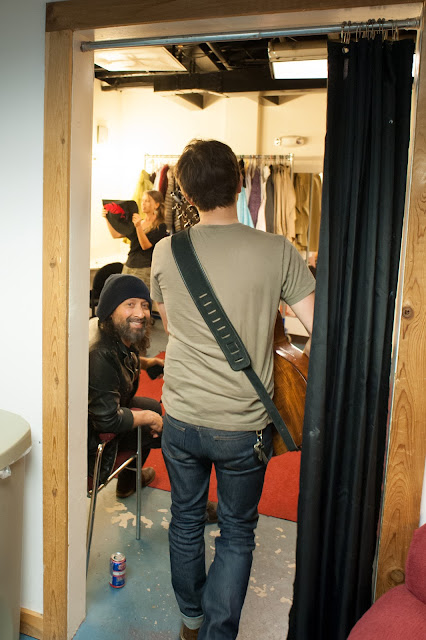
Whole Lotta Leica - More February Results From the W-Nikkor 3.5cm f2.5 - Musical Benefit for a Friend

 
Furnace Mountain Band - Benefit for a Friend, by Reed A. George
Leica M9, W-Nikkor 3.5cm f2.5
iso 1250, f2.5, 1/45 sec
 
The Furnace Mountain Band recently played a benefit concert for a friend in need. Held at Barns of Rose Hill in Berryville, Virginia, it was a nice family event for young to old. Unfortunately, fiddler extraordinaire David VanDeventer was at home with a sick child that night, but the show did go on.
 
Furnace Mountain Band - Benefit for a Friend, by Reed A. George
Leica M9, W-Nikkor 3.5cm f2.5
iso 1250, f2.5, 1/45 sec
 
 
Furnace Mountain Band - Benefit for a Friend, by Reed A. George
Leica M9, W-Nikkor 3.5cm f2.5
iso 1250, f2.5, 1/45 sec
 
Shooting in the low house lights of this venue without a flash was a stretch for the little f2.5 Nikkor. As you can see, I shot at iso 1250, which barely allowed a fast enough shutter speed for handheld shooting (1/45 sec.) with the lens wide open. Even then, the shots were pretty underexposed and needed a boost in exposure in post-processing. This is a recipe for making digital noise come through, and it did. Converting to black and white helps by eliminating color noise. I also added a little grain in Lightroom, which makes the noise feel a little more like grain from a fast film like TriX. But, again, it was a stretch with this equipment. I wouldn't want to make large prints of these.
 
This reminds me why I love really fast lenses, like March's Whole Lotta Leica selection, the Summilux 35mm f1.4.
 
But, there's nothing wrong with a challenge now and then.
 
DMC-365.blogspot.com
 

Friday, October 26, 2012

Live Music Coverage - Justin Jones, Luke Brindley, and Bobby Thompson at Franklin Park Arts Center, Purcellville, VA

LR-7068.jpg
Bobby Thompson, Working Over the Gibson SG, by Reed A. George
Nikon D700
 
I recently got the chance to cover another local live music event for my favorite live music blog, Cosmic Vibes Live. This one was a set of three DC area-based acts - Luke Brindley, The Bobby Thompson Project, and the headliner, Justin Jones. By the way, if you haven't heard Justin's newest album "Fading Light," do yourself the favor. It's available on iTunes.
 
(Click Here) to read my report on Cosmic Vibes Live.
 
 
LR-7139.jpg
Justin Jones, by Reed A. George
Nikon D700
 
I knew this show would have relatively low light levels, so I decided to shoot exclusively with my Nikon D700. In terms of lenses, I brought along my Nikkor 50mm f1.4, Nikkor 85mm f1.8, and newly-purchased (used) Nikkor 180mm f2.8 AF (non-D).
 
Since I also knew that through the gracious reception by producers Bill and Cheryl Bunce, I would get to go backstage at will, I also took my Nikkor 20mm f2.8 AF-D wide angle.
 
I'm still getting comfortable shooting backstage, which is a different experience with each and every band. These guys were all very welcoming, and had plenty of fun backstage.
 
LR-7120.jpg
Luke Brindley Warms Up Backstage, by Reed A. George
Nikon D700
Backstage Fun, by Reed A. George
Nikon D700
 

I'm loving the experience of shooting and writing for Cosmic Vibes. Be sure to check them out.
 
DMC-365.blogspot.com


Saturday, June 23, 2012

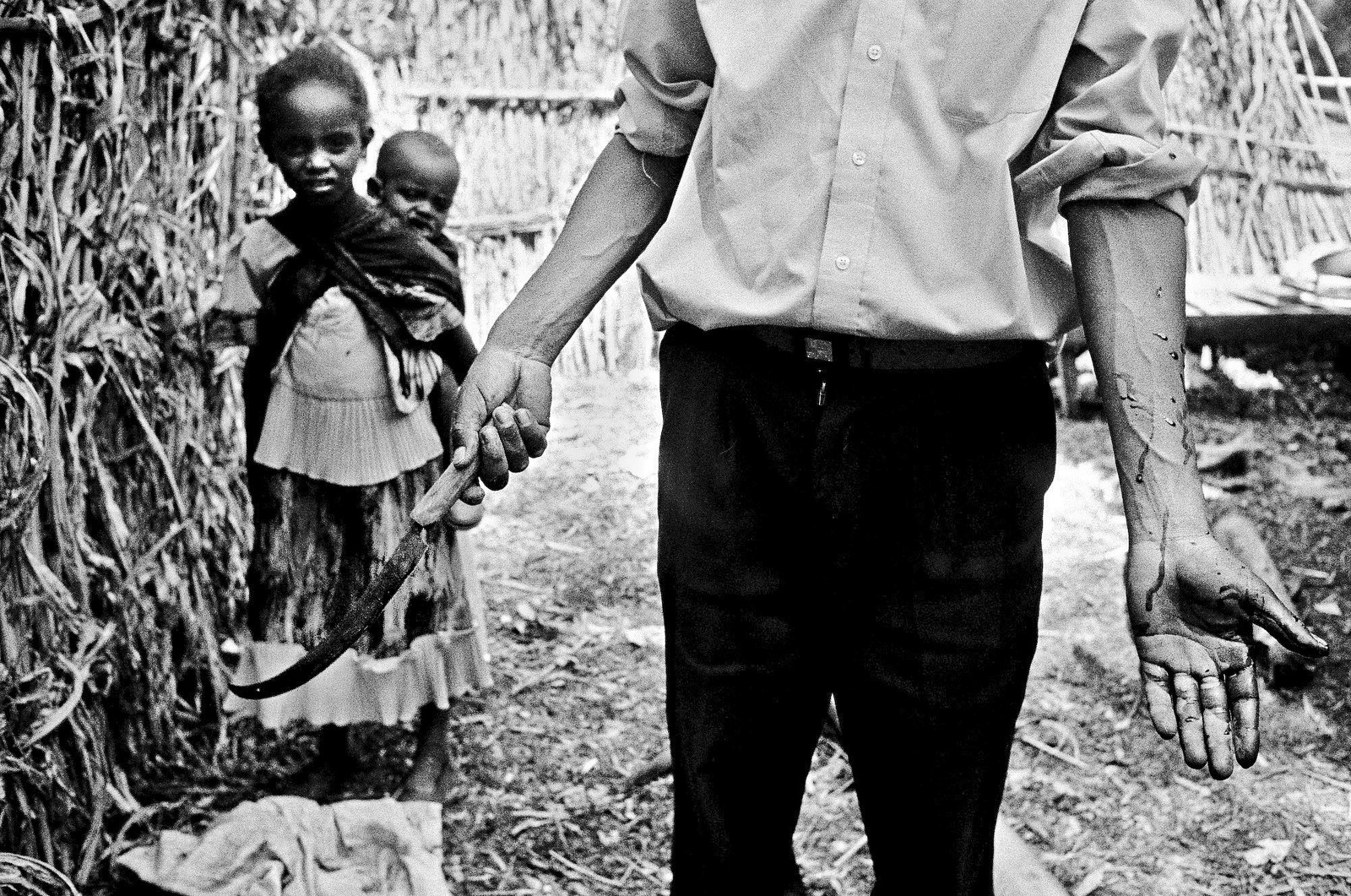
Just Go Shoot, by Aaron Hardin on Steve Huff Photo

Photo By Aaaron Hardin
Image Source: http://www.stevehuffphoto.com/wp-content/uploads/2012/06/HARDIN-Ethiopia-2.jpg

I personally need to hear this message, repeatedly, often - "JUST GO SHOOT!" It really helps when it's accompanied by great photos, as it is here on Steve Huff's blog, in a brief, inspiring piece by photographer Aaron Hardin (aaronhardinphoto.com)

(Click Here) to read the post on stevehuffphoto.com

Aaron admits that he also gets his mind diverted by new equipment (the Leica M9, in his case), but is able to pull away and use what he already has to make beautiful pictures. In this case, he photographed in Ethiopia with a single film body (Leica M4-P), 35mm lens, and a bag of film. No back-up equipment.

Personally, I'm hesitant to attend a local event without a back-up camera body on hand. How often do I need a back-up? Very rarely. Especially if I'm restricting myself to a single lens.

I currently find myself strategizing which new lenses to buy for my Lumix Micro 4/3 kit - at the moment I'm fixated on the Lumix 12-35mm f2.8 and the Olympus 75mm f1.8. At the same time, I'm considering whether to broaden the scope of my blog sometime in the future, to regularly include equipment other than Panasonic. I already include other equipment, but try to keep a Panasonic-related theme. If I decide to broaden that focus, Micro 4/3 may not be where I want to add equipment. So, as you can see, I'm preoccupied with equipment. This is nothing new; I'm a self-described gear head.

But, I need to become equally obsessed with shooting great projects. Luckily, I'm persistently pursuing a couple of projects. For example, this weekend will add another piece to my local music project, with a festival on the shores of the Shenandoah River.

Obsession is not a bad thing. In fact, it's a common theme amongst highly successful people. I just need to keep mine focused on the photography, as well as the equipment.

Here's something for me to keep in mind: I have the same Leica M4-P and 35mm lens in my collection. When was the last time I took just that combination out and used it consistently? Well, let's just say it's not my normal mode. I will think about that.

Thanks for reading through my self-counseling!

DMC-365.blogspot.com

And, if you want to spend the same on a single lens that you'd spend on a whole kit:


Thursday, June 21, 2012

Landscape Photographer Hans Strand Shares His Story On Zeiss Lens Blog

 
Hans Strand on Zeiss Lenses
Hans Strand - Master Landscape Photographer and Zeiss Enthusiast
Image Source: http://blogs.zeiss.com/photo/en/?p=1785

Hans Strand, Swedish landscape photographer, and I have at least a couple of things in common. First off, Hans is a trained Mechanical Engineer with a passion for photography. Second, he appreciates fine photographic equipment, from the point of view of an engineer.

(Click Here) to read Hans' complete story on the Zeiss lens blog, outlining how he transitioned from Engineering to Photography as his vocation, how he composes his images, and why he enjoys Carl Zeiss lenses.

We also have some differences. Hans is a master of the wide angle, which is somewhat elusive to me (I'm working on it). He maximizes depth of field and ultra-sharp focus in his landscape work. Another difference - he loves cold places. If I were to pick an ideal location to photograph, it would likely be a tropical island (Kauai comes to mind), or the Sierra Nevada Mountains, at the cold end. Hans prefers Iceland. To each his own.

Finally, one more point we share - even though he does a completely different style of photography, Hans appreciates the precision and timing of Henri Cartier Bresson's (HCB's) compositions. In my opinion, no other famous photographer has gotten it as right as HCB. Every time I pick up a rangefinder and head out to shoot a street scene, I wish for some insight from that guy.

I also enjoy Zeiss lenses - especially old ones, like the old Zeiss Tessar f2.8 on my 521/16 medium format folding camera that I used for these two shots:
Snow Dance, by Reed A. George
Zeiss 521/16 Medium Format Folding Camera, Zeiss Tessar f2.8

Waterford News, by Reed A. George
Zeiss 521/16 Medium Format Folding Camera, Zeiss Tessar f2.8

To tie it in a little, of course I enjoy my modern Zeiss Biogon 25mm f2.8, which makes a wonderful normal lens on the Lumix G3, great for street photography.

(Click Here) to see my recent post of a triptych shot with that combination.

DMC-365.blogspot.com


Wednesday, June 20, 2012

Waiting For The New Lumix 12-35mm f2.8 To Become Available, and Thinking..

Panasonic Lumix 12-35mm f2.8 X lens
Image Source: shop.panasonic.com
 
 
I am watching daily (obsessively?) for the new Panasonic Lumix 12-35mm f2.8 zoom lens to become available for purchase. And, the wait is making me think more about it.
 
 
I have always preferred shooting with prime (fixed focal length) lenses. It's been said many times that primes are smaller, lighter, and generally faster than zooms. It is often argued that they produce better image quality. However, I think this is largely a holdover from the past. Lens technology is so good now that a state-of-the-art zoom is extremely capable.
 
(Click Here) to read a current post on mu-43.com where others are discussing their reasoning for wanting or not wanting the new 12-35mm f2.8 zoom.
 
One of the questions in the post above is whether a kit zoom like the 14-42mm lens minimizes the need for a fast zoom like the new 12-35mm. I say emphatically, no. The kit lenses really are the cheapest lenses out there, and don't fall into "state-of-the-art" in my opinion. Their variable, slow f-stop is a showstopper for all but the very best lighting situations.
 
(Click Here) for a post of one of the rare times I have used my kit zoom. I was not displeased with the results, but the lens was certainly limiting in which scenes I could record. For example, inside the mill, it was nearly useless without a tripod.
 
So, since I have a great set of prime lenses, why am I considering the new 12-35mm zoom? Well, to be honest, it's because I get tired of changing lenses in the field. And, especially at events, I do occasionally miss a shot while I'm fumbling to change lenses. This is why I now regularly carry two bodies - two identical Panasonic Lumix DMC-G3s. One is usually attached to a normal lens (Pana-Leica 25mm f1.4 Summilux, most commonly), and the other has either a short telephoto (Pana-Leica 45mm f2.8 Macro-Elmarit) or wide angle (Panasonic Lumix 14mm f2.5). I even find myself changing between wide angle and telephoto on the second body more often than I would like.
 
Right now, I am working on two long-term projects - 1) the Civil War Sesquicentenial and 2) local live music. Will this new zoom help me in those?
 
Well, I can honestly say that the 12-35mm f2.8 will be great for the civil war project. The majority of that project involves shooting in daylight, outdoors, and at events where things change reasonably quickly. Sometimes in working around crowds of spectators, or composing carefully to not include modern elements around re-enactors, for example, the flexibility of a zoom would be great. And, back to the example of the mill, I could have gotten by with f2.8 (not the f3.5-5.6 of the kit lens).
 
For shooting live music, I cannot see relying on f2.8 to be fast enough for shooting inside dark bars and music venues. I'm sure I'll stick to my Pana-Leica Summilux 25mm f1.4 for that. This is where the other lens I'm waiting on, the Olympus 75mm f1.8, comes in. Many times, I'd like more reach than the 25mm can provide.
 
I also enjoy travel photography a lot. The 12-35mm would be very helpful for that.
 
So, will the new 12-35mm stay on my camera all the time? No. But, I think it will certainly fill a gap for event and travel photography. How's that for rationalizing? :).
 
DMC-365.blogspot.com


Friday, May 18, 2012

Nice Post on Natural Light from Digital Photography School

 
Image Source: http://digital-photography-school.com/are-you-practicing-these-5-natural-lighting-tips

The Digital Photography School has a nice post on how to think about, observe, and capture natural light. They give the following five tips:
  1. Be aware of the characteristics of light. Learn to think about how that scene you're observing now would look at a different time of day (or night). The differences can be dramatic.
  2. There is no "good" or "bad" light. Yes, the golden hour is great for beautiful images. Sometimes, you want to communicate something other than just "beautiful." Sometimes the harsh light of mid-day is exactly right for communicating your story.
  3. Obsess about observing light. Even when you don't have a camera. Look at contrast, how the shadows are illuminated. I find it useful to think about how many stops difference I think there are between the shadows and highlights, and about how I would expose an image, if I were taking it.
  4. Give it a try, experiment. To me, this point follows on the one above. Why ever be without a camera? If you see it, shoot it. It's digital, right? You can simply delete it later, with no cost, and with the potential of learning something.
  5. Don't forget that you can post-process. Learn to shoot challenging scenes with a plan in mind for post-processing. Want to capture that person's face, but also want the sky correctly exposed? See if you can capture the sky and bring the face exposure up a little in post-processing.
And most importantly, the article reminds us to get out an make photos. That's the thing we're interested in, right?
 
(Click Here) to read the whole article on digital-photography-school.com.
 
DMC-365.blogspot.com


Wednesday, May 16, 2012

Civil War Event - John Mosby's Rangers at Mount Bleak, Virginia

 
Paris, Virginia, by Reed A. George
Panasonic Lumix DMC-G3, Pana-Leica Summilux 25mm f1.4
iso160, f8, 1/250 sec

On Sunday, May 13, 2012, I attend a Civil War historical event at Sky Meadows State Park in Delaplane, Virginia. This is amazingly serene countryside, as the panorama of nearby Paris above demonstrates.

This area was deeply involved in the Civil War, and was home to John S. Mosby, a confederate officer turned vigilante, who constantly tested and perturbed federal forces in the heart of Virginia. Mosby was known as the "Gray Ghost," based on his rangers' ability to appear and disappear seemingly instantly, using local "safe houses" to harbor himself and his men. In fact, the historic home at Mount Bleak in the park was one of those safe houses.


Rich Gillespie, by Reed A. George
Richard Gillespie, Director of Education for the Mosby Heritage Area Association
by Reed A. George
Panasonic Lumix DMC-G3, Pana-Leica Summilux 25mm f1.4
iso160, f2.8, 1/125 sec

The evening's event presented several vignettes of individuals from the period, played by local reenactors associated with the Gray Ghost Interpretive Group. Starting near sundown, we listened to their stories as the sky grew dark, the program transformed to lantern light - wonderful for setting the mood and allowing our minds to go far back in time.


George Slater (Reenacted), by Reed A. George
In the Role of Estate Owner and Former Mosby Ranger, George M. Slater
by Reed A. George
Panasonic Lumix DMC-G3, Pana-Leica Summilux 25mm f1.4
iso160, f2.8, 1/200 sec


Local Virginia Girl and Mosby Aid, by Reed A. George

Local Girl and Aid to Mosby's Rangers, by Reed A. George
by Reed A. George
Panasonic Lumix DMC-G3, Pana-Leica Summilux 25mm f1.4
iso3200, f1.5, 1/800 sec


Former Mosby Ranger, by Reed A. George
Memoirs of a Ranger, by Reed A. George
by Reed A. George
Panasonic Lumix DMC-G3, Pana-Leica Summilux 25mm f1.4
iso400, f1.8, 1/1250 sec


Lone Federal, by Reed A. George
Lone Federal Soldier Watches From the Shadows, by Reed A. George
by Reed A. George
Panasonic Lumix DMC-G3, Pana-Leica Summilux 25mm f1.4
iso6400, f1.4, 1/15 sec


Rich Gillespie, by Reed A. George
The Tour Wraps Up After Dark, by Reed A. George
by Reed A. George
Panasonic Lumix DMC-G3, Pana-Leica Summilux 25mm f1.4
iso640, f1.4, 1/25 sec


(Click Here) for more information on the beautiful Sky Meadows Park, which is about an hour east of Washington, DC, and is a beautiful natural and historical reserve.

(Click Here) for more about the Mosby Heritage Area Association, who put on this event. They are excellent at bringing civil war history to life.

Here are a few more images of the beautiful scenery in the area:


Cultivation, by Reed A. George
Panasonic Lumix DMC-G3, Lumix 14mm f2.5
iso400, f8, 1/250 sec


Whitewashed Fence, by Reed A. George
Panasonic Lumix DMC-G3, Pana-Leica Macro-Elmarit 45mm f2.8
iso400, f2.8, 1/400 sec

Ivy, by Reed A. George
Panasonic Lumix DMC-G3, Pana-Leica Summilux 25mm f1.4
iso400, f8, 1/80 sec


As you can see from the exposure information, as the evening wore on, I relied on the Summilux for its fast f1.4 aperture, and increased iso to 6400 near the end. It was a nice challenge to capture the event in near darkness. I hope I've done well enough that you can get a feel for this early summer evening in the countryside.
 
DMC-365.blogspot.com