Showing posts with label photographer. Show all posts

Saturday, March 14, 2015

Spring Really Coming? And Some Thoughts on Cheap Cameras.

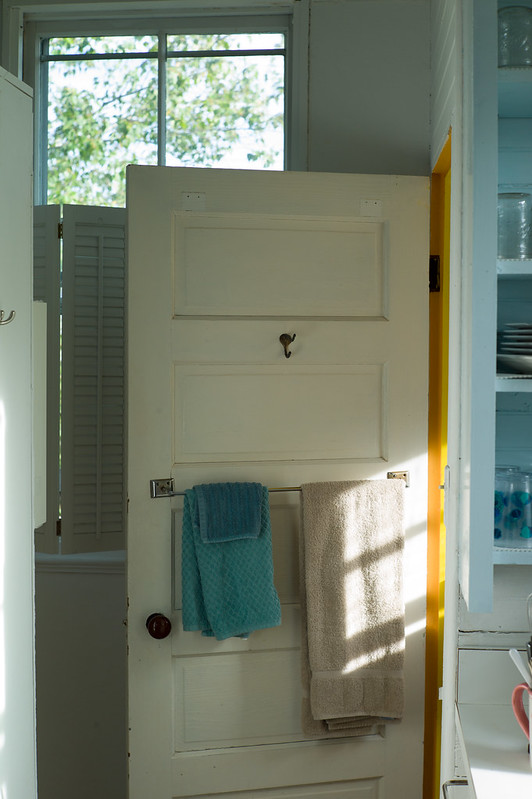
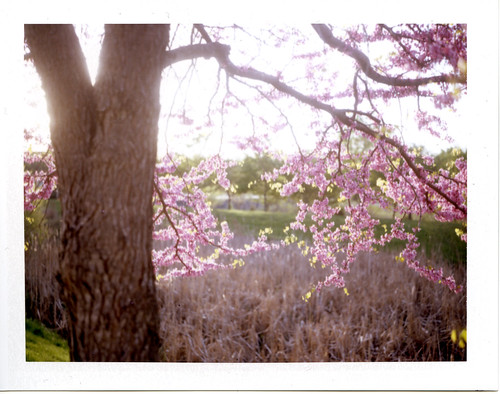
Previous Spring, by Reed A. George
Polaroid 103, Fuji FP100C Instant Film
 
I was talking with a couple of friends today about favorite and not-favorite photographers, what I like about cameras and photography and why, and the like, today.
 
It was an interesting discussion, starting off with the fact that neither of them is fond of Gary Winogrand's work; I find it fascinating. Then, we moved on to cameras. Now, you probably know that I love fine cameras. But, I also love cheap ones. This brought me to the realization that some of the images that stick in my mind were made with the cheaper, less precision-made cameras. This image is a good example of that. I can still remember the smell of spring in the air, and the fact that my allergies had started up. It almost makes my eyes itch to look at this picture. But, it also reminds me that spring is right around the corner.
 
Would this image win any popularity contests? Almost certainly not. But, it works for me.
 
DMC-365.blogspot.com

Wednesday, December 3, 2014

Amazing Instant! - Seamus Heneghan on Snap It | See It

 
The blog Snap It | See It is one of my favorites for instant photography. They have been spotlighting great instant photographers, which I think is really cool. Once I have a little body of instant work, I will probably send them a note to see if they'll feature it.
 
This artist, Seamus Heneghan, has some great stuff on the blog right now. I really like the gridlines in the image above. He's got another there, with just a cat's face behind the grid, too. Interesting.
 
(Click Here) to see the post on Snap It | See It.
 
DMC-365.blogspot.com


Sunday, October 5, 2014

Magnum Workshop, Day 1/7, Travel to Provincetown.

I've decided to document the experience of attending the Magnum Days workshop in Provincetown Massachussetts, one day at a time.
 
(Click Here) to read about Magnum Days.
 
I'm doing this after the fact, because our days were too full to do it in real time. I want to document for my own purposes, and share the process that I went through in the course of the five day workshop. I'll actually cover seven days, starting with Sunday, September 14, and ending with Saturday, September 20.
 
Sunday started early, with an hour drive from my home into DC to catch a flight from Reagan National to Boston's Logan Airport. There, I rented a car and drove the 2 1/2 hours to Provincetown, arriving in the mid afternoon. This allowed me the opportunity to meet up with my friends James and Maria, Boston natives who happened to be in Provincetown for a mini-vacation. We spent a little time together, and then I headed off to check in to my room and attend the first Magnum Days activity, a welcome party and barbecue.
 
Based on the fact that this was a Magnum event, I assumed that we would each work on a project throughout the week. In fact, I think it said that in the informational materials somewhere. In any case, I knew that we would have an exhibition of the workshop students' work on the following Friday. In order to prepare, I did a couple of things. First, weeks before the event, I started getting information about Provincetown (which I'll abbreviate as "Ptown," since that's fully accepted by the locals). I sent off an email to a historic lifesaving museum at the National Seashore, to see if there were any events during the time I'd be there. I received a nice response telling me there weren't, but that I was welcome to come and meet a historian on either Tuesday or Thursday afternoon, and see their museum. Didn't sound like much of a lead, but better than nothing.
 
I also decided to purchase a book on Ptown, entitled Land's End: A Walk in Provincetown, by Michael Cunningham. That turned out to be a very good primer about the town. It quickly became clear that Ptown is known for a few things: art, homosexuality, and partying. I also learned quite a lot about the land, lighthouses, and the National Seashore. Knowing that a Magnum workshop would be no place for landscape images, I wasn't sure if I could work any of that knowledge into my project. And, I wasn't particularly interested in covering the gay or party community, at least not on the surface of it.
 
I had also thought about the type of stories that our mentors have covered in their careers. Clearly, I wouldn't be covering a war in Ptown (thankfully). In fact, I tried to imagine anything there that may even reflect the fact that our country is currently involved in several military actions. The closest I could come was finding that Ptown had a Veterans of Foreign Wars (VFW) post. I thought that may lead somewhere.
 
Of course, as I checked in and got my bearings, I shot a few images. You may have already seen this one, which has no interesting subject, but does show the beautiful nature of the Ptown light.
 
 
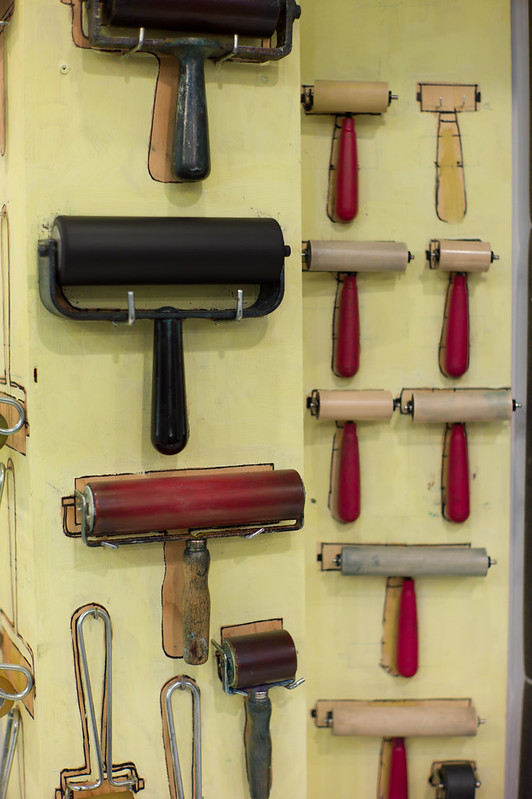
Attending the welcome party, we got a quick orientation to the Fine Arts Work Center (FAWC) in Ptown, which includes a fully-functional printing operation. I always love to look at tools, a practice that I'm sure came from my Dad. Check out these brayers. That's what I call organization.
 
 
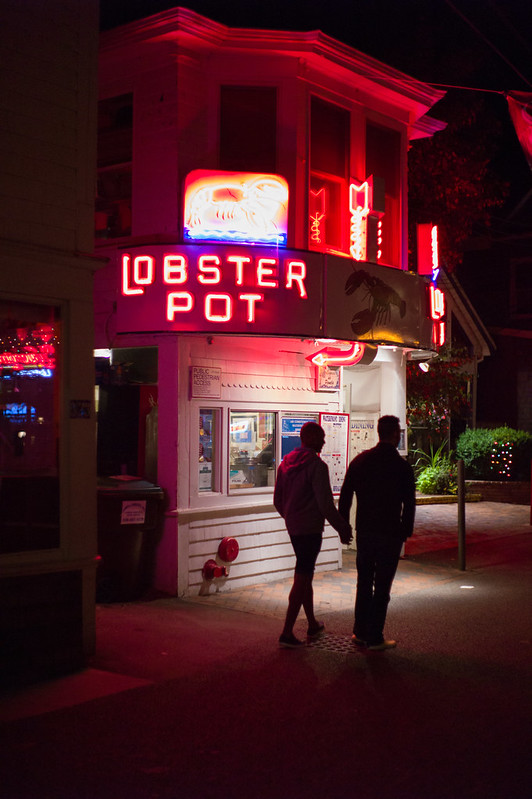
After the party, I decided to walk down the main drag, Commercial Street, to see what it was like. I didn't want to just shoot random street photography during this workshop, and ended up spending much less time here than most of the other students.
 
 
When you're looking for a project idea, I think it's generally a bad idea to define what you don't want to do. But, on this evening, I did decide not to focus on drinking and homosexuality in Ptown. It was just too obvious. Not that this thought brought me any closer to what I did want to cover. I think you can see that I didn't have a coherent project idea at this point; it would take a while to form.
 
The other important development on Sunday was that those of us signed up to work with David Alan Harvey learned that he was stuck in Europe due to an airline strike, and would not arrive until Tuesday night. I decided to take this as a positive opportunity, as I was also very interested in learning from the other Magnum mentors, specifically Bruno Barbey. I got to spend the first two days with Bruno, which really added to the experience.
 
DMC-365.blogspot.com


Friday, July 4, 2014

Music Festival Photography

I really like shooting at music festivals. I love live music, creative people, and nature. The festivals give me all of that.


I especially like the smaller local festivals here in Northern Virginia. In fact, I'm headed out to one this weekend at Watermelon Park, in Berryville. This one's called "River and Roots," and I'll get to see many of my friends there.
 
By shooting at festivals, I've met a few of the best live music photographers there are. One of those is Milo Farineau. Another, his mentor, is Chester Simpson. Both are fabulous photographers and people.
 
Chester recently posted a link to his friend's thoughts on modern festivals, including Glastonbury in the UK.
 
(Click Here) to read Barry Wolman's thoughts, which include comparing Glastonbury to a "prison yard."
 
While the festivals I attend do focus as much on camping and spending time with friends, they also clearly celebrate the music, something that seems to be lost at some of the larger festivals. The music is what really brings us all together around here. If I felt as Wolman does, it would be time for me to stop attending festivals. As it is, I can't wait for this weekend!
 
Oh, and Happy Fourth of July!
 
DMC-365.blogspot.com


Monday, June 23, 2014

Saul Leiter - "In No Great Hurry"

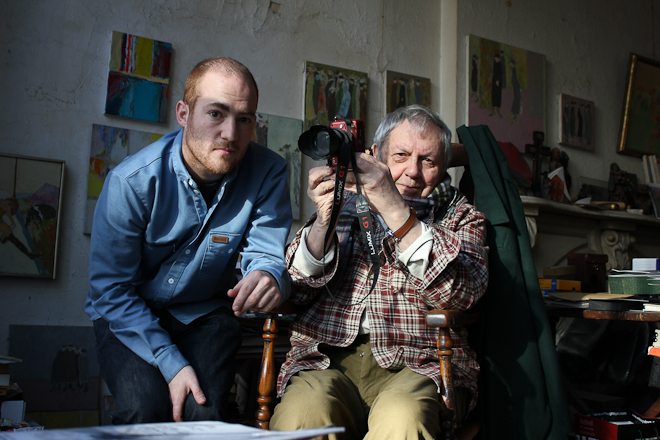
Photographer Saul Leiter (Left) and Director Tomas Leach
Image Source: http://erickimphotography.com/blog/wp-content/uploads/2013/06/INGH7-Saul-Leiter-and-Director-Tomas-Leach.jpg

Here's a movie I'm actually looking forward to seeing. Director Tomas Leach was given a book of Saul Leiter's photographs, called Early Color. He decided to approach Leiter with a proposal to make a biographical film about him, and it was accepted.
 
Based on the trailer, which you can see by
 
(Clicking Here) on http://watch.innogreathurry.com

I'm convinced this will be an interesting film for me. Leiter seems like a very down-to-earth guy. The trailer is somewhat reminiscent of the film about Bill Cunningham, which I wrote about earlier. (Click Here) to see that post.
 
While Cunningham continued to use a Nikon FM2 camera for his whole career, we see in the picture above that Leiter at least toyed with more modern digital cameras, including a Panasonic Lumix G1, and an LX series (LX5), both excellent cameras in my opinion.
 
Use google image search to look for Leiter's pictures. There's a lot for me to learn from this man.
 
I learned about Leiter on Google+ in a post by Kent Forrest. The image above came from Eric Kim's photography blog. (Click Here) to see Eric's post about the film, which opens in the US in July.
 
DMC-365.blogspot.com


Friday, January 10, 2014

Japanese Photographer Kikujiro Fukushima - 70 Years of Exposing Nuclear Tragedy in Japan

 
Image Source: http://japandailypress.com/japan-lies-documentary-about-photojournalist-kikujiro-fukushima-reaps-awards-1323241/
 
Kikujiro Fukushima (odd coincidence of name with the Fukushima nuclear disaster currently ongoing in Japan) was in the Japanese military during World War II, honorably serving his country and emperor, Hirohito. In fact, he was stationed at Hiroshima until one week before the bomb was dropped, when he was transferred to train for a suicide mission. As the war ended, Fukushima was apalled not only by the damage, sickness, and orphaning of families that resulted from the bomb, but also by how poorly his own government responded to the situation. He even wrote a book that was critical of emperor Hirohito.
 
There is a great post about Fukushima on the NY Times blog, Lens.
 
(Click Here) to read the post.
 
Fukushima photographed many people suffering after the bomb in Hiroshima, including a personal friend. He later moved on to covert photography of Japan's self defense forces, while simultaneously supplying them with photographs for use in publicity. In the end, he exposed weapons manufacturing that was not supposed to be happening. Fukushima's been the victim of physical violence multiple times in retribution for his work.
 
Fukushima recently traveled to the site of the recent nuclear disaster, caused by earthquake and tsunami, to photograph the aftermath. He's 92 years old.
 
When the interviewer asked what's next for him, Fukushima answered that he's 92, his body is failing, how can there be anything? Then, and I like this very much, he asked the interviewer if he knew of any really good, tiny, point and shoot cameras. I hope I have that spirit at 92.
 
DMC-365.blogspot.com


Monday, January 7, 2013

Leica M Digital - No Longer Just a "Dentist's Camera?"

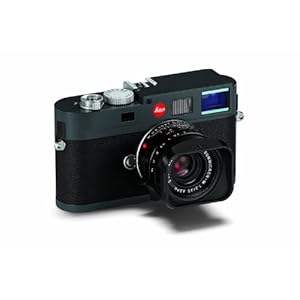
Photographer Sarah Lee from the UK's Guardian has started using a Leica M-E, the camera that's nearly identical to the M9 (missing only the frameline preview lever and USB connection), yet significantly less expensive.
The Leica M-E Digital Rangefinder
Image Source: www.amazon.com
 
(Click Here) to read Sarah's thoughts on the Leica M-E on the Guardian's blog
 
Sarah discusses how the Leica M9 was not well-adopted by professional photojournalists because of price. In fact, she says that the pros refer to it as the "dentist's camera." I suspect a little of this is also involved in her decision to tape over the red dot on her M-E.
 
Like the M9, the useful iso is limited at about 1250, and it shares the slow write speed and small image buffer of the M9. Otherwise, her comments are quite positive, and par for the course as other photographers have reported. For Sarah, it has taken her back to shooting for fun, and to the reasons she became a photographer in the first place. It even has her printing images again.
 
Sarah Lee with her gaffer-taped Leica

Sarah Lee with her gaffer-taped Leica. Photograph: Sarah Lee for the Guardian

Image Source: http://www.guardian.co.uk/artanddesign/photography-blog/2012/dec/28/leica-m-e-rangefinder-photography
 
Another comment by Sarah is interesting to me - it has to do with her Pentax K1000 (my featured "Skeletons from the Closet" camera for January), and how she still appreciates it. That's cool.
 
You should read the whole article if you're interested in Leica digital rangefinders. But, to sum up, she says that once you can afford this type of camera, "it changes everything."
 
I would venture to add that going back and shooting the K1000 for a while may change everything as well. Don't get me wrong - I'm no dentist, but I do own an M9, so am certainly not a detractor of Leica. I just think that shooting with the basics, whether it be an M9 or a manual film SLR, changes the way you look at photography.
 
Buy your "inexpensive" Leica through my link below :).
 
DMC-365.blogspot.com


Thursday, June 21, 2012

Landscape Photographer Hans Strand Shares His Story On Zeiss Lens Blog

 
Hans Strand on Zeiss Lenses
Hans Strand - Master Landscape Photographer and Zeiss Enthusiast
Image Source: http://blogs.zeiss.com/photo/en/?p=1785

Hans Strand, Swedish landscape photographer, and I have at least a couple of things in common. First off, Hans is a trained Mechanical Engineer with a passion for photography. Second, he appreciates fine photographic equipment, from the point of view of an engineer.

(Click Here) to read Hans' complete story on the Zeiss lens blog, outlining how he transitioned from Engineering to Photography as his vocation, how he composes his images, and why he enjoys Carl Zeiss lenses.

We also have some differences. Hans is a master of the wide angle, which is somewhat elusive to me (I'm working on it). He maximizes depth of field and ultra-sharp focus in his landscape work. Another difference - he loves cold places. If I were to pick an ideal location to photograph, it would likely be a tropical island (Kauai comes to mind), or the Sierra Nevada Mountains, at the cold end. Hans prefers Iceland. To each his own.

Finally, one more point we share - even though he does a completely different style of photography, Hans appreciates the precision and timing of Henri Cartier Bresson's (HCB's) compositions. In my opinion, no other famous photographer has gotten it as right as HCB. Every time I pick up a rangefinder and head out to shoot a street scene, I wish for some insight from that guy.

I also enjoy Zeiss lenses - especially old ones, like the old Zeiss Tessar f2.8 on my 521/16 medium format folding camera that I used for these two shots:
Snow Dance, by Reed A. George
Zeiss 521/16 Medium Format Folding Camera, Zeiss Tessar f2.8

Waterford News, by Reed A. George
Zeiss 521/16 Medium Format Folding Camera, Zeiss Tessar f2.8

To tie it in a little, of course I enjoy my modern Zeiss Biogon 25mm f2.8, which makes a wonderful normal lens on the Lumix G3, great for street photography.

(Click Here) to see my recent post of a triptych shot with that combination.

DMC-365.blogspot.com