Showing posts with label small. Show all posts

Thursday, December 4, 2014

Trip to NYC - Traveling "Camera Light"

My family and I are heading out to NYC for the Thanksgiving weekend. Our plan is to head up on Black Friday, return on Sunday (remember the delay in my posts, usually about a week).
My NYC Kit
 
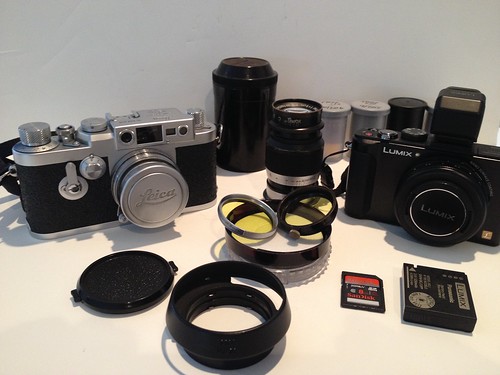
I've got several cameras that I've acquired recently, which I have not fully explored. One is my Leica IIIG, which I've only used for a single test roll. It will be my main camera for this trip. I'll pair it up with my 50mm f2 Summicron collapsible lens. Since the IIIG has framelines for both 50 and 90mm, I'll also bring along my wartime 90mm f4 Elmar. I plan to shoot all black and white with the IIIG.
 
For color, and for family snapshots, I'm bringing along my Lumix DMC-LX7.
 
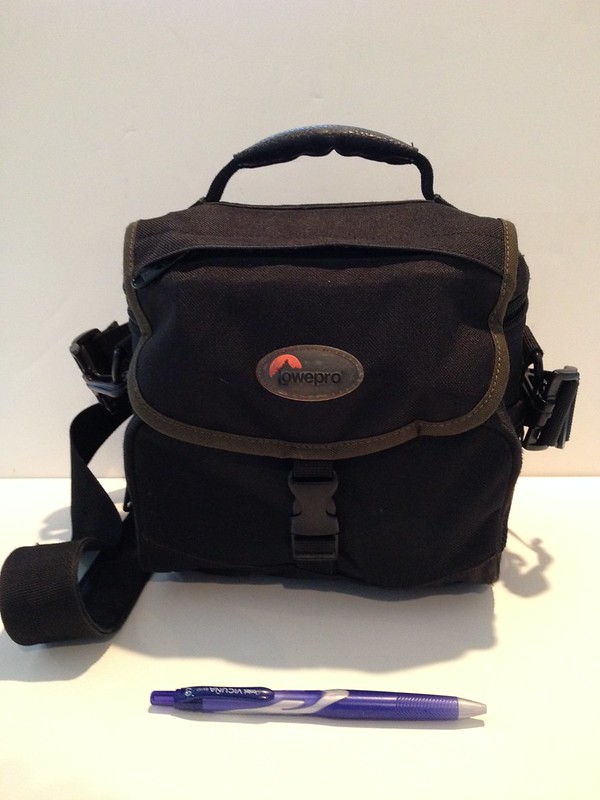
All of it fits in this tiny Lowepro bag. It is very light and will be easy to carry.
 
My Packed Camera Bag
 
DMC-365.blogspot.com
 

Sunday, August 25, 2013

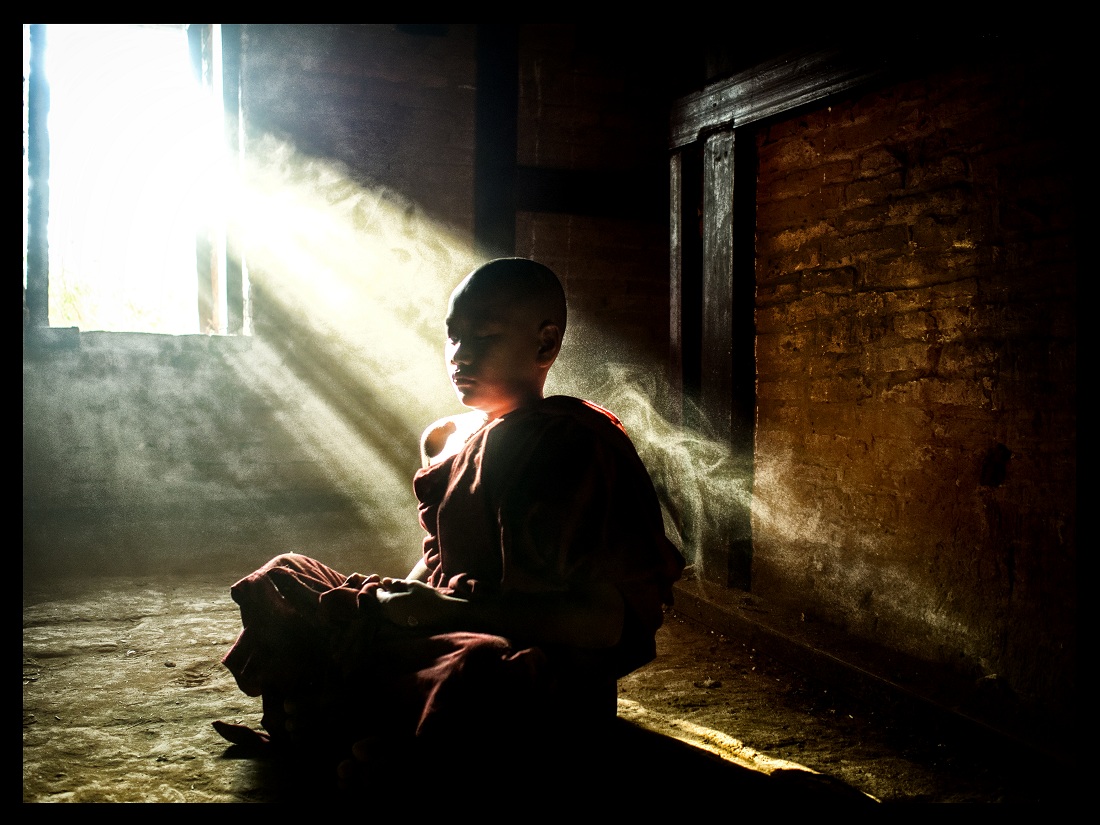
Suryo Widjaja Shares Olympus OM-D Photos From Myanmar on Steve Huff Photo

Image Source: http://www.stevehuffphoto.com/wp-content/uploads/2013/08/Semedi.jpg
 
Photographer Suryo Widjaja has written a guest piece on Steve Huff's blog, sharing several wonderful images he took in Myanmar in January of this year.
 
(Click Here) to read Suryo's post on Steve Huff's site.
 
Myanmar is definitely on my bucket list. I know a couple of people who've been able to gain entry to the country for tourism, and they have a lot of great things to say about the place. Anywhere that measures "Gross National Happiness" sounds okay to me.
 
Suryo reports that he took two Olympus OM-D bodies on the trip - his most-used lens was an Olympus 17mm f1.8, second was the Olympus 75mm f1.8. His 12mm saw little use. I have the 75mm f1.8, and it's a keeper.
 
I am about to take a week long vacation, and I'm planning to take my Leica M9, 35mm Summicron, and a medium telephoto (likely my Canon 135mm f3.5 LTM). This post encourages me to travel light, and my choice of lenses closely matches the field of view of Suryo's lenses on his Micro 4/3 gear. Of course, I'll carry the diminuitive Lumix DMC-LX7 as well. So much capability in such a small package simply cannot be left behind. Plus, it gives me closeup capability not available in the M9, at least not easily.
 
Suryo has shown how much you can do with two lenses. I'm impressed.
 
DMC-365.blogspot.com


Friday, April 5, 2013

Panasonic Lumix DMC-LX7 Shoots HDR in the Dark!

 
Kodaiji at Sunset, by Reed A. George
Panasonic Lumix DMC-LX7, HDR Scene Mode
 
I've been using the Panasonic Lumix DMC-LX7 extensively on my trip to Japan. What an amazing little camera.
 
On this particular night, I went to see a "light up" event at the Kodaiji temple in Kyoto. During the spring cherry blossom season, they light the trees up at night. It's an incredibly beautiful sight. In the picture above, I was hoping to balance the artifical light on the trees in the foreground left with the natural sunset. I decided to try the high dynamic range (HDR) scene mode on the LX7. I was blown away by the results. The camera took three consecutive exposures and merged them on the spot. They were taken handheld, as tripods were not allowed in this location. You're looking at the result straight out of the camera.
 
Needless to say, I used the same HDR scene setting throughout the night. Even when it was completely dark out, it did a great job handling the very challenging lighting situations.
 
 
HDR in the Dark, by Reed A. George
Panasonic Lumix DMC-LX7, HDR Scene Mode
 
The area inside the shrine above was extremely dark. The lamps were very bright. Again, you're looking at the result right out of the camera. I'm hoping to bring up the shadows some when I get this in Lightroom. Regardless, it's quite impressive, especially handheld.
 
Technology has come a long way in the recent past.
 
I'm sure that I won't be able to make large prints of these, but to be able to capture these images at all is a pleasant surprise to me.
 
DMC-365.blogspot.com
 
Get my Kindle eBook on the LX7 here:
 
 
Get your LX7 here:


Monday, March 11, 2013

Nice DMC-GH3 Image - Am I Missing Micro 4/3?

Image Source: http://www.mu-43.com/f56/pier-sunrise-gh3-40421/
 
Brian G posted the shot above, taken with the Lumix 20mm f1.7 lens and new DMC-GH3 camera.
 
(Click Here) to read Brian's post on mu-43.com
 
As I've recently written, I have not been exercising my Micro 4/3 gear much this year. Not at all, really. I am beginning to think the only reason is that I have so many other fun choices, and because I overdid it a little last year, focusing too much on that format.
 
I am planning a one day add-on to a business trip coming up, to go shoot in the California desert. In thinking about what gear to take, my first thought was Nikon DSLR. I want the ultimate image quality that the full frame D700 affords me, and everything from wide to macro to telephoto lenses. However, that would be a big, heavy pack. Hmm. Maybe. I think I would likely take a wide (20 or 24mm f2.8), 35mm f2, 50mm f1.4, and one zoom - the 70-300mm AF-S VR. I could cover the wider focal lengths with a single 24-85 zoom, but believe the tradeoff in optical quality makes it less sensible to go Nikon in that case. I am becoming even more dedicated to primes as time passes.
 
Alternatively, I could carry my DMC-G3 kit, with the following lenses: 14mm f2.5 (tiny), 20mm f1.7 (tiny), 45mm f2.8 macro (no macro in the Nikon kit above), and Olympus 75mm f1.8. I get faster apertures, great optics, and a very light kit, particularly if I don't carry a second body. The only tradeoff (and it's a big one) is sensor quality.
 
On the subject of Micro 4/3 image quality, the DMC-GH3 is the top of the line for Panasonic. The shot above is one of very few I've actually seen posted. Maybe it's just early in the GH3 life cycle. But, I have also read that many people don't like the increased size of the GH3. I'm certainly in that boat. If I don't get the tiny size of previous Micro 4/3 cameras (like my G3s), I will certainly carry a full frame Nikon.
 
So, you may see some new Micro 4/3 shots from me in the near future. I think I've recovered from last year's Lumix focus, with some good old Nikon, Leica, and even film camera therapy. I'm ready to get the G3s out again. And I'm still waiting on that DMC-GX2 announcement...
 
DMC-365.blogspot.com


Tuesday, March 5, 2013

Roger Coulam on "Travelling Light" on the Leica Camera Blog

Image Source: http://blog.leica-camera.com/photographers/guest-blog-posts/roger-coulam-travelling-light/
 
Traveling with less gear is a common subject on DMC-365. That can mean lighter gear, reduced complexity, or both. This is what initially took me into the world of Micro 4/3 gear - I could maintain a diverse set of lenses, a second body, and lots of other stuff that I may or may not end up using on a particular shoot, while reducing the strain on my back. I have to say that worked pretty well for me.
 
However, because the gear is lighter, I tend to jam more into my bag. For example, I almost never carry a second body when I'm shooting a Nikon DSLR; it is simply too much to carry. When shooting Micro 4/3, I almost always carry a second body. And yes, that allows me to shoot mostly prime lenses, which I love far more than zooms, and minimize switching lenses in the field. But, I must remember my primary goal in using Micro 4/3 - reducing overall weight. A two camera Micro 4/3 kit is still lighter than a similarly-equipped single Nikon DSLR kit, but not by all that much.
 
In addition to reducing weight, if I'm out shooting for pure enjoyment, I'd also like to reduce complexity in my kit. For example, I love to take a single camera, single lens kit on some shoots. For this to work, I must adopt the mindset that I may miss some great shots, but the ones I get should be really, really good. This doesn't work for everything. I would never go this way if I were shooting for someone else.
 
Roger Coulam has written a nice post on this subject for the Leica Camera blog.
 
(Click Here) to read Roger's post.
 
Roger has made an effort to reduce his normal equipment set to one camera - either his Leica MP or a Ricoh GR1V. But then he found himself taking both. Then adding a third camera to the mix. Then a tripod. You can see where this is going.
 
So, Roger's back to trying to simplify again. He finds that it allows him to be more expressive in his work. This sounds paradoxical, as most of us believe that more tools, lenses ranging from ultra wide to super telephoto, for example, will allow us to be more expressive. However, I see Roger's point. Sometimes, having to do the "manual zoom" (walking closer or backing away from your subject) forces you to look at it more closely, and from different perspectives.
 
I am not firmly in either camp at this point - carrying lots of gear to allow flexibility, or carrying a minimum of gear to drive me to be more creative. It truly depends on where I'm going and what I plan to shoot. For example, I'm planning a one-day trip to the desert soon. For that, I imagine some wide angle and telephoto shots. I will take a full Micro 4/3 kit with me on that trip. Soon after, I'm going to Japan for a week. My current plan is to take my Leica M9, maximum of three compact lenses, and my Panasonic Lumix DMC-LX5 pocket camera. If I were going into the city for a morning of shooting, as I often do, I would probably take just the M9 and a single lens.
A Dock, by Reed A. George
Panasonic Lumix DMC-LX5
iso 80, f5.6, 0.6 sec
 
So, I suppose this compromise has no single solution. It's the balance of range of capability and level of pain in my back at the end of the day. However, don't lose sight of the fact that reduced complexity can also free up some creative flow.
 
DMC-365.blogspot.com


Thursday, February 21, 2013

Lumix DMC-TS3 and I Go Fossil Hunting Again - Lots of TS3 Images

One of my favorite local activities here in Northern Virginia is fossil hunting. I'm very fortunate to have close friends who really know their Paleontology - both academic and in the field. For more on that -
 
(Click Here) to go to paleoquest.org, my friends' non-profit organization, targeting education in prehistoric science.
 
So, Jason Osborne and I headed out on President's Day for a day of fossil hunting near Liverpool Point in Maryland. I carried my Lumix DMC-G3 and 100-300 zoom in a backpack all day, never taking it out. I did, however, shoot little vignettes of the day, all day long, with my waterproof Lumix DMC-TS3. Here they are (pretty much straight from the camera):
 
 
Bird Tracks, by Reed A. George
Panasonic Lumix DMC-TS3
iso 100, f10, 1/250 and 1/20 sec, respectively
 
Icicles, by Reed A. George
Panasonic Lumix DMC-TS3
iso 100, 3.3, 1/1000
 
Yes, it was cold in the morning. However, there was essentially no wind, no cloud cover, and it got up into the 40s later in the day. All in all, the nicest day we've seen in a while.
 
Duck Blind, by Reed A. George
Panasonic Lumix DMC-TS3
iso 160, f3.3, 1/1000
 
 
For some reason, I really like this shot. I knew I liked it when I shot it. Yes, the subject is centered, a compositional no-no. I like the "T" shape made by the combination of the dock and the horizon. I also like the bush sticking out of the roof.
These next two shots seem to me like they could have come from the desert southwest. I'm told this is likely holocene (recent) river bed.
 
 
Sedimentary Layers, by Reed A. George
Panasonic Lumix DMC-TS3
iso 160, f10, 1/100 (both shots)
 
I thoroughly enjoy shooting with the TS3. I used iAuto pretty much all day, which means that I didn't make any decisions other than composition. The small sensor provides lots of depth of field regardless of settings (except in extreme closeups), so I can trust the camera to take care of exposure for me, and not worry about it. On these fossil trips, I'm usually carrying other stuff, and in this case had multiple layers of clothing to contend with as well. Having the little TS3 in my hand was so simple.
Speaking of closeups, again the small sensor and wide focal length lens allow you to get very close. Here are a few examples.
 
Barnacles (Modern), by Reed A. George
Panasonic Lumix DMC-TS3
iso 100, f10, 1/160
Turritella Fossil, by Reed A. George
Panasonic Lumix DMC-TS3
iso 100, f3.3, 1/250
Tracks, by Reed A. George
Panasonic Lumix DMC-TS3
iso 100, f10, 1/320
 
Oyster, by Reed A. George
Panasonic Lumix DMC-TS3
iso 100, f10, 1/320
 
And here's the real goal - a shark tooth. This one was sticking right out of the cliff side. It's nice to find them this way, as the real Paleontologists can see which layer they're in. And, they're not worn down by wave and sand. Beautiful.
 
Tooth in the Matrix, by Reed A. George
Panasonic Lumix DMC-TS3
iso 100, f10, 1/160
 
Unlike most days out in the field with Jason, we didn't find anything spectacular on this trip. But, we sure had a good time walking the shore, enjoying some sunshine, and having a laugh or two.
 
The TS3 was a useful tool for grabbing some images along the way. I hope you enjoy them.
 
DMC-365.blogspot.com
 
There's a newer version of the DMC-TS3, the TS4. I would recommend this camera for a nice balance of image quality and toughness (including shock resistance and waterproof operation).
 

Tuesday, February 19, 2013

I Succumbed to a GAS Attack - Lumix DMC-LX7

If you don't know what GAS is, it stands for Gear Acquisition Syndrome. Most photographers suffer from it. I have it bad.
 
You probably know that I'm a Panasonic Lumix fan. I've written about my favorite ultra-compact camera, the Lumix DMC-LX5 several times. Up until now, I have refrained from upgrading to the latest model, the DMC-LX7. Yesterday, I gave in and ordered one.
Image Source: http://panasonic.net/avc/lumix/compact/lx7/index.html
 
So, if I'm content with the LX5, what made me do it? Well, first off, the LX7 comes with a Pana-Leica Summilux f1.4 lens, a full stop faster than the LX5's Summicron. With small sensors like the one in the LX5 and LX7, high iso noise is always a concern. With an extra full f-stop over the LX5, the LX7 will allow me to stay a full iso level lower, drastically reducing noise. The LX7 also has a CMOS sensor, rather than the CCD in the LX5. This may end up being a compromise, as CCD sensors can yield sharper images, while CMOS is better at high iso. We'll just have to see about that when it arrives.
 
(Click Here) for a nice review and table summarizing the other differences between the LX5 and LX7 on dpreview.com.
 
The other reason I bought on the spur of the moment? The LX7 is drastically marked down at Adorama. With a list price of $448, it is now available for $150 off at Adorama, for $298. Hard to decline.
 
Now, here's the only dilemma left for me - do I need the new DMW-LVF2 electronic viewfinder that goes with the LX7? Unfortunately, very unfortunately, the DMW-LVF1 that I have for my LX5 (and for my old Micro 4/3 DMC-GF1) won't work on the LX7. The new one, the LVF2, is supposed to be much better in resolution, but it's also larger. That matters on a compact camera like the LX7.
 
From my experience with the LX5, I do enjoy the LVF1. However, I would say that I more often use an old optical finder, a Russian model, with the zoom set to 35mm equivalent. This makes a great, bright, fast little street shooter out of the LX5; I expect to do the same with the LX7. So, for now, I'm not buying the LVF2. If I found out that the new DMC-GX2 Micro 4/3 camera (if and when it's finally announced) used the LVF2, then I'd be very tempted. It's not at all clear that will be the case. By the way, the LVF2 isn't cheap. It costs around $160.
 
There is a great set of information about the LX7 on Panasonic's website, including nice descriptions of the features, galleries of images, and a nice video of Charlie Waite using the LX7 to shoot in Holland.
 
(Click Here) to see the LX7 on Panasonic's site.
 
I have been sharing pictures from the LX5 occasionally on the getdpi forum. Some of us are making the transition to the LX7, and there's a relatively new link where others have shared some very nice LX7 images. I will be adding to this thread soon.
 
(Click Here) to see the LX7 image post on getdpi.
 
One final clincher for me? The LX7 uses the same battery as the LX5. So, I can use my existing set of batteries!
 
I anticipate writing my second e-book soon. The one I wrote on how to set up and use the Lumix DMC-G3 has been very popular, with thousands of downloads. So, I'll commit to writing one on the LX7 soon. I'll have to do it soon, as the next model in this line will undoubtedly come around soon. Stay tuned for that.
 
DMC-365.blogspot.com
 

Thursday, January 31, 2013

Could the Ricoh GR Digital V Be Another Runner in the Large Sensor Compact Market?

My wife has been using my Panasonic DMC-LX5 a lot recently. Given her record with damaging cameras, I'm starting to look for a replacement. Honestly, I probably should have taken advantage of the holiday deals on the DMC-LX7. It was available for $275. Now, it's back over $400.
New Ricoh Digital with APS-C Sensor Coming?
Image Source: http://www.petapixel.com/2013/01/21/ricoh-gr-digital-v-to-feature-an-aps-c-sensor/
 
 
In any case, it's a good time to look again and see what's out there. I would like a larger sensor than the LX7 offers. That brings up some excellent new cameras, all with large sensors and compact designs. Namely, I'm thinking of the new Sony RX1, Leica X2, and Fujifilm X100s. All of these are fixed-lens designs, without zooms. For my purposes, I think I want a zoom. This will be my pocket camera - the backup when needed, or sometimes the only camera I'll carry on a short trip. The Panasonic DMC-LX7 would be perfect, if it just had a little larger sensor.
 
Anyway, I read this short post about the possibility of a new Ricoh compact that may have an APS-C (larger than most other compact cameras) sensor.
 
(Click Here) to read the post on PetaPixel.
 
I think this one will likely have a fixed focal length lens as well. The GR IV does. But, I'll keep my eyes open.
 
Right now, the Fuji X20 seems like a possible good upgrade from the LX5. But, while it's sensor is bigger than the LX5 (and LX7), it's still much smaller than APS-C. Another potential is the Sony RX100, but it doesn't have a viewfinder of any type, so that's not going to work for me.
 
DMC-365.blogspot.com