Showing posts with label 100-300mm f4-56 OIS. Show all posts

Friday, December 9, 2016

Back to Color, Digital, Lumix? Well, Maybe a Little

I've been offline, mostly, working with black and white film in the darkroom. And, enjoying it immensely.
 
But, I decided to give Micro 4/3 a go again, after never being able to quite fall in love with the DMC-GX7 body. The image quality is fine, quite fine, in fact, but the camera feels weird in my hand, and I don't like the electronic viewfinder (EVF) on that particular camera. So, I decided to jump on a Black Friday deal and get the similar but somewhat less full-featured DMC-G7. Much better, for me. I gave up in-body image stabilization (which the GX7 has), but gained a camera that feels right in my hand, with what I feel is a better EVF.
 
Here's a shot I made with the new G7 today, using the Lumix 100-300mm f4-5.6 zoom lens, at 800 iso:
Mockingbird in Winter
 
I'm still really having a blast in the darkroom, but this was SO easy, and shooting color again is also fun...
 
DMC-365.blogspot.com
 

Monday, November 17, 2014

A Morning Out Birding as Winter Approaches

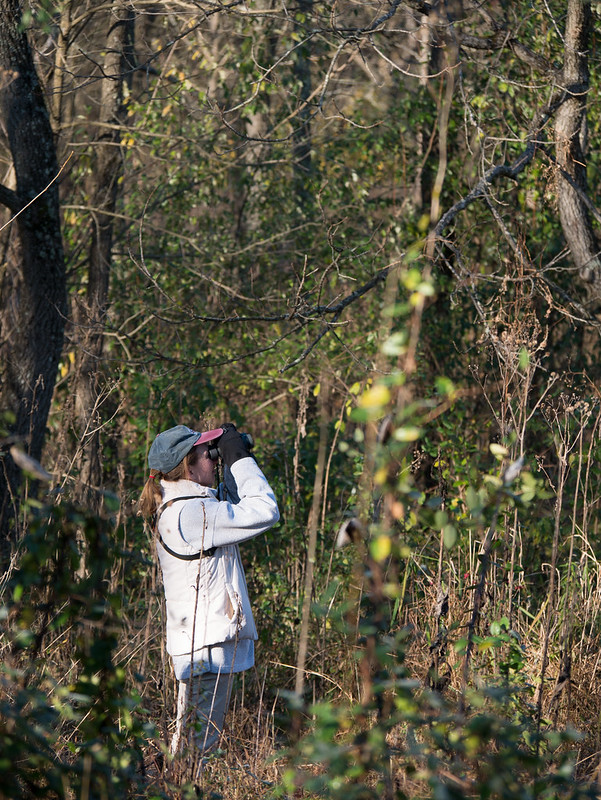
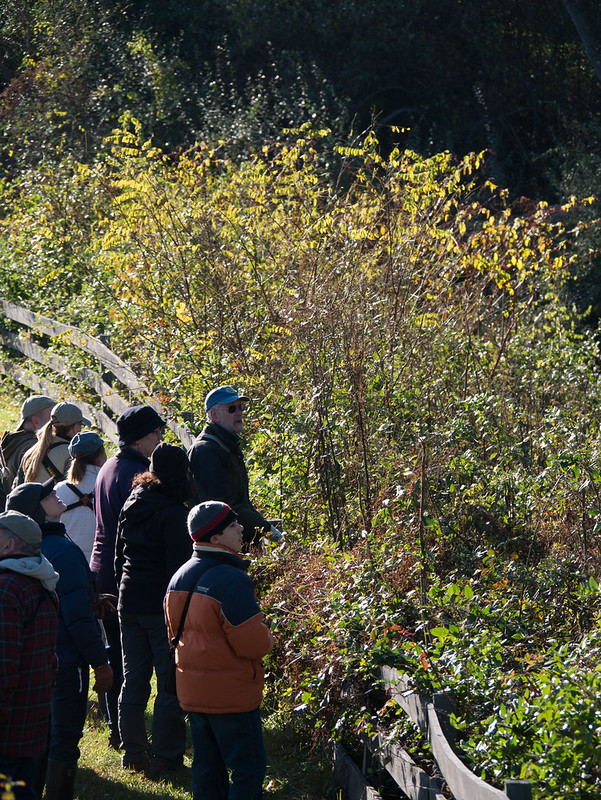
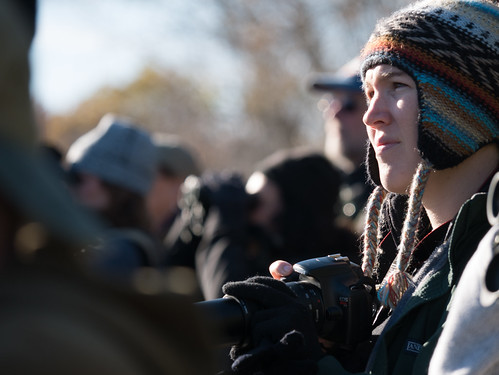
Yesterday, I joined a bird watching walk at my nearest wildlife preserve, which is called Banshee Reeks. The walk happens monthly, and is sponsored by the Loudoun Wildlife Conservancy. (Click Here) to read about the organization. They host quite a number of interesting events.
 
I realized that the walk was happening at 7:35 AM; it started at 8:00 AM. I quickly grabbed my Lumix GX7 and 100-300mm f4-5.6 OIS lens and headed out the door. A quick stop at Peets for my Saturday morning coffee, and away I went. I arrived just in time to join the group.
 
 
I really am a telephoto guy at heart. Though I've expanded my skills to include normal and wide angle lenses, from the start I've loved shooting long lenses. The 100-300 Lumix lens is a fantastic combination of long reach (600mm equivalent) and compact size. Because of the OIS vibration isolation, it's even more reasonable to use handheld.
 
Considering that it's winter, and the majority of migratory birds have already gone, we saw quite a range of birds: white throated sparrow, bluebird, fish crow, American crow, flicker, hawk (didn't get a good identification, but probably either red tailed or red shouldered), an immature bald eagle, mockingbird, plenty of robins. It's always great to go with someone like our tour leader Joe and his sidekick Del, who can spot and identify birds well beyond my capabilities.
 
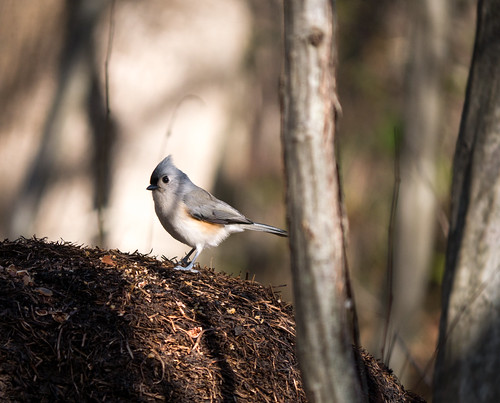
Knowing that I had to get back home, after about an hour with the group I just wandered off into the forest and sat down. After a few minutes, I heard a single bird call. Then, I heard a different bird answer, much closer to where I was sitting. Within a few minutes, a small group of tufted titmouse had been drawn to an old hay bale, rolled off into the woods next to me.
 
I sat and enjoyed watching them for another ten minutes or so, and then got up, got the blood back into my legs, and began the walk back to the car.
 
I shot a few more pictures on the way back.
 
I think that telephoto lenses get underrated for their use in landscape photography.
 
Finally, coming around a corner in the trail, I got a quick shot off of this Mockingbird, against the blue autumn sky.
 
 
It was a very nice way to spend just a couple of hours on an autumn Saturday morning.
 
DMC-365.blogspot.com
 

Friday, July 25, 2014

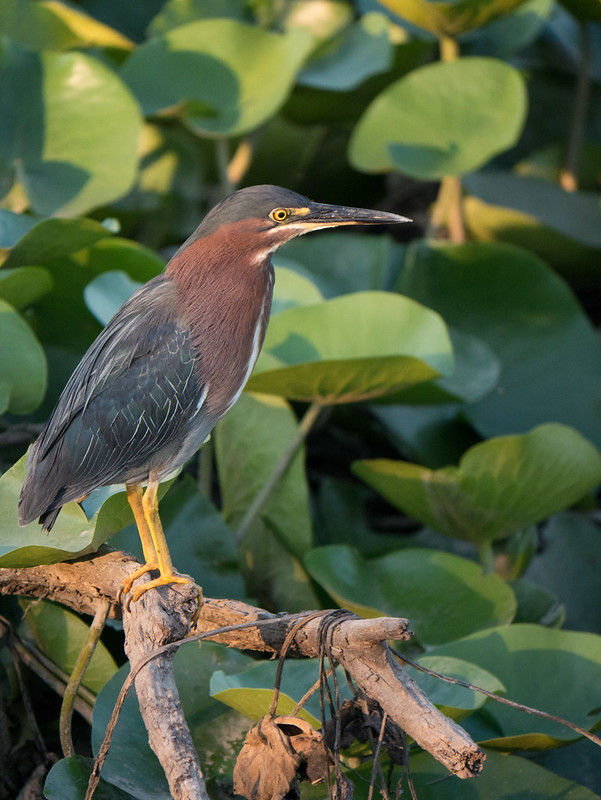
Green Heron - Panasonic Lumix DMC-GX7 and Lumix 100-300mm f4-5.6 Lens


Green Heron, Butorides virescens, by Reed A. George
Panasonic Lumix DMC-GX7, Lumix 100-300mm f4-5.6 Zoom Lens at 300mm
iso 1600, f6.3, 1/800 sec.
 
In our neighborhood suburban "nature preserve," I've been noticing a pair of green herons on our occasional evening walks. I took out a telephoto lens at sunrise last weekend, but they were nowhere to be found. Having seen them again last night, when I didn't have a long lens along, I decided that was it. I was coming back today with a long lens and tripod.
 
Well, I was rewarded with the presence of this little guy. I wasn't able to catch him feeding, so there's reason to try again (and again, I'm sure).
 
I'm pretty pleased with the result, especially given that I was shooting the GX7 at iso 1600. Not bad. Not bad at all...
 
DMC-365.blogspot.com
 

Thursday, June 26, 2014

George, From Belize

Meet George, the iguana. He seems to be the mascot of our hotel here in Belize.
 
 
George the Iguana, by Reed A. George
Panasonic Lumix DMC-GX7, Lumix 100-300mm f4-5.6 Mega OIS Lens at 200mm
iso 200, f6.4, 1/400 sec. (handheld)
 
I worked around George to shoot from various angles, and like this shot best mainly because it includes his whole body while focusing attention on his eye with shallow depth of field. I also like the red hibiscus flowers in the background.
 
We're in Belize for a few days of scuba diving and relaxation. Our hotel, Coco Beach Resort in San Pedro, is quite nice if a bit isolated. It's our first day here, so we're still getting the lay of the land. Our plan is to head into San Pedro via water taxi today to do a little exploring in the city. I'll be carrying my Panasonic Lumix DMC-LX7, as it's super-capable, compact, and unobtrusive.
 
By the time this posts, we'll be back in Virginia. Here's hoping for a nice break in a place we've never visited before!
 
DMC-365.blogspot.com


Friday, February 21, 2014

Reminder That Micro 4/3 is Capable of Low Light Excellence

 
Acoustic Burgoo, by Reed A. George
Panasonic Lumix DMC-G3, Lumix 100-300 f4-5.6 OIS at 100mm
iso 6400, f4, 1/100 sec.
 
Lately, I've been shooting live music with cameras other than Micro 4/3. Mostly my Nikon D700, but also with Leica, and even with film.
 
I read an interesting post by Kevin Paris, where he shares a lot of live music photography from Belgium, all shot with Micro 4/3 cameras.
 
(Click Here) to read Kevin's post and click on the flickr link to see his images. He's included a lot of black and white images. I really like some of his results.
 
Anyway, this got me looking back on images I'd made with Micro 4/3. The shot above was made with several generations of Lumix sensor back - the DMC-G3. It's amazingly good for iso 6400. I can only imagine what my DMC-GX7 would do in this situation. I can only imagine because I haven't tried it. That's inexcusable, and I'll remedy that situation soon.
 
DMC-365.blogspot.com


Wednesday, December 11, 2013

Winter Doldrums? December is Here.

Sunsets on the Month of November, by Reed A. George
Panasonic Lumix DMC-GX7, Pana-Leica Summilux 25mm f1.4 Lens
iso 200, f8, 1/50 sec.

As I write this, it's Sunday morning, December 1, 2013 (I usually write posts several days ahead). Amazing how fast this year has gone; it seems like yesterday we were in January.
 
Yesterday, I went to visit a friend in Warrenton, Virginia, and captured the shot above, the final sunset of November, with my new Lumix GX7 and 25mm Summilux.
 
Oh yeah, while I was out, I got to handle the new Nikon Df at McClanahan's Camera in Warrenton. It's really, really attractive.
 
(Click Here) to got to McClanahan's. Mr. M. has a Df waiting for your purchase; I;m sure he'll be happy to ship it to you.
 
Winter makes it harder to find interesting subjects to photograph, especially outdoors. This just means that I need to focus my lens and efforts elsewhere. People are still interesting in winter, right? And, it's a chance to focus on cleaning up all of the image files I shot all year round, organize my folders for next year, and maybe even do some post-processing and printing.
Last of the Leaves, by Reed A. George
Panasonic Lumix DMC-GX7, Lumix 100-300mm f4-5.6 OIS Lens at 280mm
iso 400, f5.6, 1/400 sec.
 
If you know me at all, you know that organizing files isn't what turns me on about photography. No, it really is December 1, and that means it's time to select my final lens for my monthly series Whole Lotta Leica (that series will end after this month), and pull a neglected camera out of the closet for my Skeletons From The Closet series. The future of SFTC is uncertain at the moment, but I'm thinking of focusing on a few of my favorite cameras next year, for longer than a month. I may even do multiple cameras at the same time. We'll see.
 
So, time to start thinking about some new projects, and continue on some current ones. I'm sure I'll find some good live music being played in the local venues even as it snows outside, for example.
 
DMC-365.blogspot.com


Saturday, June 1, 2013

My Shot of The Acoustic Burgoo Wins the Piedmont Virginian Photo Contest!

The Acoustic Burgoo, by Reed A. George
Panasonic Lumix DMC-G3, 100-300mm f4-5.6 at 100mm
iso 6400, f4, 1/100 sec.
 
My photo of the local band, The Acoustic Burgoo has won first place in the Arts/Music category in Piedmont Virginian's 2012 photo contest!
 
(Click Here) to go to the Piedmont Virginian's website.
 
The hard copy magazine will be on shelves in early July.
 
Once again the Lumix G3 comes through for me, even at high iso settings!
 
DMC-365.blogspot.com


Saturday, March 30, 2013

Joshua Tree National Park - Lumix In The Desert

 
Prickly, by Reed A. George
Panasonic Lumix DMC-G3, Lumix 20mm f1.7 Lens
iso 160, f4.5, 1/500 sec
 
Desolate, by Reed A. George
Panasonic Lumix DMC-G3, Lumix 20mm f1.7 Lens
iso 160, f5.6, 1/250 sec
 
The detail in the twisted tree in the foreground contrasts nicely with the smooth, weather-worn cliffs. The dry riverbed gives the eye something to follow.
Namesake Joshua Trees, by Reed A. George
Panasonic Lumix DMC-G3, Lumix 100-300mm f4-5.6 Lens at 162mm
iso 200, f8, 1/160 sec
 
The space between features at Joshua Tree makes composition a challenge. In this case, I decided to shoot from afar with the 100-300mm, to compress the Joshua Trees a little closer together in perspective.
 
I decided to put the 45mm f2.8 Macro-Elmarit on and shoot some macros:
 
Wood Detail, by Reed A. George
Panasonic Lumix DMC-G3, Pana-Leica 45mm f2.8 Macro-Elmarit
iso 200, f5.6, 1/25 sec
 
 
Monarch's Demise, by Reed A. George
Panasonic Lumix DMC-G3, Pana-Leica 45mm f2.8 Macro-Elmarit
iso 200, f5.6, 1/30 sec

 
Radial, by Reed A. George
Panasonic Lumix DMC-G3, Pana-Leica 45mm f2.8 Macro-Elmarit
iso 200, f4, 1/320 sec
 
Miniature Flower, by Reed A. George
Panasonic Lumix DMC-G3, Pana-Leica 45mm f2.8 Macro-Elmarit
iso 200, f4, 1/200 sec

 
Skeleton, by Reed A. George
Panasonic Lumix DMC-G3, Pana-Leica 45mm f2.8 Macro-Elmarit
iso 200, f11, 1/60 sec
 
Wherever there is water, life abounds. These are fan palms at a small spring.
Fan Palms, by Reed A. George
Panasonic Lumix DMC-G3, Lumix 100-300mm f4-5.6 Lens at 300mm
iso 200, f5.6, 1/200 sec
 
Ocotillo, by Reed A. George
Panasonic Lumix DMC-G3, Pana-Leica 45mm f2.8 Macro-Elmarit
iso 200, f4.5, 1/800 sec

My trip was a little early in the year for the short-lived desert bloom. The ocotillo (above) was well on its way, though.
 
The desert is an amazing place to shoot. It's challenging. You really have to tune in to see what to photograph. I find it stimulating. It stretches me beyond my normal shooting situations, which is always a good thing.
 
 
Earth's Spine, by Reed A. George
Panasonic Lumix DMC-G3, Lumix 14mm f2.5 Lens
iso 200, f5.6, 1/640 sec


Split Rock, by Reed A. George
Panasonic Lumix DMC-G3, Lumix 14mm f2.5 Lens
iso 200, f11, 1/320 sec

 
Window To The Horizon, by Reed A. George
Panasonic Lumix DMC-G3, Lumix 14mm f2.5 Lens
iso 200, f11, 1/200 sec
Wispy Clouds, by Reed A. George
Panasonic Lumix DMC-G3, Lumix 14mm f2.5 Lens
iso 200, f8, 1/320 sec
 
 
This little guy is called a side-blotched lizard:
Side-Blotched Lizard (Uta stansburiana), by Reed A. George
Panasonic Lumix DMC-G3, Lumix 100-300mm f4-5.6 Lens at 300mm
iso 200, f8, 1/1600 sec
 
Even though it was only about 75 degrees fahrenheit on this day, as the sun rose directly overhead at mid-day, it was brutal. I got sunburned much more quickly than I expected. I also stepped off the trail, and got myself into a walk several miles longer than planned. The desert is no place to mess around. Stay on the trail. Period.
 
Mid-day Shadows, by Reed A. George
Panasonic Lumix DMC-G3, Lumix 14mm f2.5 Lens
iso 160, f16, 1/200 sec
 
I hope you enjoyed this little tour of the desert. I will take any opportunity to go back and shoot here again.
DMC-365.blogspot.com



Friday, March 15, 2013

Climb! Fun With the Lumix DMC-G3 in the Desert

Climbing, by Reed A. George
Panasonic Lumix DMC-G3, Lumix 100-300 f4-5.6 OIS Lens at 150mm
iso 160, f6.3, 1/4000 sec.
 
I shot this image in Joshua Tree National Park over the weekend. It was the first time I'd had the G3 kit out for a while. After spending so much time with it last year, I guess I needed a break. This trip reminded me just how flexible Micro 4/3 is.
 
In a single waist bag I was able to carry a G3 body, 20mm f1.7, 14mm f2.5, 90mm Macro-Elmarit f2.8 and 100-300mm f4-5.6 lens. Amazing.
 
On the subject of the 100-300mm lens, it's is such a great lens. I was pretty far from the scene above, walking across the flat desert floor. With a very quick change of lenses from the 20mm to the 100-300mm, I was able to capture this moment. Sometimes it's good to not be restrained by your equipment. This shot would not have been the same without the reach of a nice telephoto.
 
I'll be posting more pictures from the desert soon.
 
DMC-365.blogspot.com


Monday, January 21, 2013

Including People in Your Landscapes? It Can Work.

Kauai Beach, by Reed A. George
Panasonic Lumix DMC-G1, Lumix 100-300mm f4-5.6 Lens at 100mm
iso 400, f7.1, 1/1250 sec
 
Many times, when we think of a landscape image, we picture an untouched wilderness. One of the old rules of landscape photography is to include a strong foreground element, a focal point of some type, to anchor the scene. I can admit that I find myself trying to accomplish the untouched look, and have to search hard to find something interesting to put in the foreground.
 
Including a person is an easy way to achieve the necessary foreground element and focal point. It also has the nice feature of adding scale to a landscape, by letting the viewer see something that they know the size of. In the picture above, what I was trying to show was the steep mountains of Kauai, jutting straight up from the seashore. Yes, the trees would have given some idea of scale, but the two people on the beach do a better job of that. And, the trees were just a "layer" in the composition. They would not have provided a focal point. Without the people, this shot would not have a focal point in the lower 2/3 of the image at all.
 
There is a nice brief article by Matt Dutile on this concept on the Digital Photography School's blog.
 
(Click Here) to read Matt's article and see some nice example shots.
 
DMC-365.blogspot.com
 

Saturday, November 24, 2012

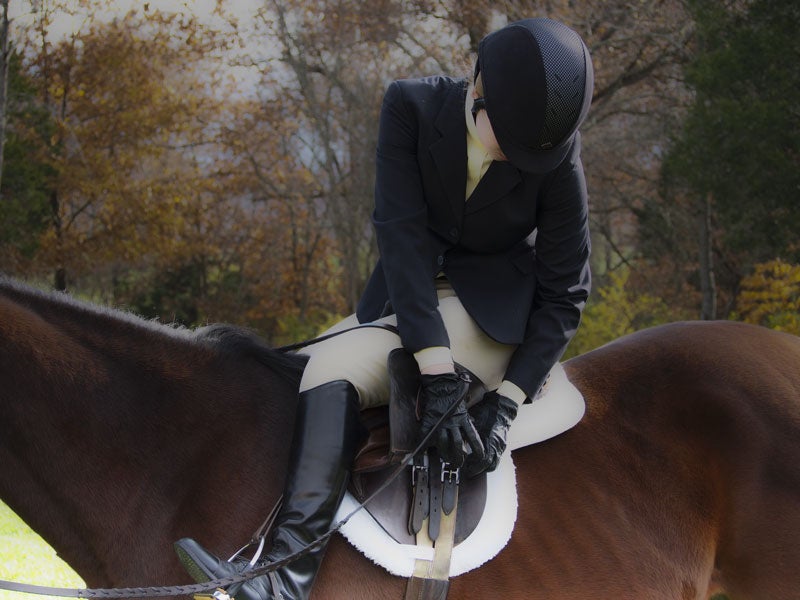
Olympus OM-D and Lumix 45-200mm Zoom - Nice Horseback Pictures by caimi on mu-43.com

 
Olympus OM-D, Panasonic Lumix 45-200mm f4-5.6 Lens
 
Member caimi posted several very nice pictures from a horseback riding event, all shot with the Olympus OM-D and Panasonic 45-200mm f4-5.6 lens.
 
(Click Here) to see the full post on mu-43.com
 
I bought the Lumix 45-200 with my first Micro 4/3 camera, the DMC-G1. It is an awesome lens - very compact, fast, and sharp. I sold it when I moved to the 14-140mm f4-5.8 and the 100-300mm f4-5.6. I believe the 45-200 is sharper than the 14-140. The 100-300 is so good, I can't say either one is better in the range where they overlap.
 
Ducking Parade, by Reed A. George
Panasonic Lumix DMC-G1, Lumix 45-200mm f4-5.6 Lens
iso 400, f6.3, 1/640 sec.


Goldfinch, by Reed A. George
Panasonic Lumix DMC-G1, Lumix 45-200mm f4-5.6 Lens
iso 400, f5.6, 1/500 sec.

Nothing wrong with the 45-200, even though it was one of the first Lumix Micro 4/3 lenses.

DMC-365.blogspot.com


Monday, October 15, 2012

Using Micro 4/3 for Concert Photos

 
Monograma, by Gary Ayala on mu-43.com
Image Source: http://www.mu-43.com/f88/brea-jazz-festival-ii-34199/
 
Gary Ayala has shared a series of images from the Brea Jazz Festival, all shot with an Olympus OM-D. He used both Lumix 100-300 4-5.6 zoom (as in the shot above) and the Olympus 75mm f1.8 prime lenses.
 
(Click Here) to see Gary's post on mu-43.com. There are more pictures there.
 
I have been using my Panasonic Lumix G3s for live music events for quite some time. Most opt for DSLRs, for the larger sensor and lower noise performance. Overall, I'm quite pleased with the G3, even at high iso settings.
 
Here are a couple of my own results. The first is with the 100-300mm zoom:
 
 
Storyteller Tim O'Brien, by Reed A. George
Panasonic Lumix DMC-G3, Lumix 100-300mm f4-5.6 at 100mm
iso 1600, f4, 1/100 sec
 
 
And here's one with the Olympus 75mm f1.8 that I just got. This is the first and only show I've shot with it so far.
Acoustic Burgoo at Watermelon Park Festival 2012, by Reed A. George
Panasonic Lumix DMC-G3, Olympus 75mm f1.8
iso 800, f2.8, 1/100 sec
 
I'm very happy with the Olympus lens so far. But, as I mentioned, I've got a lot more testing to do with it. It is a gorgeous lens, and sharp as a tack.
 
I need to learn how fast I need the shutter to be to handhold it steadily, since it does not have stabilization (that's built into the body with Olympus, so the lenses don't have it). The rule of thumb is to keep your shutter speed faster than 1/ the focal length (equivalent at full frame 35mm). So, in this case, since 75mm on the Micro 4/3 sensor has the same field of view as a 150mm on the full frame sensors, I should keep it faster than 1/150 sec. The shot above is at a slightly slower shutter speed, so I got lucky. That wasn't always the case. I would have been better off increasing the iso to 1600, and getting a 1/200 shutter speed. I didn't want to open the aperture wider, since I wanted all of the band members to be reasonably within the depth of field. In terms of focus and depth of field, I achieved my goal - central focus on Melissa, the singer, and the rest of the band in adequate focus.
 
Lots of fun to be had with the new Micro 4/3 products - that's for sure!
 
DMC-365.blogspot.com


Friday, October 12, 2012

Awesome Bird Shots With Panasonic Lumix DMC-G5, Lumix 100-300 f4-5.6, and a Telescope

 
By FernandoBatista on mu-43.com
Shot with DMC-G5 and Lumix 100-300mm f4-5.6
Image Source: http://www.mu-43.com/f54/bird-new-g5-image-heavy-33977/
 
FernandoBatista on mu-43.com has posted several amazingly sharp bird photos, all shot with the new Lumix DMC-G5. Some were shot with the Lumix 100-300mm f4-5.6, others with an apochromatic telescope adapted to the Lumix body.
 
(Click Here) to see them all.
 
I have really gotten some nice images with the 100-300mm Lumix lens. Sitting birds are one thing. Shooting them in flight, which really helps to make them look less like stuffed taxidermy models, is much harder. The Lumix lens' fast autofocus is pretty good, but it's definitely still not a high hit-rate endeavor.
 
 
Red-Wing Blackbird, by Reed A. George
Panasonic Lumix DMC-G1, Lumix 100-300mm f4-5.6 at 275mm
iso400, f5.6, 1/80sec
 
This is about the best I've done on birds in flight with the Lumix 100-300:
 
Osprey in Flight, by Reed A. George
Panasonic Lumix DMC-G1, Lumix 100-300mm f4-5.6 at 177mm
iso400, f8, 1/1250sec

I've actually done much better with a manual focus Nikkor 500mm f4 than with any autofocus lens. That said, I've spent a lot more time perfecting my technique with that lens, and matched with the superb Nikon D700 full-frame sensor, it's not really a fair comparison:


Ospreys in Flight, by Reed A. George
Nikon D700, Nikkor Ais 500mm f4 (manual focus)
iso500, f5.6, 1/1500 sec


I have this one enlarged to 12x18 on my wall, and the sharpness is remarkable. It's easy to tell these guys aren't stuffed!


DMC-365.blogspot.com


Thursday, July 26, 2012

Music Festival Photography - Timely Piece on ePhotoZine

 
"The Shakedown," by Reed A. George
Panasonic Lumix DMC-G3, Lumix 14mm f2.5
iso 200, f5.6, 1/60 sec
 
There's an entry on the ePhotoZine blog about festival photography. This is timely, as I'm heading out to Floyd Fest starting tomorrow (by the time you read this, I'll be at the festival).
 
(Click Here) to see the Floyd Fest webpage.
 
It's a five hour drive from home, and I'll be staying for three nights.
 
Okay - so what does ePhotoZine have to say about festival photography? Here are the main points:
 
  1. Get a high vantage point if possible.
  2. Arrive early - good advice for any event.
  3. "Good Zoom" - this means to be ready to use a range of focal lengths to me, not necessarily a zoom. They also mention waterproof cameras or cases at this point. I'll be bringing my Panasonic Lumix DMC-TS3 underwater camera to this show; I hope I don't need it.
  4. Steady hands - some tips on minimizing vibration when shooting
  5. Have a plan - this one is a must, especially at a large festival. There is no way that I'll cover all the bands at Floyd Fest. In fact, there's no way that I'll cover the whole day, every day, during a four day music festival. My goal is to see the bands that I know and like, and hopefully add a few new favorites.
(Click Here) to read the original piece on ePhotoZine.


My plan for this show is to take only Lumix gear, plus maybe one film camera. I will take two DMC-G3s, Lumix 12mm f2.5, Pana-Leica 25mm f1.4 and 45mm f2.8, Lumix 100-300mm f4-5.6 and Voigtlander 75mm f2.5 manual focus Leica Thread Mount (LTM) lenses, and Nissin flash. I am receiving my new Lumix 12-35mm f2.8 zoom today. If I'm comfortable with its operation, it may replace all the primes for this trip, but I doubt it. It's never a good idea to rely too much on a new lens on a trip.
 
In terms of a film camera, I'm planning to carry a Leica CL and adapted LTM 3.5cm Elmar f3.5. I hope to use that for candid shots of festival-goers.
 
DMC-365.blogspot.com


Sunday, July 22, 2012

Airshows - Blue Angels and More

 
Image Source: http://forums.dpreview.com/forums/read.asp?forum=1041&message=42009156
 
Member LTZ470 posted a series of shots of the US Navy Blue Angels practicing over on dpreview.com. All were shot with the Olympus OM-D and Panasonic 100-300mm f4-5.6 lens. I absolutely love that lens!
 
(Click Here) to see them all over on dpreview.
 
Also, be sure to visit my friend Rob's flickr sets (username robsv) to see many more AWESOME airshow shots, including the Blue Angels and many others.
Vapor, by Rob Svirskas
Image Source: http://www.flickr.com/photos/robsv/5155953876/
Nikon D300, Nikkor 300mm f4 AF-IF Lens
 
These amazing technical marvel aircraft test the limits of photographic equipment. It is absolutely amazing to see the detail that modern cameras can capture at-speed on the distant beauties.
 
While Rob is a Nikon user, Micro 4/3 is now at the point where you can carry an equivalent 600mm field of view lens without the need for a heavy tripod, and get very acceptable shots at airshows. And, the 100-300mm f4-5.6 is fast enough for these normally-bright outdoor events! LTZ470 proves the competency of the lens for the application!
 
DMC-365.blogspot.com


Wednesday, June 13, 2012

Pairing the Pana-Leica 45mm f2.8 Macro-Elmarit With the Olympus E-M5

 
Olympus E-M5 and Pana-Leica 45mm  by Frank B on dpreview
Image Source: http://forums.dpreview.com/forums/read.asp?forum=1041&message=41605970
There has been an enormous amount of buzz about the new Olympus E-M5 Micro 4/3 body. It is a very attractive camera, with retro styling sure to appeal to the Olympus film SLR user, and superb image quality.
 
(Click Here) to see the Olympus E-M5 review on dpreview.com
 
I found the following post by Frank B on dpreview's Micro 4/3 forum, pairing the E-M5 with the Pana-Leica 45mm f2.8 Macro-Elmarit:
 
(Click Here) to see the original post and one more macro image.
 
Right now, I'm planning almost the opposite - pairing my Panasonic body (Lumix DMC-G3) with Olympus lenses. In particular, I'm very much looking forward to the new Olympus 75mm f1.8 becoming available for purchase.
 
(Click Here) to see a preview of the Olympus 75mm f1.8 on dpreview.
 
I think that handful of fast glass will be great for my low light concert photography, giving me a combination of more reach than my Pana-Leica 45mm and faster aperture than my Lumix 100-300mm f4-5.6. By the way, the 100-300 works pretty well if the stage lights are bright enough. But, the new Oly lens will do fine in near darkness. C'mon, Olympus, ship those lenses to the US market!
 
DMC-365.blogspot.com


Monday, May 28, 2012

Specialty Blogs Are Cool - Check Out Micromotorsport

 
Classic Corvette Interior, by Reed A. George
Panasonic Lumix DMC-G1, Leica Summarit 50mm f1.5 (LTM)
iso 100, 1/800sec

When I started this blog, specifically focused on Panasonic Lumix cameras and my uses of them, I was concerned about it being focused on too small of a subject. However, what I read about blogging indicated that it was better to focus tightly, so I gave it a try. While I do write about things other than purely Lumix topics, there is always a connection to my photography interests, which all include Panasonic in some way, or at some time or another.

Anyway, I found this very focused blog, centered on the use of Micro 4/3 cameras to photograph automobiles and automotive events:

http://micromotorsport.wordpress.com/about/

(Click Here) to check it out.

This intersection of Micro 4/3 gear and automobile interests is clearly focused, but I'm sure still draws quite a number of followers. There are excellent examples of car images throughout, a shooting guide, and interesting writing about techniques and equipment. Bravo!

I love to attend car shows, and used to be seen pretty regularly at the Laguna Seca Antique races in Monterey, California, when I lived near there.

(Click Here) for the Laguna Seca website.
Black Cat, by Reed A. George

I hope those of you who are car and Micro 4/3 enthusiasts will enjoy this site. If cars aren't your bag, you may still want to read the shooting guide's information on motion panning - it works for anything in motion.

DMC-365.blogspot.com

 
DMC-365.blogspot.com