Saturday, October 19, 2013

Revisiting Japan Pictures - Six Months Later

I have the great fortune of visiting Japan often, usually every spring. This year we went in late March, and had a wonderful time, as usual. My wife's cousin, Yoshiko, is a highly-experience guide focusing on the Kyoto area, one of Japan's most historic places. Yoshiko and I spent a half-day walking around Kyoto for a photo tour. It was not the best weather, and in fact rained quite hard. I carried my Leica M9 and 35mm f1.4 Summilux.
 
(Click Here) to read about the Summilux, or use the tab at the top of this page to see all of my Whole Lotta Leica posts, including results posts for this lens.
 
To be honest, I was not very pleased with my own photographic results. Yoshiko took me to some amazing places, and weather is no reason to fail to bring back excellent images. I remember looking through them and thinking that I just had not hit the mark on that day.
 
I decided to go back through those images, and see if I'd missed anything. Here are two shots that I now quite like:
 
Gion Crossing, by Reed A. George
Leica M9, Summilux 35mm f1.4 Lens
iso 640, f6.7, 1/90 sec.
 
 
Gion, in Kyoto, is the most famous geisha district in Japan. What I really like about the shot above are the secondary elements (the two ladies in kimono sharing an umbrella are the primary element). I love how the ladies across the street are turning to look at them. The Japanese have a fascination with their past and culture, even if many of them no longer practice any aspects of it regularly. They are always interested to see someone who is. The other element I like is the painting of a geisha on the wall to the left of those ladies. It was an announcement for an event, and adds another nice touch of historic Japanese imagery.
 
Here's another that caught my eye:
 
Noren, by Reed A. George
Leica M9, Summilux 35mm f1.4 Lens
iso 640, f6.7, 1/90 sec.
 
 
I always love the graphic arts in Japan. For example, restaurants frequently hang "noren," decorative curtains, in their doorways. In this shot, you see the purple noren dominating nearly half of the image, and the semi-line of red paper lanterns pulling you further into the picture. The person looking out between the second and third lantern really adds a nice finishing element in my opinion.
 
So, maybe I did a little better than I initially thought. I find that I sometimes need to take a good long time to let my expectations for a particular shoot or event fade before I can fairly judge my own results. I was not able, due to my own limitations, to get the shots I expected on that day, even though I was presented with a rare opportunity and an expert guide. As I'm learning through other pursuits in life, expectations can be expensive; Buddha says they're the root of suffering. Once I get past expectations, I can usually find beauty.
 
DMC-365.blogspot.com


Friday, October 18, 2013

New Pana-Leica Lens! 15mm f1.7 Summilux Aspheric


Pana-Leica 15mm f1.7 Summilux
Image Source: http://panasonic.net/avc/lumix/pressrelease/leica_dg_summilux_15/

Well, it seems that Panasonic and Leica's collaboration continues. I'm pleased to hear it.

While I'm anxiously awaiting the arrival of my newly-ordered Lumix DMC-GX7, Panasonic has just announced the latest addition to the Pana-Leica lens set for Micro 4/3. While 30mm equivalent field of view is a little odd, being neither here nor there between 28mm and 35mm traditional fields of view, I'm sure it's going to be a great lens. It will be a nice addition to my 25mm Summilux and 45mm Macro-Elmarit. A tiny three lens prime kit that covers lots of ground.

As you probably know, I am a Leica nut. I have been focused on shooting my M9 this year, which is appropriate given the investment I made in it. I didn't want to stray from Leica, but my Micro 4/3 lenses have been calling me, albeit with a muffled voice, from inside my equipment drawers. So, I decided to jump back in with the purchase of a DMC-GX7 camera. Now it seems I can really have the best of both worlds - the latest Lumix features and Micro 4/3 size advantage with the highest quality Pana-Leica lenses.

Exciting times in photo equipment!

Now, please, Panasonic. Please ship my GX7!

DMC-365.blogspot.com


Thursday, October 17, 2013

Watermelon Park Festival, 2013 - Shot With Nikon D700

I've been shooting a lot of live music and local musicians over the past few years. It's a wonderful project, and has helped me to meet a lot of great people, musicians and fans alike.
Every September, I look forward to the Watermelon Park Festival, held in Berryville, Virginia, about an hour from my home. It's a great time of year to be outdoors, camping, listening to great music. This year was no exception.
There will soon be a review of the festival written by Jim McWalters on the live music blog Cosmic Vibes Live. It will include photos from both Jim and myself.
(Click Here) to check out Cosmic Vibes Live.
Here are my pics from the festival.
Impromptu Music with David Van Deventer, Danny Knicely, and Jared Pool, by Reed A. George
Nikon D700, Nikkor 50mm f1.4 AF-D Lens
iso 1600, f2, 1/125 sec.
The Plank Stompers, by Reed A. George
Nikon D700, Nikkor 85mm f1.8 AF-D Lens
iso 400, f4.8, 1/250 sec.
The Bumper Jacksons, by Reed A. George
Nikon D700, Nikkor 50mm f1.4 AF-D Lens
iso 3200, f1.4, 1/250 sec.
The Green Boys, by Reed A. George
Nikon D700, Nikkor 50mm f1.4 AF-D Lens
iso 800, f4.8, 1/125 sec. With Fill Flash
The Green Boys, by Reed A. George
Nikon D700, Nikkor 85mm f1.8 AF-D Lens
iso 800, f4.8, 1/125 sec. With Fill Flash
Watermelon Boat Float!, by Reed A. George
Nikon D700, Nikkor 50mm f1.4 AF-D Lens
iso 400, f8, 1/250 sec.
 
Dwayne Brooke of The Woodshedders, by Reed A. George
Nikon D700, Nikkor 50mm f1.4 AF-D Lens
iso 3200, f1.7, 1/125 sec.

Dwayne Brooke and Jared Pool of The Woodshedders, by Reed A. George
Nikon D700, Nikkor 50mm f1.4 AF-D Lens
iso 3200, f1.7, 1/125 sec.

David Van Deventer of The Woodshedders, by Reed A. George
Nikon D700, Nikkor 50mm f1.4 AF-D Lens
iso 3200, f1.7, 1/125 sec.
Dwayne Brooke and Jared Pool of The Woodshedders, by Reed A. George
Nikon D700, Nikkor 50mm f1.4 AF-D Lens
iso 3200, f1.4, 1/125 sec.
Larry Keel, by Reed A. George
Nikon D700, Nikkor 85mm f1.8 AF-D Lens
iso 1600, f2, 1/180 sec.
Larry Keel, by Reed A. George
Nikon D700, Nikkor 85mm f1.8 AF-D Lens
iso 1600, f2, 1/180 sec.
Aimee Curl and Danny Knicely of Furnace Mountain Band, by Reed A. George
Nikon D700, Nikkor 85mm f1.8 AF-D Lens
iso 800, f2.8, 1/125 sec.
 
Hoopin' It Up!, by Reed A. George
Nikon D700, Nikkor 50mm f1.4 AF-D Lens
iso 800, f2.8, 1/2 sec.
 
 
This festival presents a lot of opportunities to test my photographic skills. This year, I took the D700, 20mm f2.8, 50mm f1.4, and 85mm f1.8 autofocus lenses. I shot in daylight, dark, with and without flash. The flash came in real handy in the dance tent during the day, as in the Green Boys shots above.
 
I will admit that I was a pretty lazy photographer on this particular weekend. This festival has become a great relaxation for me. I guess that's a pretty good thing in itself.
 
I do have some film shots, taken with my Leica CL and Rokkor 40mm f2.8, but the film is off at The Darkroom for processing. I'll share those later.
 
DMC-365.blogspot.com
 
This book (below) includes some great festival photography, including some by my buddy J. Milo Farineau.
 
(Click Here) to go to Milo's site. He's a master.


Wednesday, October 16, 2013

New Lumix G Vario 14-42mm Series II Kit Lens - Cousin To the Leica X Vario Lens?

Indulge me in a little fantasy, please. Read on.
 
I have decided to jump back into Micro 4/3 in a big way, with the new DMC-GX7 from Panasonic. I packed up my Panasonic Lumix DMC-GF1 and G3, sending them off to KEH for resale. Hard to see them go, but it was time. So now I'll be shooting with the new GX7, and the GX1 as my backup body. Two tiny, full-featured cameras.
 
Panasonic Lumix DMC-GX7
Image Source: shop.panasonic.com
 
I happened to order the GX7 with the new Panasonic kit lens, the 14-42mm G Vario Series II. Interested to see what had changed from the last version of the cheap 14-42mm Lumix kit zoom, I was intrigued to find that they've made it smaller, and reportedly better, through the use of two aspheric elements. This rang a bell in my head.
 
Here's how Panasonic describes the new lens:
 
"Lens Construction:  9 elements in 8 groups (2 aspherical lenses)"
 
Intrigued, I decided to look up the new, highly-acclaimed zoom on Leica's new X Vario camera. Here's how Leica describes their lens:
 
"Lens Leica Vario-Elmar 18-46 mm f/3.5-6.4 ASPH. (corresponds to 28-70 mm in 35 mm format),
9 lenses in 8 groups, 2 aspherical lenses."
Now, I know they're not the same lens. They're not the same focal range, but they're close. And, the Leica lens must cover the larger APS-C sensor. But, it does seem a little ironic to me that they have the same number of elements, groups, and aspheric lenses, especially since we know Panasonic and Leica collaborate at some level, as evidenced by the excellent Pana-Leica lenses (the 14-42 is not one of those, and is branded solely by Panasonic).
 
So, I'm going into this with the probably-unrealistic belief that my new kit zoom has some influence in design from the X Vario!
 
DMC-365.blogspot.com
 

Tuesday, October 15, 2013

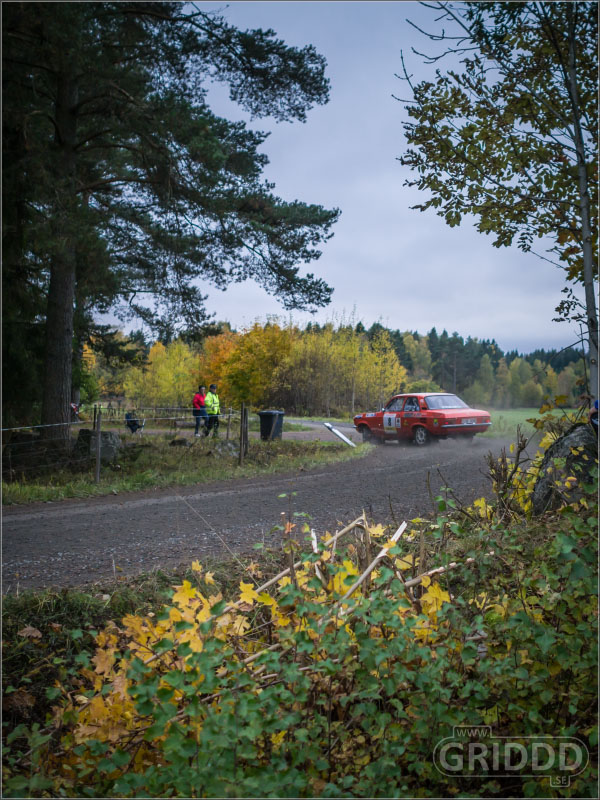
Swedish Rally Championship, Photographed on Micro 4/3 by Lars Martensson

 
Image Source: http://www.mu-43.com/showthread.php?p=535446#post535446

Swedish photographer Lars Martensson made the image above with a Panasonic Lumix DMC-GX1, Micro 4/3 camera, and Olympus 17mm lens. He didn't say whether it was the original Oly 17mm f2.8, a much-maligned but probably very capable lens, or the newer f1.8 lens (which gets great reviews).

(Click Here) to see all of the pictures Lars posted on mu-43.com.

(Click Here) to see Lars Martensson's web page.

I appreciate a photographer who can put a wide angle lens to good use in an event like this. Martensson also used a 300mm lens on an Olympus E-M5, but I think his wide angle usage adds significantly to the series. My first thought would be to grab a telephoto, and I may bring something wider to shoot the crowd, drivers up close, etc. That would be conventional. Lars shows us how to do that, and still make some unique images using the wide angle lens.

As I've mentioned, I've made the decision to add Micro 4/3 back into my active kit very soon. Just waiting on delivery of my new DMC-GX7.

DMC-365.blogspot.com


Monday, October 14, 2013

Accidental Degas (Impressionism) on THEME blog

Image Source: http://www.the.me/the-accidental-degas/?utm_source=feedburner

I love this. On the photography daily blog THEME, the author describes how they got the image above by accident - using an iPhone to photograph in low light at a gala dinner party.

It appears to me that noise reduction software in the iPhone provided the impressionist smearing. The colors are just magnificent.

(Click Here) to read about it, and see the image compared to a real Edgar Degas painting on THEME.

It is so easy to get hung up in technical perfection. Sometimes the impression is more important than the details. It was shown by the impressionists, who really weren't accepted at the time by more realistic painters. This picture proves that it translates to photography as well.

DMC-365.blogspot.com


Sunday, October 13, 2013

The Fishing Camera - Panasonic Lumix DMC-TS5 - Strikes Again

I got out in my kayak for a couple of hours this weekend. I have a nice reservoir near my home, and have fished it a few times, never catching anything of any size. This time, I caught a nice smallmouth bass. Or was it a largemouth? A friend and I have been debating that back and forth. Every fisherman will have an opinion.


Smallmouth(?) Bass, by Reed A. George
Panasonic Lumix DMC-TS5
iso 325, 160, 125 (in same order as photos), f3.3, 1/250 sec.
 
The TS5 works great for this kind of shooting. In the kayak, fish on the line, I'm able to quickly open my waterproof bag and pull out the TS5. In iAuto mode, all I have to do is turn the power on and shoot. It autofocuses quite nicely for these types of shots.
 
I always want to take those cool images where the lens is partially underwater, partially above. That is particularly difficult with the TS5, as the lens element is so small, it's difficult to position it correctly to capture the water line.
 
Here's the smallmouth above the surface. My friend and I agree that he looks more like a largemouth in this picture:
 
Smallmouth(?) Bass, by Reed A. George
Panasonic Lumix DMC-TS5
iso 200, f3.3, 1/640 sec.
 
In all, I caught six fish - two smallmouth bass (the second was quite small, but more clearly a smallmouth), three white bass (all small) and one crappie (small). This was the first crappie I've ever caught in this particular reservoir. Here's what it looked like:
 
Crappie, by Reed A. George
Panasonic Lumix DMC-TS5
iso 100, f3.3, 1/125 sec.
 
I was tempted to stay and fish a while longer, but sunset came and went, and it was time to go.
 
Reservoir Sunset, by Reed A. George
Panasonic Lumix DMC-TS5
iso 160, f3.3, 1/800 sec.
 
I notice that iAuto mode on the TS5 seems to choose f3.3 often. I suppose with such a small sensor, getting enough depth of field is never an issue. I'm quite impressed with this little camera.
 
DMC-365.blogspot.com